Home Depot vs McDonald’s: Which Beaten-Down Blue Chip Is the Better Buy Right Now?
Home Depot (NYSE: HD | HD Price Prediction) and McDonald’s (NYSE: MCD) both sold off in the past month, and retirement-focused investors are asking the same question: which beaten-down blue chip deserves fresh capital right now? Both are institutional-grade dividend…

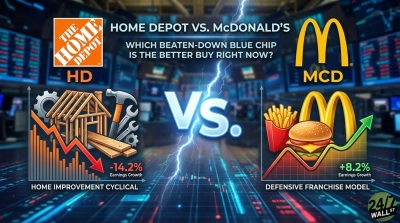
Home Depot (NYSE: HD | HD Price Prediction) and McDonald’s (NYSE: MCD) both sold off in the past month, and retirement-focused investors are asking the same question: which beaten-down blue chip deserves fresh capital right now?
Both are institutional-grade dividend payers with decades of operating history. But after digging into three dimensions that matter most for retirees, the comparison is not close.
1. Earnings Momentum
This is where the gap is widest. Home Depot’s most recent quarter showed quarterly earnings growth of −14.2% year-over-year, with full-year adjusted diluted EPS of $14.69 versus $15.24 the prior year. Comparable sales for FY2025 came in at just +0.3%, and free cash flow fell 9% year-over-year to $16.33 billion. The SRS Distribution acquisition added revenue but also brought debt and amortization drag. With the 10-year Treasury yield sitting at 4.25%, mortgage rates remain elevated, directly suppressing the housing turnover that drives Home Depot’s core home improvement business.
McDonald’s tells the opposite story. After a weak Q1 2025 where U.S. comparable sales fell 3.6%, the company executed a decisive recovery. By Q4 2025, global comparable sales had accelerated to +5.7%, with U.S. comps at +6.8%. Full-year net income grew 4.13% to $8.56 billion, and free cash flow rose 7.7% to $7.19 billion. Quarterly earnings growth came in at +8.2% year-over-year. CEO Chris Kempczinski’s value strategy is producing measurable traffic gains, not just check inflation.
Winner: McDonald’s.
2. Defensive Characteristics
For retirement portfolios, volatility is not just a number, but it is a risk to income and principal at the worst possible time. Home Depot carries a beta of 1.044, meaning it moves roughly in line with the broader market. McDonald’s beta is 0.496, less than half the market’s volatility. That difference is structural, not cyclical. McDonald’s franchise model, where franchised revenues represent approximately 90% of restaurant margin dollars, insulates earnings from direct cost pressures. Home Depot, by contrast, is a consumer cyclical directly exposed to housing sentiment and big-ticket discretionary spending. With University of Michigan consumer sentiment at 55.5, well below the neutral 80 to 100 band, the macro backdrop favors a defensive name. Home Depot’s stock is already down 15.79% over the past month versus McDonald’s decline of just 5.28% over the same period.
Winner: McDonald’s.
3. Valuation and Upside
This dimension gives Home Depot its best argument. Analyst consensus targets Home Depot at $409.84, against a current price near $322, implying meaningful upside from current levels. McDonald’s consensus target of $343.28 sits closer to its current price near $310. Home Depot trades at a forward P/E of 23x, while McDonald’s carries a forward multiple of 24x, a modest premium for a business with better near-term earnings momentum. Home Depot’s dividend yield of 2.9% edges out McDonald’s 2.4%, though both trail the 4.3% risk-free rate.
Winner: Home Depot, narrowly, on valuation alone.
Verdict
For a retirement-focused investor prioritizing capital preservation and income reliability, McDonald’s presents lower volatility, accelerating earnings, a recovering comp sales trajectory, and a franchise model that holds up in weak consumer environments. The recent dip has brought the stock closer to levels that analysts consider supported by fundamentals.
Home Depot is the contrarian play for investors with a longer horizon and tolerance for housing-cycle risk. A genuine housing recovery, driven by eventual mortgage rate relief, could unlock significant upside. But that catalyst remains dependent on rate moves that have not materialized, and earnings are declining in the interim. Retirees drawing on portfolios cannot afford to wait for a cycle to turn. McDonald’s metrics reflect a more durable foundation based on current data.
Contact [email protected] for any questions or corrections.
Trey has been an editor and author at 24/7 Wall St. for more than a decade, where he has published thousands of articles analyzing corporate earnings, dividend stocks, short interest, insider buying, private equity, and market trends. His comprehensive coverage spans the full spectrum of financial markets, from blue-chip stalwarts to emerging growth companies.
Beyond 24/7 Wall St., Trey has created and edited financial content for Benzinga and AOL's BloggingStocks, contributing additional hundreds of articles to the investment community.
Trey's editorial expertise extends across multiple publishing environments. He served as production editor at Dearborn Financial Publishing and development editor at Kaplan, where he helped shape financial education materials. Earlier in his career, he worked as a writer-producer at SVE. His freelance editing portfolio includes work for prestigious clients such as Sage Publications, Rand McNally, the Institute for Supply Management, the American Library Association, Eggplant Literary Productions, and Spiegel.
Outside of financial journalism, Trey writes fiction and has been an active member of the writing community for years, moderating workshop sessions at regional conventions.