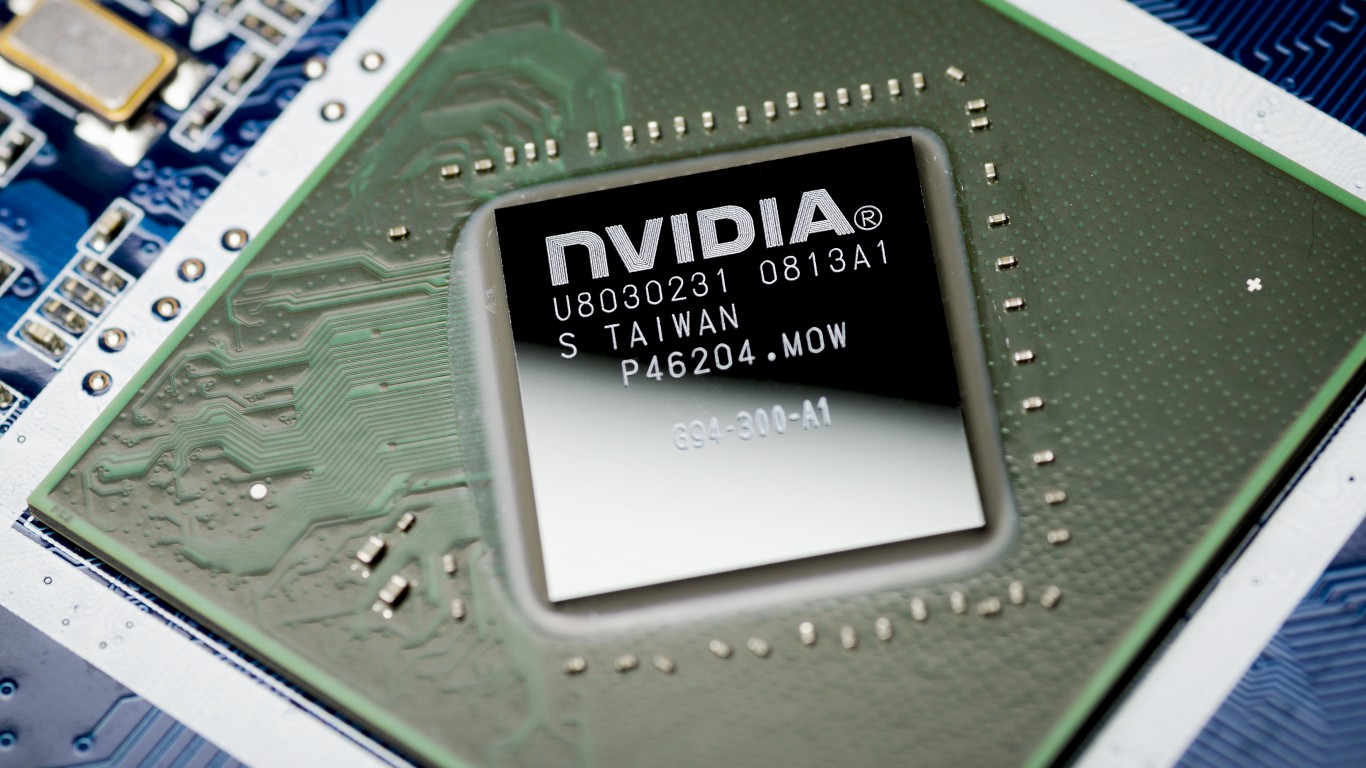
The Most-Covered Stock on Earth Is Unstoppable — NVIDIA’s $68.13 Billion Quarter Is Just the Beginning
NVIDIA (NASDAQ:NVDA | NVDA Price Prediction) is dominating financial headlines at a blistering pace, a new article every 26 minutes across 12,849 tracked stories, and this morning’s Fast Company Most Innovative Companies 2026 list shows exactly why. From Crusoe and…


NVIDIA (NASDAQ:NVDA | NVDA Price Prediction) is dominating financial headlines at a blistering pace, a new article every 26 minutes across 12,849 tracked stories, and this morning’s Fast Company Most Innovative Companies 2026 list shows exactly why. From Crusoe and SolComms to UVeye, Optro, Laudio, and Cirrus Logic, leading innovators are all citing NVIDIA partnerships as central to their breakthroughs. This isn’t media saturation for its own sake. It’s proof that NVIDIA has become the foundational layer of the entire innovation economy, and the fundamentals confirm the momentum is only accelerating.
Pillar One: Earnings That Keep Accelerating
The most recent quarter delivered a decisive beat. Q4 FY2026 revenue came in at $68.13 billion, up 73.2% year-over-year, with EPS of $1.62 against a consensus estimate of $1.52, a 6.58% beat. What matters more than the beat itself is the trajectory: quarterly revenue has climbed from $44.06 billion in Q1 FY2026 to $46.74 billion in Q2, $57.01 billion in Q3, and $68.13 billion in Q4. That is not a plateau; it is acceleration. Forward guidance for Q1 FY2027 calls for approximately $78.0 billion in revenue, and that figure explicitly excludes any Data Center compute revenue from China. The growth engine is running without one of its cylinders.
Pillar Two: Agentic AI Is the Next Demand Wave
The forward driver here is structural, not cyclical. AI inference token generation surged tenfold in just one year, and enterprise adoption of AI agents is accelerating rapidly. CEO Jensen Huang has been direct: “The agentic AI inflection point has arrived. Grace Blackwell with NVLink is the king of inference today — delivering an order-of-magnitude lower cost per token — and Vera Rubin will extend that leadership even further.” With the Vera Rubin platform promising up to 10x reduction in inference token cost versus Blackwell, NVIDIA is not defending market share; it is expanding the addressable market itself.
Pillar Three: The Platform Moat Is Widening
No competitor can replicate NVIDIA’s full-stack advantage in the near term. The CUDA software ecosystem, NVLink fabric, Blackwell architecture, and Omniverse platform form a switching-cost wall that deepens with every enterprise deployment. The partnership roster reinforces this: Meta has committed to millions of Blackwell and Rubin GPUs, CoreWeave is targeting 5+ gigawatts of AI factories by 2030, and sovereign AI programs span Saudi Arabia, the UAE, the UK, India, South Korea, Germany, and France. Data Center Networking revenue alone grew 263% year-over-year in Q4, driven by NVLink fabric demand, a segment that barely existed two years ago.
The One Risk Worth Watching
China export restrictions are a real headwind. NVIDIA absorbed a $4.5 billion H20 charge in Q1 FY2026 and estimates approximately $8.0 billion in H20 revenue lost in Q2. That is not a trivial number. But the Q1 FY2027 guidance of $78 billion, with China revenue zeroed out, demonstrates that sovereign AI buildouts, hyperscaler demand, and enterprise adoption are more than absorbing the gap. The momentum is structurally larger than the restriction.
The Fundamental Picture
NVIDIA is trading at a forward P/E of approximately 21x against forward EPS of $6.38, while 59 analysts carry a Buy or Strong Buy rating with a consensus price target of $269.58. The stock is down 5.82% year-to-date, a pullback that has nothing to do with the underlying demand story. Full-year free cash flow hit $96.58 billion in FY2026, and $58.5 billion in share repurchase authorization remains. The fundamentals reflect a company with accelerating revenue, expanding platform adoption, and significant analyst conviction behind the current price.
Contact [email protected] for any questions or corrections.
Joel South covers large-cap stocks, dividend investing, and major market trends, with a focus on earnings analysis, valuation, and turning complex data into actionable insights for investors.
He brings more than 15 years of experience as an investor and financial journalist, including 12 years at The Motley Fool, where he served as an investment analyst, Bureau Chief, and later led the Fool.com investing news desk. He has also co-hosted an investing podcast and appeared across TV and radio discussing market trends.