Advanced Micro Devices Retreats After a 7% Rally: Can the Linux CIQ Partnership Keep AMD Competitive?
Advanced Micro Devices (NASDAQ:AMD | AMD Price Prediction) stock is trading at around $216 this morning, down approximately 2% as broader market weakness pulls it off Wednesday’s strong close. The retreat follows a 7.26% rally to $220.27 on Wednesday, March…

Advanced Micro Devices (NASDAQ:AMD | AMD Price Prediction) stock is trading at around $216 this morning, down approximately 2% as broader market weakness pulls it off Wednesday’s strong close. The retreat follows a 7.26% rally to $220.27 on Wednesday, March 25, a single-day surge that pushed the stock to its highest level in weeks.
A 2% pullback after a 7% gain is textbook. Investors who chased the rally are taking a breath, and the macro backdrop is giving them a reason. Middle East conflict developments are weighing on the broader market this morning, creating a risk-off tone hitting semiconductor names across the board.
The company-specific angle worth watching is Advanced Micro Devices’ emerging partnership with CIQ, a Linux and high-performance computing software company. Advanced Micro Devices is partnering with CIQ to enhance its AI offerings through Linux-based solutions, adding a new layer to its AI infrastructure story.
The real question is whether this partnership can meaningfully differentiate Advanced Micro Devices in a market that grows more crowded by the month.
CPU Price Hikes and AI Demand Fueled Wednesday’s Rally
Wednesday’s surge wasn’t driven by a single catalyst. Reports of CPU price hikes ranging from 10% to 15%, driven by supply constraints and high AI and data center demand, sent AMD stock up sharply. Investors read pricing power as a signal of improving margins ahead, and the market responded accordingly.
The underlying fundamentals support the enthusiasm. In Q4 2025, Advanced Micro Devices reported revenue of $10.27 billion, up 34.1% year over year, with EPS of $1.53 against a $1.32 consensus estimate. The Data Center segment was the standout, posting record revenue of $5.38 billion, up 39% year over year. Moreover, the company’s free cash flow hit a record $2.082 billion for the quarter.
Advanced Micro Devices CEO Lisa Su framed the company’s position heading into this year clearly:
“We are entering 2026 with strong momentum across our business, led by accelerating adoption of our high-performance EPYC and Ryzen CPUs and the rapid scaling of our data center AI franchise.”
The Linux CIQ Partnership: A Strategic Angle, Not a Silver Bullet
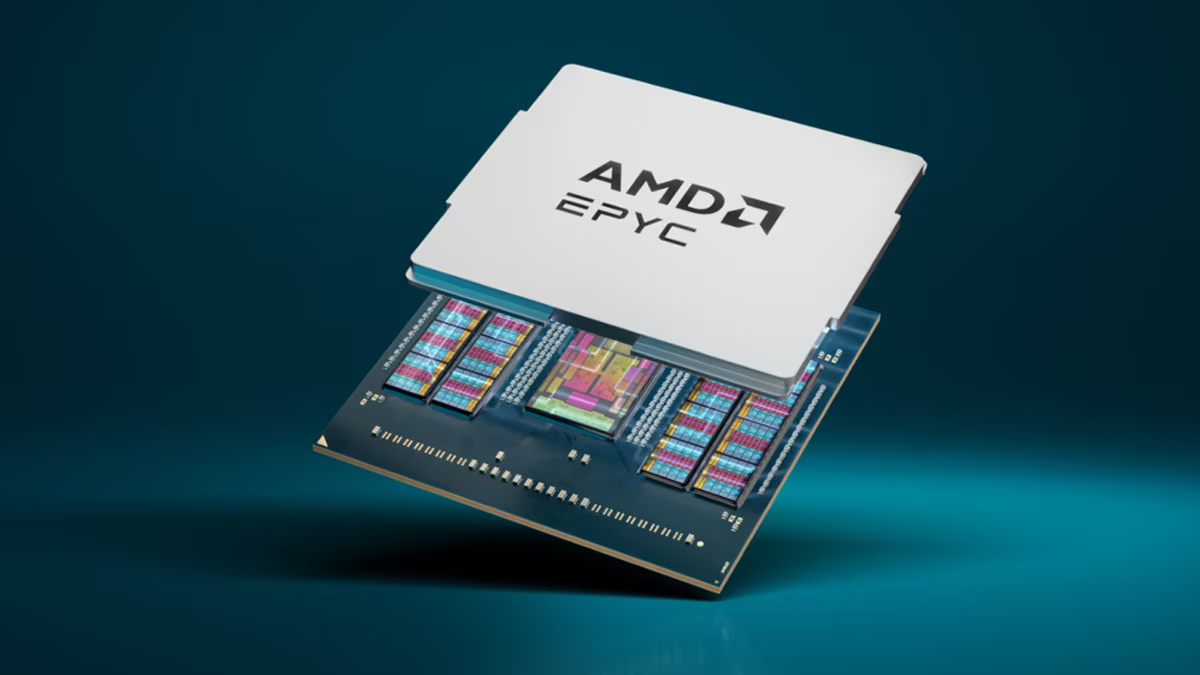
The CIQ partnership is best understood as an enterprise Linux play layered on top of Advanced Micro Devices’ existing EPYC server momentum. Linux dominates the server and high-performance computing environment, and CIQ specializes in making Linux deployments more reliable and enterprise-ready. Tying that capability to EPYC CPUs gives Advanced Micro Devices a more complete software-plus-hardware story for enterprise data center buyers.
The execution risks are real, however. Advanced Micro Devices already has major strategic partnerships in flight, including an OpenAI deal for 6 gigawatts of GPU deployment, an Oracle (NYSE:ORCL) commitment for 50,000 Instinct MI450 GPUs, and a joint venture with Cisco Systems (NASDAQ:CSCO) and HUMAIN targeting 1 gigawatt of AI infrastructure by 2030.
Adding CIQ makes sense strategically, but converting a software partnership into measurable revenue share takes time. Watch for concrete deployment wins, not just announcements.
Sector Weakness Is the Bigger Story Today
Advanced Micro Devices isn’t falling in isolation. Shares of Sandisk (NASDAQ:SNDK) and Micron Technology (NASDAQ:MU) are also opening lower today, confirming that the pressure is macro-driven rather than company-specific. Additionally, NVIDIA (NASDAQ:NVDA) stock is down about 4% year to date, reflecting the same sector-wide caution clipping Advanced Micro Devices this morning.
A potential SK Hynix U.S. listing of approximately $14 billion is in the news today, a reminder that capital is flowing into the AI memory and semiconductor space from multiple directions. The field Advanced Micro Devices is competing in keeps getting bigger and more expensive to win. Rising competition and sector pressure have been testing chip stocks all month, and today is another chapter in that story.
The analyst community remains broadly constructive. Of 51 analysts covering AMD stock, 39 rate it a Buy or Strong Buy, with a consensus price target of about $290 and zero Sell ratings.
The forward picture for Advanced Micro Devices looks more reasonable than the trailing multiple suggests: the trailing P/E sits near 85x, but the forward P/E drops to about 31x, reflecting the earnings growth the market is pricing in.
Putting the Pullback in Perspective
Advanced Micro Devices stock has been up about 92% over the past year. Hence, a morning like today, with the stock off 2% on geopolitical noise, is the cost of owning a fast-moving asset with a beta of about 2.
The Linux CIQ partnership will not move the needle this quarter, but it’s the kind of strategic layering that compounds over time. Whether it matters enough in a market where NVIDIA is up nearly 50% over the past year and Arm (NASDAQ:ARM) is building its own chip business is the question Advanced Micro Devices has to keep answering.
Contact [email protected] for any questions or corrections.
David Moadel is financial writer specializing in stocks, ETFs, options, precious metals, and Bitcoin. David has written well over 1,000 articles for leading online publications, helping investors understand markets, income strategies, and risk.His work has appeared in The Motley Fool, InvestorPlace, U.S. News & World Report, TipRanks, ValueWalk, Benzinga, Market Realist, TalkMarkets, Finmasters, 24/7 Wall St., and others.With a master’s degree in education, David has taught at the elementary, high school, and college levels. That teaching background shapes his writing style: clear, educational, and practical. David has also built a loyal social-media audience by providing trustworthy financial content on YouTube, X/Twitter, and StockTwits.