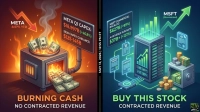
Microsoft vs Meta: Both AI Stocks Have Been Hit Hard, But One Is a Better Buy Now
Tech giants Microsoft (NASDAQ:MSFT | MSFT Price Prediction) and Meta Platforms (NASDAQ:META) both reported earnings in early 2026, spotlighting two very different AI bets. Microsoft is selling the infrastructure of the AI era through enterprise cloud. Meta is spending at…


Tech giants Microsoft (NASDAQ:MSFT | MSFT Price Prediction) and Meta Platforms (NASDAQ:META) both reported earnings in early 2026, spotlighting two very different AI bets. Microsoft is selling the infrastructure of the AI era through enterprise cloud. Meta is spending at historic scale to own the consumer AI layer, while leaning on one of the most powerful advertising engines ever built. The comparison reveals where AI value creation is actually landing.
Azure Carries Microsoft. Advertising Carries Meta.
Microsoft posted revenue of $81.27 billion, up 16.7% year over year, with its Intelligent Cloud segment generating $32.91 billion, up 29%. Azure alone grew 39% year over year. The commercial remaining performance obligation surged 110% to $625 billion, signaling enterprises are locking in long-term cloud and AI commitments at an accelerating pace.
Meta’s quarter told a different story. Revenue reached $59.89 billion, up 23.8% year over year, powered by ad impressions growing 18% and average price per ad rising 6%. The Family of Apps segment, which includes Facebook, Instagram, and WhatsApp, drove $30.77 billion in operating income for the quarter. With 3.58 billion daily active people across its family of apps, Meta’s advertising flywheel remains one of the most durable revenue machines in tech.
| Business Driver | Microsoft | Meta |
|---|---|---|
| Primary Growth Engine | Azure cloud / AI infrastructure | Ad impressions + pricing power |
| Q4 Revenue | $81.27B (+16.7% YoY) | $59.89B (+23.8% YoY) |
| Operating Margin | 47.1% | 41% (down from 48% YoY) |
| Capex (Quarter) | $29.88B (+89% YoY) | $21.38B (+48% YoY) |
One Bets on Enterprise Infrastructure. Other on Personal Superintelligence.
Microsoft is embedding Copilot across its entire productivity and enterprise suite, from Microsoft 365 to Dynamics 365 to GitHub, and restructured its OpenAI partnership to include a $250 billion Azure services commitment from OpenAI. Every enterprise dollar spent on AI increasingly flows through Azure, a structural advantage rather than a product cycle.
Meta’s play is more audacious and harder to value. Mark Zuckerberg launched Meta Superintelligence Labs and guided for 2026 capital expenditures of $115 to $135 billion. That is a staggering commitment for a company whose core business is advertising. Reality Labs continues to bleed, posting a $6.0 billion operating loss in Q4 alone and $19.2 billion for full year 2025. Meta AI reached nearly 1 billion monthly actives as of Q1 2025, an impressive user base, though monetization pathways remain undefined.
| Strategic Lens | Microsoft | Meta |
|---|---|---|
| Core AI Bet | Enterprise cloud and Copilot suite | Personal superintelligence and consumer AI |
| Key Vulnerability | More Personal Computing down 3% | Reality Labs losses, margin compression |
| 2026 Capex Signal | Infrastructure scaling for Azure demand | $115-$135B full-year guidance |

Regulatory Pressure and Margin Trends Will Decide the Next Chapter
Meta’s operating margin compressed from 48% to 41% year over year as total costs grew 40% YoY. With full-year 2026 expenses guided at $162 to $169 billion, the pressure is not easing.
EU regulatory headwinds around personalized advertising and U.S. youth litigation trials scheduled for 2026 add further uncertainty. For Microsoft, watch whether Azure guidance of 37% to 38% growth next quarter signals deceleration or a conservative baseline.
Why Microsoft Looks More Durable Right Now
Both stocks have pulled back sharply in 2026. Microsoft is down 25.61% year to date while Meta has fallen 18.67% year to date. Analysts carry a $589.90 price target on Microsoft and a $862.60 target on Meta, both implying substantial upside from current levels.
Microsoft offers a more predictable AI compounding story. The enterprise lock-in through Azure, the $625 billion commercial backlog, and Copilot integration across a suite businesses already pay for give Microsoft a durability Meta’s moonshot spending cannot yet match.
Meta’s upside is real if Zuckerberg’s superintelligence vision lands, and insider buying of 178 recent transactions trending toward buying suggests conviction in that thesis. But Reality Labs losses and regulatory exposure make Meta a higher-variance bet. Margin stabilization would be the clearest signal of improving fundamentals.
Contact [email protected] for any questions or corrections.
Vandita Jadeja is a financial copywriter who loves to read and write about stocks. She believes in buying and holding for long term gains. Her knowledge of words and numbers helps her write clear stock analysis. She has contributed to several publications, including the Joy Wallet, Benzinga, The Motley Fool and InvestorPlace.