Meta Is Burning Cash With Nothing to Show for It. Buy This Stock Instead
Meta Platforms (NASDAQ:META | META Price Prediction) is dominating headlines because Q1 looked like a blowout, with EPS of $10.44 versus $6.66 expected and revenue of $56.31 billion growing 33.1% year over year. The composition of that beat is what…

Meta Platforms (NASDAQ:META | META Price Prediction) is dominating headlines because Q1 looked like a blowout, with EPS of $10.44 versus $6.66 expected and revenue of $56.31 billion growing 33.1% year over year. The composition of that beat is what actually matters.
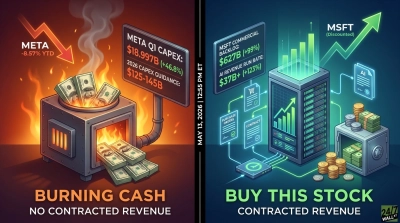
That stunning beat was substantially manufactured by a one-time gift. An $8.03 billion income tax benefit tied to U.S. Treasury Notice 2026-7 on CAMT and R&D pushed Meta’s effective tax rate to -23% and added roughly $3.13 per share. Strip that out and the “beat” becomes a polite nod to consensus. Meanwhile the spending picture deteriorated. Management raised 2026 capex guidance to $125-145 billion, citing component prices and additional data centers, while Q1 capex alone hit $18.997 billion, up 46.8% year over year.
The arithmetic of that does not work the way bulls want it to work. Free cash flow for FY2025 fell 19.39% to $43.585 billion even as revenue grew 22.17%, because capex jumped 93.83% to $72.215 billion. The core ad engine remains healthy. Ad impressions rose 19% and average price per ad rose 12%. That is the part nobody disputes. The part nobody is pricing correctly is what’s eating the cash. Reality Labs lost $4.03 billion in the quarter and $19.2 billion for all of 2025, and the AI spend that’s supposed to justify the next leg of capex has, so far, no contracted customer revenue attached to it. Mark Zuckerberg’s pitch is that Meta will “deliver personal superintelligence to billions of people.” Polymarket gives that an 18% probability of even shipping the “Mango” model by June 30. The crowd is skeptical of the deliverable. The stock has been telling you the same thing. META is down 8.57% year to date.
Microsoft is selling the AI Meta is buying
Put the same lens on Microsoft (NASDAQ:MSFT) and the picture inverts. Yes, Microsoft is also spending, with Q3 FY2026 capex of $30.88 billion, up 84.39%. The difference is that the customers have already signed.
Three reasons the Microsoft setup looks more durable for long-duration capital.
First, the backlog. Commercial remaining performance obligations sit at $627 bilion, up 99% year over year. That is contracted, multi-year, visible revenue. OpenAI alone committed an incremental $250 billion in Azure services under the restructured partnership that extends IP rights through 2032. Meta has ambition. Microsoft has purchase orders.
Second, AI monetization is already real. The AI business surpassed a $37 bilion annual revenue run rate, up 123% year over year, per Satya Nadella. Azure grew 40% and Intelligent Cloud revenue of $34.68 billion rose 30%. Microsoft is the picks-and-shovels operator in this gold rush. Meta is buying the shovels.
Third, the business is diversified and the cash comes back to shareholders. Operating margin of 45.62%, net margin of 36.15%, return on equity of 33.28%. Microsoft returned $12.7 billion to shareholders in Q2 FY2026 alone via dividends and buybacks, up 32%. Q3 FY2026 EPS came in at $4.27 versus $4.07 expected, the fourth consecutive beat, on revenue of $82.89 billion, up 18.3%. And after a 15.49% drawdown year to date, that quality is trading at a discount.


Microsoft isn’t perfect
The contrast for investors weighing the two: Meta is funding an AI buildout whose revenue is still hypothetical, while Microsoft’s AI revenue is already contracted, margins are intact, and cash is being returned to shareholders rather than absorbed by a Reality Labs P&L.
That said, I would still be careful because no hyperscaler is safe from a possible downturn if all this spending does not lead to strong cash flow in the future. Microsoft is showing healthy results now, but a large part of that is due to the company being forceful with AI. Copilot is integrated into almost every Microsoft product now. Microsoft Windows even had Copilot in the notepad, but it was removed due to users pushing back. Are users spending because they are happy with Copilot, or is this a gimmick they’re paying more for? Either way, Microsoft is benefiting as long as they are paying.
For Meta, the story is almost entirely ad-dependent. If there’s an ad downturn, whatever subscriptions it has won’t be able to hold up the extreme amount of AI spending.

Contact [email protected] for any questions or corrections.
Omor Ibne Ehsan is a writer at 24/7 Wall St. He is a self-taught investor with a focus on growth, cyclical, and dividend equities that have strong fundamentals, value, and long-term potential. He also has an interest in high-risk, high-reward investments such as penny stocks.