




Ford Motor Company (NYSE: F | F Price Prediction) closed 2025 with a $10.70 billion impairment charge tied to Model e asset write-downs and EV program cancellations, crystallizing one of the most expensive pivots in automotive history. The company taking shape after that reckoning looks less like a traditional automaker and more like an industrial infrastructure play built around software, commercial fleets, and battery energy storage.
The EV Stumble, by the Numbers
Ford’s Q4 2025 GAAP net loss reached $11.10 billion, driven by $15.50 billion in total special charges that included a $3.20 billion BlueOval SK joint venture disposition charge. The Model e segment posted a full-year EBIT loss of $4.81 billion. In Q1 2026, Model e lost another $777 million, and Ford guides for a total Model e loss of $4.0 billion to $4.5 billion for the full year. The EV bet has not paid off on the timeline projected.
CEO Jim Farley framed the write-downs as necessary surgery. “We made difficult but critical strategic decisions that set us up for a stronger future,” he said. Ford’s Q1 2026 results showed some progress: revenue reached $43.25 billion, up 6% year over year, with EPS of $0.66 and adjusted EBIT of $3.49 billion. Management subsequently raised full-year adjusted EBIT guidance to $8.5 billion to $10.5 billion and free cash flow guidance to $5 billion to $6 billion.
Ford Energy: Repurposing the Factory Floor
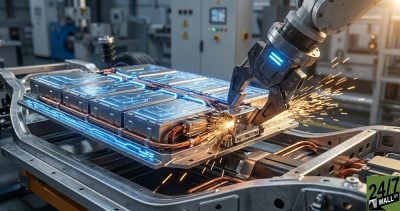
The most consequential move in Ford’s restructuring is Ford Energy, a wholly owned subsidiary formally launched in May 2026. The business manufactures U.S.-assembled battery energy storage systems for utilities, data centers, and large industrial customers. Ford is repurposing battery manufacturing capacity at BlueOval Battery Park in Glendale, Kentucky, targeting 20 gigawatt-hours of annual capacity by late 2027. The capital commitment is approximately $2 billion over two years.
The flagship product is the Ford Energy DC Block, a standardized 20-foot containerized BESS built around 512 Ah lithium iron phosphate prismatic cells. It comes in two configurations: the FE-250 (a two-hour system) and the FE-450 (a four-hour system). Ford holds a cost advantage through its CATL licensing agreement for LFP chemistry, an edge over rivals relying on imported cells or more expensive lithium chemistries.
Ford Energy already has its first major customer. In May 2026, the subsidiary signed a five-year framework agreement with EDF Power Solutions North America under which EDF can procure up to 4 GWh of DC Block systems per year, for a potential total of 20 GWh. Deliveries are expected to start in 2028. Ford Energy president Lisa Drake described the deal as validation that the market needs “a BESS supplier” with industrial-scale manufacturing discipline and full lifecycle accountability.
Farley described the scale of the opportunity directly: “The growth for battery storage for both data center build-out and grid stability, places like California, Texas, and Florida, is exploding.” The data supports that view. The U.S. is expected to add roughly 24 GW of new utility-scale battery storage in 2026 alone, nearly double the record 15 GW installed in 2025, with industry projections pointing to more than 600 GWh on the U.S. grid by 2030.
The strategic logic goes beyond pure volume. “We don’t want to be a contract manufacturer of batteries,” Farley said. “We want to have end-to-end solutions for customers where Ford Energy people will be calling, fulfilling, not just a sales contract, but servicing those customers over the long term.”
The Caterpillar Parallel
Investors looking for proof that a legacy industrial company can make a genuine pivot to AI infrastructure power demand need look no further than Caterpillar (NYSE: CAT). Its Power Generation product line posted revenue of $3.238 billion in Q4 2025, up 44% year over year, capping a full year of accelerating demand. In Q1 2026, Power Generation revenue rose another 41% year over year to $2.817 billion, fueled by data center engine and turbine orders. The company’s order backlog hit a record $63 billion in Q1 2026, up 79% year over year, and Caterpillar raised its long-term power generation revenue target to more than three times the 2024 baseline by 2030. The stock has risen roughly 191% over the past year.
Ford’s path differs in form but mirrors the underlying logic: use manufacturing scale, existing infrastructure, and established customer relationships to capture the energy demand created by the AI buildout.
Ford Pro Anchors the Transition
While Ford Energy is the new growth vector, Ford Pro remains the financial engine of the company. The commercial segment guides for $6.5 billion to $7.5 billion in EBIT for 2026, with paid software subscriptions growing 30% in full-year 2025 and reaching 879,000 subscribers by Q1 2026. Ford holds over 42% Class 1-7 market share in the U.S., a position that competitors cannot replicate quickly.
For comparison, General Motors (NYSE: GM) also absorbed $7.10 billion in EV capacity realignment charges in Q4 2025, but its pivot centers on combining Cruise and technical teams for autonomous driving rather than energy infrastructure. GM guides for $13.0 billion to $15.0 billion in adjusted EBIT for 2026.
What Investors Should Watch
Analyst consensus on Ford currently stands at approximately 4 Buys, 16 Holds, and 1 Sell among 21 analysts, with an average price target near $14.41. Ford’s forward P/E stands at 8x, and the stock yields roughly 5%. The valuation remains modest relative to the potential upside if Ford Energy scales as planned and Ford Pro margins hold above 11%.
Key milestones include Ford Energy’s Kentucky plant conversion timeline, whether the EDF deliveries begin on schedule in 2028, and whether Model e losses narrow as the Universal EV Platform launches in 2027. Ford’s raised 2026 adjusted EBIT guidance of $8.5 billion to $10.5 billion and its long-term 8% adjusted EBIT margin target by 2029 both hinge on execution across all three segments.
Editor’s note: This article has been updated to reflect Ford Energy’s formal subsidiary launch in May 2026, its EDF Power Solutions framework agreement for up to 20 GWh of BESS deliveries, the revised capital investment figure of approximately $2 billion over two years, Ford’s raised full-year 2026 adjusted EBIT guidance of $8.5 billion to $10.5 billion following Q1 2026 results, and Caterpillar’s Q1 2026 Power Generation revenue growth of 41% year over year alongside its record $63 billion order backlog.









 Top Gaining Stocks
 Top Losing Stocks