CrowdStrike (CRWD) Falls, But Here’s Why Wall Street Sees 15% Upside

Photo of Thomas Richmond
By Thomas Richmond Published

Quick Read

  • CrowdStrike (CRWD) reported record fiscal 2026 results with $5.25 billion in ARR, net new ARR growth of 47% year-over-year, and achieved its first-ever positive GAAP net income, while 42 analysts maintain Buy or Strong Buy ratings despite the stock trading over 20% below its 52-week high of $566.90.

  • AI advancement concerns sparked by Anthropic’s announcement of the Claude Mythos model triggered a sharp decline in investor sentiment, causing a temporary pullback that appears disconnected from CrowdStrike’s solid underlying business execution and management’s $20 billion ARR target by FY2036.

  • The analyst who called NVIDIA in 2010 just named his top 10 AI stocks. Get them here FREE.

This post may contain links from our sponsors and affiliates, and Flywheel Publishing may receive compensation for actions taken through them.
CrowdStrike (CRWD) Falls, But Here’s Why Wall Street Sees 15% Upside

© gorodenkoff / iStock via Getty Images

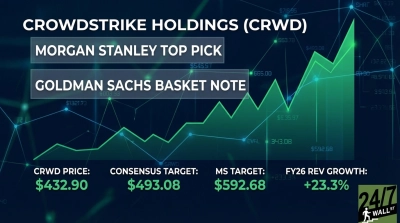
CrowdStrike Holdings (NASDAQ:CRWD) currently trades at $426.51, while the Wall Street consensus price target sits at $489.86, a gap of roughly 14.85%. That is a meaningful dislocation for a company that just delivered its strongest fiscal year on record.

CrowdStrike operates the Falcon platform, a cloud-native cybersecurity suite protecting enterprise endpoints, cloud workloads, identity, and data. With $5.25 billion in ending ARR and its first-ever positive GAAP net income, the fundamental story looks intact. While the current upside to analysts’ price targets is only 15%, this is a high-quality business that may be worth a closer look.

A Stock That Peaked Above $560 and Hasn’t Recovered

CrowdStrike shares hit a 52-week high of $566.90, but the stock is currently over 20% below that peak. The pressure stems from company-specific overhang and broader sector rotation.

More recently, sentiment weakened after Anthropic unveiled its new “Claude Mythos” model, which it claims can identify hidden cybersecurity vulnerabilities across a wide range of software systems. The model has only been shared with about 40 major tech companies, including CrowdStrike and Palo Alto Networks, but the announcement sparked broader concerns about how quickly AI could disrupt traditional cybersecurity approaches.

That narrative spread quickly across retail channels, with social sentiment on CrowdStrike dropping from around 74 in early March to as low as 28 by late March. While the fears highlight how quickly AI is advancing, the sell-off appears driven more by perception than by any clear change in CrowdStrike’s underlying business.

What 42 Buy-Rated Analysts Are Still Betting On

Despite the pullback, Wall Street’s conviction has not wavered. Forty-two analysts rate CRWD a Buy or Strong Buy, with 14 at Hold and zero at Sell. Wall Street is clearly bullish. The bull thesis centers on platform consolidation, AI tailwinds, and an ARR trajectory that management believes can reach $20 billion by FY2036.

Net new ARR grew 47% year-over-year in Q4 FY26 to a record $330.7 million, and the Falcon Flex segment posted ARR of $1.69 billion, up more than 120% year-over-year. Gross retention held at 97%, signaling customers are not leaving. CEO George Kurtz stated: “As enterprises rapidly adopt AI, CrowdStrike is mission-critical infrastructure, securing AI across every layer from GPU to agent to prompt.”

The Q1 FY27 pipeline came in at a record high, and full-year FY27 guidance calls for revenue of $5.868 billion to $5.928 billion, with non-GAAP EPS of $4.78 to $4.90. Module adoption is deepening, with 50% of customers using six or more modules and 24% using eight or more, supporting both retention and upsell revenue.

Strong Fundamentals Paired with Analyst Optimism

At $426.51, CrowdStrike trades at roughly 82x forward earnings based on consensus estimates. The average analyst price target of $489.86 implies about 14.9% upside, which is relatively modest given the company’s growth profile. Still, sentiment remains highly positive, with 42 Buy ratings and zero Sell ratings across 56 analysts.

Year to date, the stock is down 9.0% compared with a roughly 0.9% decline in the S&P 500, reflecting sector rotation and lingering incident-related overhang. Over the past year, however, shares are up 31.2%, showing the longer-term trend is still intact. The balance sheet also remains strong, with $5.23 billion in cash and $1.235 billion in free cash flow generated in fiscal 2026, providing the company with ample financial flexibility.


The Case For and Against Buying the Dip

CrowdStrike’s bull case, like many businesses, depends on continued execution. Falcon Flex adoption needs to keep accelerating, and Q1 FY27 net new ARR should validate the company’s strong pipeline. The path to higher prices comes from sustained ARR growth above 20% and continued margin expansion, with non-GAAP operating margins already reaching 25% in Q4. The shift to positive GAAP net income marks a real inflection point, and strong free cash flow supports the valuation.

The bear case comes down to expectations. Litigation tied to the 2024 incident could prove more costly than expected, while macro pressure may weigh on enterprise security spending. At the same time, competition could slow Falcon’s module expansion. With the stock trading at about 82x forward earnings, there is very little room for a miss. Sentiment has also cooled, with the composite score falling to 45.6 from 66.1 just weeks ago, suggesting investor conviction has weakened.

The fundamentals remain solid, and analyst support is strong, but the roughly 15% upside to price targets is not especially compelling on its own. This looks like a high-quality business that has been caught in a temporary dip in sentiment rather than a true breakdown. At this valuation, the story needs to keep delivering, and so far, CrowdStrike has done just that.

Photo of Thomas Richmond
About the Author Thomas Richmond →

Thomas Richmond is a financial writer and content strategist with 5+ years of experience covering stocks and financial markets. He has published over 250 articles focused on individual stock analysis, helping investors better understand business fundamentals, stock valuations, and long-term opportunities.

Thomas previously served as a Content Lead at TIKR, a stock research platform, where he helped scale the company’s blog to hundreds of articles per month and contributed to a weekly newsletter reaching more than 100,000 investors.

He specializes in breaking down complex companies into clear, actionable insights for everyday investors, with a focus on fundamentals-driven research.

His work has also been featured on platforms including Seeking Alpha and Sure Dividend.

Outside of work, Thomas enjoys weight lifting and soccer.

Featured Reads

Our top personal finance-related articles today. Your wallet will thank you later.

Continue Reading

Top Gaining Stocks

SMCI Vol: 43,517,965
TPL Vol: 1,261,110
AVGO Vol: 29,933,207
MKC Vol: 7,438,395
AMD
AMD Vol: 36,447,009

Top Losing Stocks

AKAM Vol: 14,278,697
FICO Vol: 1,086,932
NOW Vol: 58,715,140
PANW Vol: 15,568,993
CDNS Vol: 3,492,722