





Coherent Corp (NYSE:COHR) has risen 448.34% over the past twelve months, climbing from $51.39 to $281.79. If you watched that move from the sidelines, the question is fair: is there anything left, or did you miss it?
Valuation: Stretched on the Surface, Complicated Underneath
The trailing picture looks alarming. Coherent carries a trailing P/E of 279, which reflects GAAP earnings weighed down by restructuring charges and impairments rather than the company’s operating reality. The more relevant number is the forward P/E: 13x, based on a forward EPS estimate of $5.00. That is a strikingly low multiple for a company growing its datacenter segment at 34% year-over-year. The PEG ratio sits at 0.921, below 1.0, a threshold widely used in equity analysis to indicate a stock may be fairly valued relative to its growth rate.
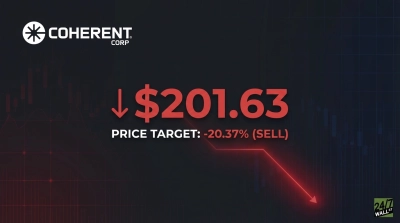
The stock trades 5% below its 52-week high of $300.20, and the analyst consensus target of $284.25 is nearly identical to the current price, implying the street sees almost no near-term upside from here. A quantitative price model projects a base-case price of $208.43 over the next twelve months, a -26.03% decline from current levels.
Forward Catalyst: The Demand Story Is Not Over
The bull case rests on execution. Coherent’s datacenter and communications segment generated $1.208 billion in Q2 FY26, now 72% of total revenue. Management guided Q3 FY26 revenue of $1.70 billion to $1.84 billion with non-GAAP EPS of $1.28 to $1.48. The company has beaten EPS estimates in each of the last four quarters, with an average surprise of 8.29%.
CEO Jim Anderson described the demand environment on the Q2 earnings call: “I would say, you know, I’d call the demand that we’re seeing and the visibility extraordinary.” The company reported a 4x book-to-bill ratio in Q2, with calendar 2027 bookings filling rapidly and customers providing 2-3 year forecasts extending into calendar 2028. The 1.6T transceiver ramp is underway and management expects it to be margin accretive as ASPs exceed 800G levels. Co-packaged optics revenue is expected to begin at the end of calendar 2026, with more meaningful contribution in 2027.
Risk and Entry: What the Downside Looks Like
Three risks deserve direct attention. First, the debt load: long-term debt stood at approximately $3.5 billion, though the company used proceeds from its Aerospace and Defense divestiture to repay $400 million and has brought its leverage ratio to 1.7x from 2.3x a year ago. Second, insider activity: five executives and directors disposed of shares in the $236 to $291 range between February and March 2026, with no discretionary buying at market prices. Third, tariff and trade policy exposure acknowledged by management adds macro-level uncertainty.
The stock carries a beta of 1.905, meaning corrections hit harder here than in the broader market. Post-earnings data shows a pattern of short-term pullbacks: the average one-week return after earnings across the last four quarters was -0.68%, though the average 30-day return was a strong +16.44%.
Verdict
A forward P/E of 13x on a company with a 4x book-to-bill ratio and double-digit sequential growth guidance is not a stretched valuation, and the remaining catalyst is real. The risk is that the analyst consensus target leaves almost no margin from current prices, insider selling is concentrated at these levels, and the quantitative model flags meaningful downside. For a retirement-focused investor, the data presents a mixed picture: Coherent has not been left behind by the AI buildout, but the easy money is gone. The beta of 1.905 and the $3.5 billion debt load are material factors to weigh against the 13x forward P/E and 4x book-to-bill ratio. A 20%-plus drawdown is within the stock’s historical range given its volatility profile.












 Top Gaining Stocks
 Top Losing Stocks