Why BSTZ’s 8% Yield Masks a Fragile Income Engine Built on Private Bets
BlackRock Science and Technology Term Trust (NYSE:BSTZ) has gained 57.79% over the past year, with shares recently touching $23.92. The fund combines monthly income from covered call options on public holdings with exposure to private AI companies like Databricks. The…


BlackRock Science and Technology Term Trust (NYSE:BSTZ) has gained 57.79% over the past year, with shares recently touching $23.92. The fund combines monthly income from covered call options on public holdings with exposure to private AI companies like Databricks. The question is whether that combination supports the current yield, or whether the income stream is more fragile than the price rally suggests.
Two Income Sources, One Distribution
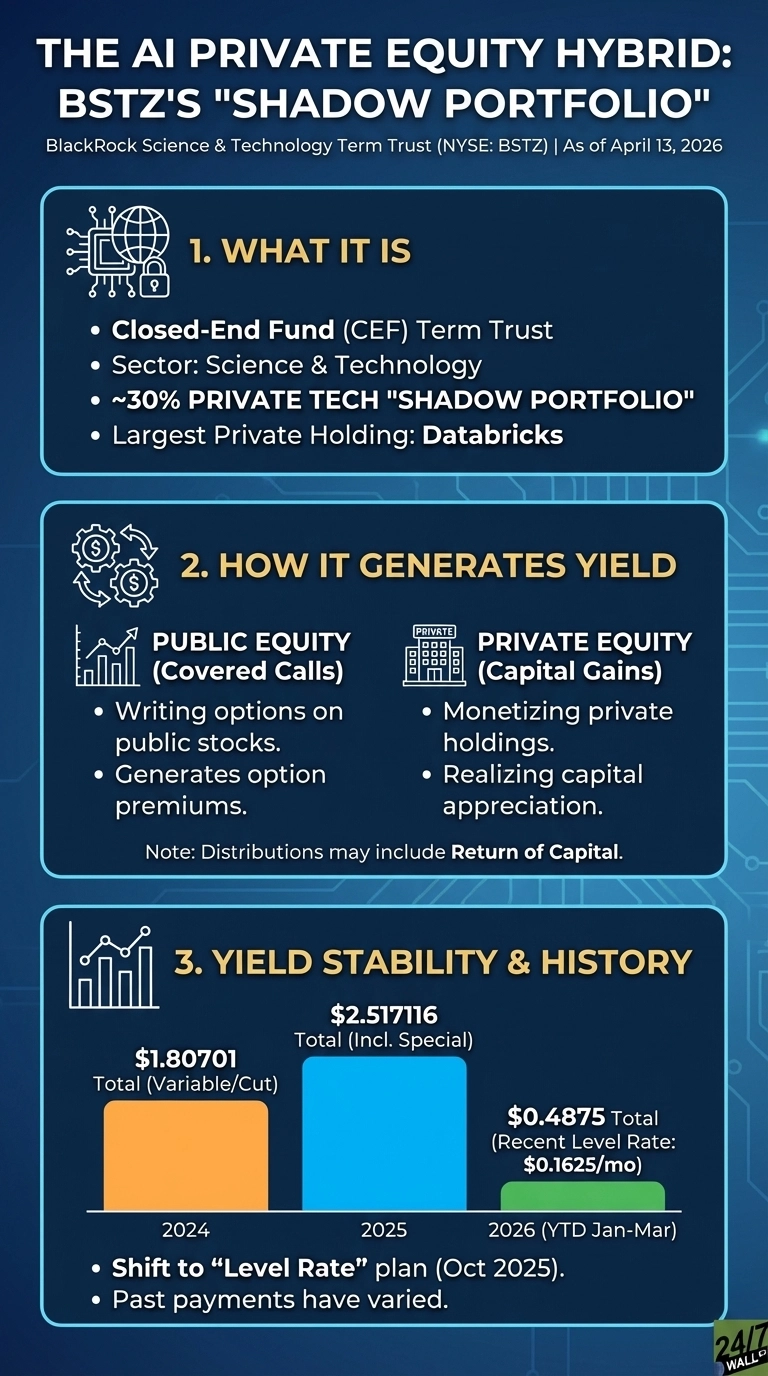
BSTZ generates most of its cash flow from covered call premiums on its public equity holdings and from realized gains when private positions are sold. BlackRock notes in its managed distribution plan that monthly payouts may include a return of capital, meaning that part of the distribution can represent a return of principal rather than portfolio earnings.
The covered call strategy is sensitive to volatility. Higher volatility produces richer option premiums and more income; calmer markets compress premiums and squeeze distributions. Tech sector volatility can simultaneously pressure NAV while inflating reported income.
Distribution History Shows Prior Cuts
BSTZ’s monthly distribution reached $0.22305 in March 2025 before declining to $0.1625 by November 2025, where it has stayed through early 2026. That shift represents a reduction of about 27% from the peak, and at the current rate, the annualized payout is $2.64 per share, yielding roughly 8% at a share price near $23.92. The higher 9.3 percent figure sometimes cited reflects earlier distribution levels that are no longer in place.
A special distribution of $0.517116 in December 2025 lifted the full‑year total to $2.517116, compared with $1.80701 in 2024. That special payment likely came from realized gains on private holdings rather than recurring income and should not be used to project future yield expectations.
Private Holdings Reduce Income Generation
BSTZ holds over 30% of its portfolio in private, illiquid technology companies, with Databricks as the largest holding at 16%. Private positions are valued using internal models rather than live market prices, so the stated NAV is partly an estimate. Seeking Alpha noted in December 2025 that the fund “outperformed major market indices over the past six months despite having over 30% private holdings, which raises valuation and liquidity concerns.”
Private holdings do not generate covered call premiums. Call options can only be written against publicly traded securities. As private allocations grow, the covered call engine’s funding of monthly distributions shrinks proportionally.
NAV Discount Signals Valuation Concerns
BSTZ’s price of around $23.92 compares to a NAV of approximately $26.35, representing a discount of roughly 9%. A persistent discount often reflects market pricing amid uncertainty about the stated NAV, particularly when a significant portion of the valuation rests on private-company valuations.
Activist investor Saba Capital disclosed a 7.94% beneficial ownership stake in March 2026, having acquired approximately 5.46 million shares for roughly $93.8 million between January and March 2026. Saba specializes in closed-end fund activism, typically pushing for the elimination of discounts through tender offers or liquidation. The fund’s term structure sets a 2031 liquidation date, at which point shares would be redeemed at NAV.
Total Return Context
The one-year price gain of nearly 58% dominates returns, while year-to-date, shares are up about 8.1%, and one-month gains are nearly 12%. Over five years, the total price return is about 5%, meaning the fund spent much of its history returning capital through distributions while the share price stagnated. Q3 2025 NAV total return was 11.6%, which depends on private valuations that cannot be independently verified.
Distribution Sustainability Depends on Three Conditions
The current $0.1625 monthly distribution is more stable than it was a year ago, but it depends on conditions that may not hold indefinitely. Option premiums need to remain supportive, private‑company valuations must remain intact, and the public‑equity sleeve must remain large enough to sustain the covered‑call program. The payout has already been reduced once, and BlackRock’s disclosure that distributions may include a return of capital means that part of the monthly amount may reflect a return of principal rather than portfolio earnings.
The fund blends technology exposure with the illiquidity risk tied to its private holdings, which account for roughly one‑third of assets. The 2031 term date provides a defined point at which the discount to NAV should close, but return‑of‑capital mechanics and the uncertainty around private valuations mean the economic yield may differ from the headline figure.
Contact [email protected] for any questions or corrections.
David Beren has been a Flywheel Publishing contributor since 2022. Writing for 24/7 Wall St. since 2023, David loves to write about topics of all shapes and sizes. As a technology expert, David focuses heavily on consumer electronics brands, automobiles, and general technology. He has previously written for LifeWire, formerly About.com. As a part-time freelance writer, David’s “day job” has been working on and leading social media for multiple Fortune 100 brands. David loves the flexibility of this field and its ability to reach customers exactly where they like to spend their time. Additionally, David previously published his own blog, TmoNews.com, which reached 3 million readers in its first year. In addition to freelance and social media work, David loves to spend time with his family and children and relive the glory days of video game consoles by playing any retro game console he can get his hands on.