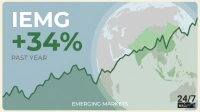
Emerging Markets Are Emerging Again, and the FFEM ETF Lets You Not Miss Out
The U.S. dollar has been weakening against a broad basket of currencies. And despite a ceasefire, the U.S.-Iran military conflict has injected a geopolitical risk premium into global energy markets that will still make oil trade at a premium. For…


The U.S. dollar has been weakening against a broad basket of currencies. And despite a ceasefire, the U.S.-Iran military conflict has injected a geopolitical risk premium into global energy markets that will still make oil trade at a premium. For investors in emerging market equities, these three forces are converging into one of the more compelling tailwinds the asset class has seen in years.
Fidelity Fundamental Emerging Markets ETF (BATS:FFEM) is built to capture exactly this kind of moment. The fund has returned 69% over the past year, and is up 8% year-to-date even after a rough patch in March. The question is whether that performance reflects a durable structural shift or a short-term surge that could reverse just as fast.
Three Macro Tailwinds Hitting at Once
Dollar weakness matters enormously for emerging market equities because most of these companies earn revenues in local currencies. When the dollar softens, those earnings translate into more dollars for U.S.-based investors, giving the portfolio a currency tailwind on top of any underlying business performance.
The energy story compounds this due to disrupted supply expectations around the Strait of Hormuz. WTI crude is still $20 higher than where it should be. That kind of move transfers wealth toward oil-exporting economies, and several of FFEM’s holdings sit inside economies that benefit when energy prices rise.
Resurgent inflation adds a third layer. Historically, elevated inflation has pushed global capital toward real assets and commodity-linked economies, many of which sit squarely in the emerging markets universe. The combination of all three forces arriving simultaneously is rare, and the macro setup of rising oil, dollar weakness, and geopolitical risk premium has historically favored commodity-linked and export-driven emerging market economies.
What FFEM Actually Does Differently
FFEM is not a passive index fund. It launched in November 2024 as an actively managed ETF that draws on Fidelity’s fundamental analyst research rather than mirroring the MSCI Emerging Markets Index. Multiple Fidelity portfolio managers run their stock-selection views through a quantitative process to build a concentrated, high-conviction portfolio.
The fund leans heavily on China (roughly 25% of assets) and Taiwan (roughly 22%), with India at about 10%. That concentration in Asia ties the fund’s fortunes closely to East Asian growth trajectories, currency movements, and geopolitical stability in the region.
The fund carries a 0.60% expense ratio, above what you would pay for a passive EM index fund but reasonable for an actively managed strategy. It trades on BATS with assets under management of around $35 million. The tension between early strong performance and a limited track record is one that investors still face today.
Does the Performance Hold Up?
The one-year return of 41% is genuinely strong, reflecting both the underlying business quality of FFEM’s holdings and the macro tailwinds described above. The fund’s price-to-earnings ratio sits around 18x, which is below what you would pay for comparable U.S. large-cap growth exposure. That valuation gap is part of the bull case.
Because FFEM launched only in late 2024, there is no multi-year track record to evaluate through a full market cycle. The strong one-year number is encouraging, but it coincides almost perfectly with a period of unusual macro tailwinds for EM. Whether active management adds consistent alpha above a passive EM benchmark over a full cycle remains an open question.
The Tradeoffs Worth Understanding
Three constraints deserve honest attention before adding FFEM to a portfolio.
First, concentration risk is real. Nearly half the portfolio sits in the top 10 names, and two countries (China and Taiwan) account for close to half of total assets. Any deterioration in U.S.-China relations, a Taiwan Strait escalation, or a sharp slowdown in semiconductor demand would hit this fund harder than a more broadly diversified EM vehicle.
Second, the macro tailwinds driving current performance can reverse. Dollar strength, falling oil prices, or the ceasefire holding up long-term in the Iran conflict could remove the three forces pushing EM outperformance. Currency translation effects work in both directions.
Third, at roughly $35 million in AUM, FFEM has limited liquidity compared to larger EM ETFs. Modest daily trading volume can create wider bid-ask spreads, making it a less practical choice for investors who may need to exit quickly in a volatile market.
Contact [email protected] for any questions or corrections.
Omor Ibne Ehsan is a writer at 24/7 Wall St. He is a self-taught investor with a focus on growth, cyclical, and dividend equities that have strong fundamentals, value, and long-term potential. He also has an interest in high-risk, high-reward investments such as penny stocks.