




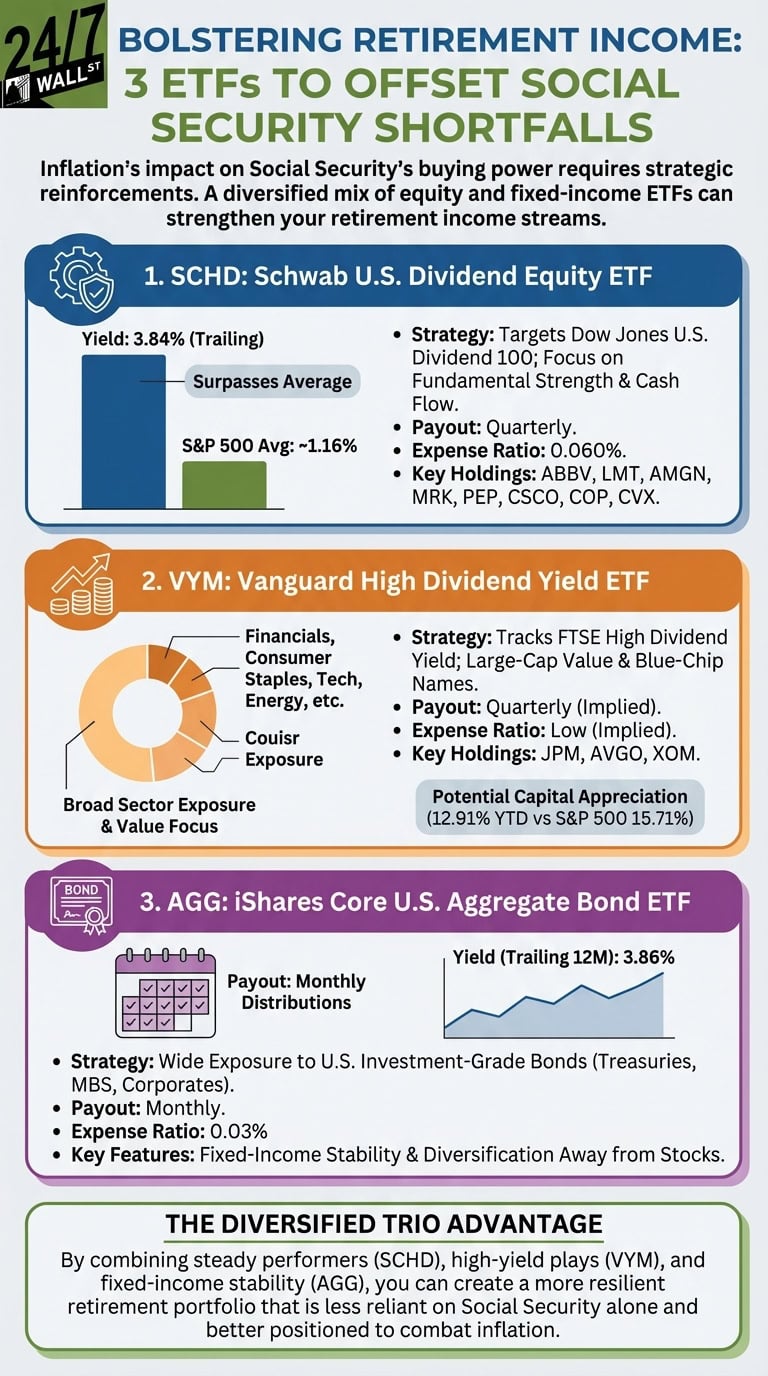
The data shows SCHD has become a notable anchor holding for long-term dividend-focused portfolios, and after looking at the numbers, the case for continued accumulation is worth examining.
Schwab U.S. Dividend Equity ETF (NYSEARCA:SCHD) has drawn attention for three specific reasons.
Reason 1: The Dividend Growth Machine Is Real
This fund doesn’t just pay a yield and stop. The dividend history tells a compounding story that’s hard to ignore. Back in Q4 2011, SCHD paid $0.1217 per share. The most recent payment: the Q1 2026 distribution came in at $0.2569 per share, paid on March 30, 2026. The quarterly cadence has been uninterrupted for over a decade. That consistency matters enormously when reinvesting dividends automatically. Every quarter, those payments buy new shares, which generate more dividends, which buy more shares. The fund’s structure reinforces this: SCHD tracks the Dow Jones U.S. Dividend 100 Index, which selects stocks based on the quality and sustainability of dividends, meaning the underlying holdings are screened to reduce the risk of dividend cuts that would break the reinvestment cycle.
Reason 2: The Cost Structure Is Nearly Zero
The friction of owning this fund is minimal. SCHD carries a total expense ratio of 0.060%. At that price, the fund is essentially free to hold. Every dollar not paid in fees stays invested, compounds through reinvestment, and works across decades. Total net assets stand at $86,210,719,492.56 with 2,809,050,000 shares outstanding as of April 14, 2026, giving the fund the scale and liquidity that eliminates any concern about closure or poor execution. The SEC yield as of April 13, 2026 is 3.35%. With the 10-year Treasury yielding 4.30%, SCHD offers not just yield but dividend growth over time in a way that a Treasury note never will.
Reason 3: The Portfolio Moat Is Built for Durability
SCHD owns a collection of businesses that have survived recessions, rate cycles, and market panics. The top holdings include Chevron (NYSE:CVX | CVX Price Prediction) at 4.48%, UnitedHealth Group (NYSE:UNH) at 4.36%, ConocoPhillips (NYSE:COP) at 4.3%, Merck (NYSE:MRK) at 4.1%, Texas Instruments (NYSE:TXN) at 4.08%, and Coca-Cola (NYSE:KO) at 4.02%. These aren’t speculative names. Consumer Staples and Healthcare together account for 38.8% of the portfolio, providing a defensive core that holds up when growth stocks crack. Portfolio turnover sits at just 30%, confirming this is a buy-and-hold strategy at the fund level. The price performance validates the thesis: over the past ten years, SCHD has returned 219.12%, rising from $9.62 to $30.71.
The Risk to Acknowledge
Yes, with the 10-year Treasury at 4.30%, SCHD’s yield sits below the risk-free rate right now, which makes the fund less compelling on a pure income comparison basis. But that framing misses the point: this is not a static coupon. It is a growing income stream attached to a portfolio of durable businesses at six basis points in annual cost, and the fund has a documented history of consecutive annual dividend increases spanning over a decade.
The Bull Case for Continued Accumulation
The Fed funds rate has dropped from 4.5% to 3.75% since late 2025, and that shift benefits dividend-paying companies directly through lower borrowing costs. SCHD is up 12.9% year-to-date in 2026 and the dividend reinvestment flywheel keeps accelerating. Each new share added buys into that compounding engine. Retail investor discussion across r/investing, r/stocks, and r/dividendinvesting has remained consistently bullish through early 2026, with sentiment scores reaching as high as 72 on March 31, 2026. Investors who add on dips and reinvest every quarterly distribution position themselves to benefit from that compounding dynamic over time.















 Top Gaining Stocks
 Top Losing Stocks