Intel’s Record $475B Valuation Raises One Big Question
Intel’s (NASDAQ:INTC | INTC Price Prediction) market capitalization has climbed to roughly $476 billion, a record valuation that has Wall Street debating whether the chipmaker has earned its seat at the AI-era table or whether retail and institutional money has…

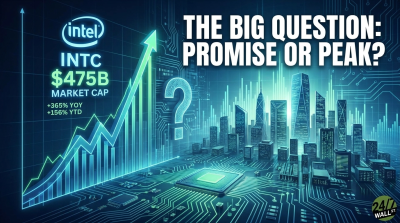
Intel’s (NASDAQ:INTC | INTC Price Prediction) market capitalization has climbed to roughly $476 billion, a record valuation that has Wall Street debating whether the chipmaker has earned its seat at the AI-era table or whether retail and institutional money has run ahead of the fundamentals. Bloomberg semiconductor reporter Ian King, speaking on Bloomberg Businessweek, framed the rally bluntly: investors are buying “on the promise” of future profitability rather than on current results. Intel shares closed at $94.75 on April 29, 2026, up 365.83% over the past year and 156.78% year to date. The forward earnings multiple now sits near 105x, which is mega-cap money for a company that just posted a $3.73 billion GAAP net loss, weighed down by a $4.07 billion restructuring charge, largely tied to a Mobileye goodwill impairment.
The Three Pillars Behind the Rally
CEO Lip-Bu Tan has focused investors on three things. First, the balance sheet looks more stable, with $17.25 billion in cash supported by outside capital and CHIPS Act funding. Second, execution has improved, with Q1 FY2026 revenue of $13.58 billion beating expectations. Third, Intel is repositioning itself as a core player in AI infrastructure.
That last point is driving most of the excitement. Data Center and AI revenue rose 22% to $5.05 billion, and foundry revenue increased 16%. Tan argues the CPU is becoming more important in AI systems, with CPU-to-GPU ratios moving from 1-to-8 closer to 1-to-4. Importantly, that view is gaining traction. Jensen Huang, along with peers like Advanced Micro Devices and Arm Holdings, has pointed to a larger CPU role in AI workloads. Even Texas Instruments added to the momentum with a stronger outlook, helping fuel the broader chip rally.
The One Big Question
The bear case for Intel today is that the cash flow still doesn’t support the story. Intel spent $4.96 billion on capital expenditures in the quarter while generating just $1.10 billion in operating cash flow. That left free cash flow at negative $3.87 billion. The foundry business alone lost $2.4 billion at the operating level. That gap is why sentiment remains split. The average price target sits at $75.42, with 33 hold ratings against 9 buys, even after the stock’s massive run.
King’s central question from the Bloomberg segment is whether investors are looking at the early stages of a new computing cycle, or if they are paying peak multiples at the top of a semiconductor cycle. Until cash flow improves, that question will be top of mind for investors.
Contact [email protected] for any questions or corrections.
Thomas Richmond is a financial writer and content strategist with 5+ years of experience covering stocks and financial markets. He has published over 500 articles focused on individual stock analysis, helping investors better understand business fundamentals, stock valuations, and long-term opportunities.
Thomas previously served as a Content Lead at TIKR, a stock research platform, where he helped scale the company’s blog to hundreds of articles per month and contributed to a weekly newsletter reaching more than 100,000 investors.
Outside of work, Thomas enjoys weight lifting and soccer.