Tempus AI Delivered on Q1 2026, But the Momentum Question Remains
Tempus AI (NASDAQ:TEM) reported Q1 2026 revenue of $348.1 million, up 36.1% year-over-year, beating estimates while MRD volumes surged roughly 500% year-over-year to approximately 6,500 tests. The stock that burst into investor consciousness after Nancy Pelosi disclosed a position and…


Investors have had a moment to digest what Tempus AI (NASDAQ:TEM | TEM Price Prediction) actually delivered when Q1 2026 results landed on May 5. The stock had burst into investor consciousness in January 2025 after Nancy Pelosi disclosed a position, ran past $100, and has since shed a significant portion of that gain. The quarter offered meaningful answers on the key metrics that matter most, but the stock’s reaction shows the story is not yet fully resolved.
From Pelosi Halo to Show-Me Story
Pelosi’s market-beating track record has turned her trades into closely followed signals, and Tempus rode that wave hard in early 2025. The fundamentals briefly justified the enthusiasm. Q4 2025 revenue jumped 83% year-over-year to $367.2 million, the Diagnostics segment grew 121.6%, and adjusted EBITDA turned positive at $12.89 million. CEO Eric Lefkofsky declared the company “poised for a phenomenal 2026.”
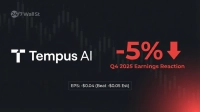
Markets initially disagreed. Shares fell 7.32% on the Q4 release and slid 20.65% over the next 30 days, badly trailing the Invesco QQQ Trust (NASDAQ:QQQ). Then Q1 2026 arrived, and the results were genuinely solid across most of the metrics that mattered, though the stock still dipped around 4% in the session following the release. As of mid-July, TEM trades near $57, well below the $100-plus peak but up meaningfully from its 52-week low of $41.73.
What Q1 2026 Actually Showed
| Metric | Figure | YoY Context |
|---|---|---|
| Q1 2026 Revenue (actual) | $348.1M | +36.1% |
| Q1 2026 EPS (non-GAAP, actual) | -$0.13 | Beat -$0.20 est. |
| FY 2025 Revenue (actual) | $1.27B | +83.4% |
| FY 2026 Revenue (guide) | $1.59B to $1.60B | ~25% |
| FY 2026 Adj. EBITDA (guide) | ~$65M | positive inflection |
The revenue beat was modest at $348.1 million versus a $345.4 million consensus, but the EPS beat was far more meaningful. A non-GAAP loss of -$0.13 per share against a -$0.20 estimate represents roughly 35% upside on the profitability metric. Management also raised full-year revenue guidance to a range of $1.59 billion to $1.60 billion, reaffirming the $65 million adjusted EBITDA target for 2026.
The Three Metrics That Answered the Big Questions
Adjusted EBITDA came in at -$2.8 million for Q1, which is a step back from Q4’s first-ever positive print of $12.89 million. That quarterly oscillation is not unusual for a company in this stage of growth, but it does put pressure on the back half of 2026 to carry more weight if the $65 million full-year target is to hold. The path remains intact; the execution gap has simply narrowed the margin for error.
The data business delivered. Data and Applications revenue hit $87 million, up 40.5% year-over-year, with the Insights segment specifically growing 44.1%. That growth came without a repeat of the large one-time AstraZeneca warrant that distorted Q4 2024 comparisons, making the organic progress cleaner and more credible. The third consecutive quarter of bookings above $100 million reinforces that pharma demand is genuinely broadening.
MRD volumes were the clearest positive surprise. Tempus ran approximately 6,500 MRD tests in Q1 2026, a roughly 500% increase year-over-year and a sharp acceleration from the approximately 4,700 tests run in Q4. Management had flagged that only around 5% of the sales force was actively selling MRD heading into 2026, which means the ramp still has considerable runway. Oncology volume grew 28% in Q1, roughly in line with the 29% growth seen in Q4.
What Has Happened Since Earnings
The May 29 ASCO annual meeting gave Tempus a showcase for its foundation model work. The company presented results from a multimodal transformer-based model trained on 2.5 million longitudinal records, including more than 250 million pages of clinical notes, 450,000 digitized medical images, and 500,000 genomic and transcriptomic sequences. That model draws from a database of more than 45 million de-identified patient journeys. The presentation demonstrated zero-shot performance in analyzing EGFR-mutant non-small cell lung cancer cohorts, providing early evidence that the data moat is translating into clinically useful outputs.
On the analyst front, TD Cowen raised its price target to $71 from $68 in mid-July while maintaining a Buy rating. Freedom Capital initiated coverage with a Hold and a $59 target in late June, reflecting more caution on the profitability timeline. Morgan Stanley remains at Buy as of July 2026. The average 12-month price target across roughly 18 analysts stands near $66, implying meaningful upside from the current trading level. Tempus is set to report Q2 2026 results on July 30, 2026.
The Narrative Still Needs More Chapters
The Pelosi halo has faded, and Tempus is now squarely in show-me territory. Q1 demonstrated that the company can beat on EPS and sustain revenue growth after the comparison base from the Ambry Genetics acquisition makes headline numbers look smaller. The MRD trajectory is the most compelling element: a 500% year-over-year volume surge from a product where the sales force is still in early rollout mode points to durable growth if the ramp continues. What the stock still needs is EBITDA that stays positive on a consistent quarterly basis rather than reverting after a milestone quarter. The July 30 Q2 report will be the next test of whether Q4’s positive EBITDA print was a turning point or a one-quarter event.
Editor’s note: This article has been updated with Tempus AI’s actual Q1 2026 results (revenue of $348.1 million, up 36.1% year-over-year; non-GAAP EPS of -$0.13, beating estimates by roughly 35%; MRD volumes surging approximately 500% year-over-year to ~6,500 tests), post-earnings analyst rating changes including TD Cowen’s price target increase to $71, and context from the company’s May 2026 ASCO foundation model presentation. The Q2 2026 reporting date of July 30, 2026 has also been added.
Contact [email protected] for any questions or corrections.
After two decades of patrolling the dark corners of suburbia as a police officer, Rich Duprey hung up his badge and gun to begin writing full time about stocks and investing. For the past 20 years, he’s been cruising the markets looking for companies to lock up as long-term holdings in a portfolio while writing extensively on the broad sectors of consumer goods, technology, and industrials. Because his experience isn’t from the typical financial analyst track, Rich is able to break down complex topics into understandable and useful action points for the average investor. His writings have appeared on The Motley Fool, InvestorPlace, Yahoo! Finance, Money Morning, and, of course, 24/7 Wall St. He has been featured in both U.S. and international publications, including MarketWatch, Financial Times, Forbes, Fast Company, and USA Today.