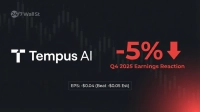
Live: Will Tempus AI Move Higher After Earnings?
Quick Read
-
Tempus AI (TEM) delivered 90% revenue growth in Q2 to $314.6M, driven by 115% genomics growth and 36% Data and Insights expansion.
-
Tempus raised full-year 2025 revenue guidance to $1.26B and reaffirmed adjusted EBITDA of positive $5M, improving over $100M year over year.
-
The company is training a large-scale biomedical AI model with AstraZeneca using 1,000 H200 GPUs across 350 petabytes of data.
- Nvidia made early investors rich, but there is a new class of 'Next Nvidia Stocks' that could be even better; learn more here.
Live Updates
Takeaway before conference call
| Period | EPS (Actual vs Estimate) | Revenue (Actual vs Estimate) | Surprise |
|---|---|---|---|
| Q3 2025 | –$0.11 vs –$0.18 | $334.2 M vs $328.7 M | Beat on both lines |
-
Bullish: First profitability print and continued 80 % growth.
-
Neutral: Guide raise underwhelming relative to expectations.
-
Bearish: GAAP losses and SBC still heavy.
Tempus delivered on growth and profitability proof points but did not expand its forward profit guide enough to satisfy a valuation-rich AI healthcare tape, explaining the post-print sell-off.
Conference call is up next for more color from management.
Updates on the quarter
-
First positive Adj. EBITDA (+$1.5 M) — proof of operating discipline.
-
Gross margin expansion to 63.6 %, up 400 bps YoY.
-
GAAP loss from operations widened to –$61 M from –$53 M YoY due to Ambry amortization and Paige acquisition costs.
-
Guidance raise modest ($1.26 B → $1.265 B).
-
Stock-based compensation up ~$34 M, keeping total opex elevated.
-
Paige acquisition adds AI pathology capability but creates temporary margin drag.
What Management Wants You To Know About Tempus Earnings
Management guided Q4 Adjusted EBITDA to ~$20 M, offset by $5 M/quarter Paige losses, implying a modestly profitable full year, a solid but not transformative step-up.
| Metric | Prior FY 2025 Guide | New FY 2025 Guide | Direction |
|---|---|---|---|
| Revenue | $1.26 B | $1.265 B | Raised slightly |
| Adj. EBITDA | +$5 M | +$10 M (≈ flat post-Paige acq.) | Raised |
| FY 2026 Revenue View | $1.56 B | Reiterated | Flat |
“Not only are we growing at an incredible rate, reaching positive adjusted EBITDA marks an important milestone and reflects the strength of our underlying business,” said Founder & CEO Eric Lefkofsky. “One of the hardest things to do … is slow the rate of reinvestment and still maintain growth, which is exactly what we achieved.”
Lefkofsky emphasized scalability and discipline, but investors wanted stronger forward EBITDA visibility after an aggressive reinvestment cycle.
Tempus Down Big After Numbers Drop
Shares down over 7% after the first take.
Revenue was $334.21 million, above the $332.02 million consensus estimate. EPS was -$0.46, below the -$0.17 consensus estimate. Tempus AI, Inc. reported a significant year-over-year revenue growth of 84.7% for Q3 2025, reaching $334.2 million, driven by strong performance in genomics and data services. Gross profit improved by 98.4% to $209.9 million, although the company reported a net loss of $80 million, slightly higher than the $75.8 million loss in Q3 2024.
The company achieved a positive adjusted EBITDA of $1.5 million, marking a substantial improvement from the previous year’s negative $21.8 million. Tempus increased its full-year revenue guidance to $1.265 billion, reflecting an 80% growth year-over-year. The company ended the quarter with $764.3 million in cash and marketable securities.
Tempus AI (NASDAQ: TEM) reports third-quarter results after the close, and investor attention is turning toward how the company will follow up on its breakout second quarter. The precision medicine and data analytics firm has become one of the most closely watched names in AI-driven healthcare, and its recent performance shows why.
In Q2, Tempus delivered revenue of $314.6 million, up nearly 90% year over year, and a normalized EPS loss of $0.22, beating estimates by three cents. Genomics revenue surged 115% as oncology testing volumes jumped 26% and hereditary testing climbed 32%, while Data and Insights revenue grew nearly 36% to about $73 million. Management raised its full-year 2025 revenue guidance to $1.26 billion and reaffirmed its forecast for positive $5 million in adjusted EBITDA, an improvement of more than $100 million from last year.
CEO Eric Lefkofsky said the company is “hitting its stride” approaching its tenth anniversary, noting that Tempus is balancing rapid top-line growth with disciplined investment. Its issuance of $750 million in low-interest convertible notes also strengthened liquidity, leaving the firm well-capitalized as it scales its AI initiatives.
Estimates Snapshot
Here’s what Wall Street expects when Tempus reports:
| Period | Revenue | EPS (Normalized) | YoY Revenue Growth |
|---|---|---|---|
| Q3 2025 (Current Qtr) | $328.67M | –$0.18 | +81.7% |
| Q4 2025 (Next Qtr) | $360.06M | –$0.10 | +79.4% |
| FY 2025 | $1.26B | –$0.72 | +81.6% |
| FY 2026 | $1.56B | –$0.12 | +24.1% |
Tempus has now exceeded EPS expectations in three of the past four quarters, with an average positive surprise of about 9%. Analysts expect continued sequential improvement in margins and a potential inflection toward breakeven by early 2026.
Key Areas to Watch When Tempus Reports
1. AI Foundation Model Expansion
Tempus’ multi-year partnership with AstraZeneca and Pathos to train a large-scale biomedical foundation model is a central narrative. Management said it is running compute across 1,000 H200 GPUs on over 350 petabytes of data — a scale that could reshape how pharma companies identify responders to therapies. Investors will look for signs that additional pharma partners are lining up to participate.
2. Genomics Growth and Market Share Gains
Q2 genomic testing volumes surged across oncology and hereditary lines, aided by improved salesforce efficiency and technology upgrades. The hereditary segment’s market share gains, particularly through the Ambry platform, have been a key driver, and management called growth “durable and sustainable” into Q3.
3. Path Toward Profitability
Adjusted EBITDA losses narrowed sharply to $5.6 million in Q2 from –$16 million in Q1. The company reaffirmed full-year profitability guidance, citing disciplined cost control and operational leverage. With revenue growing north of 30% at scale, investors will be watching if the margin expansion continues.
4. MRD and Liquid Biopsy Catalysts
Tempus expects reimbursement for its minimal residual disease (MRD) assays by late 2025, positioning this franchise for meaningful 2026 growth. The liquid biopsy and treatment response monitoring pipeline could add incremental volume once payers approve coverage.
5. Data and Insights Momentum
Following 40% growth in Q2, management guided for approximately 30% full-year growth in its Data and Insights business. This segment, fueled by large pharma partnerships, is key to Tempus’ long-term AI monetization strategy.
Joel South has been an avid investor and financial writer for over 15 years, publishing thousands of articles analyzing stocks, markets, and investment strategies across multiple leading financial media platforms. He spent 12 years at The Motley Fool, where he worked as an investment analyst and Bureau Chief before ascending to direct the Fool.com investing news desk, overseeing editorial operations and content strategy. During his tenure, Joel co-hosted an investing podcast and became a recognized voice in financial media through numerous TV and radio appearances discussing stock market trends and investment opportunities.
Currently serving as General Manager and Managing Editor at 24/7 Wall Street, Joel has published hundreds of in-depth analyses focusing on large-cap stocks, dividend-paying equities, and market-moving developments. His comprehensive coverage spans earnings previews, price predictions, and investment forecasts for major companies across all sectors—from technology giants and semiconductor manufacturers to consumer brands and financial institutions. Joel's expertise encompasses t fundamental analysis, options market interpretation, institutional investor behavior, and translating complex market dynamics into clear, actionable insights for individual investors.
© 24/7 Wall Street