Was President Trump Right About Tariffs? U.S. Exports Are Shattering Records
For months, investors have been caught between two competing realities. On Wall Street, the market keeps grinding higher, fueled by AI optimism, strong corporate earnings, and a labor market that refuses to crack. On Main Street, though, consumers are staring…


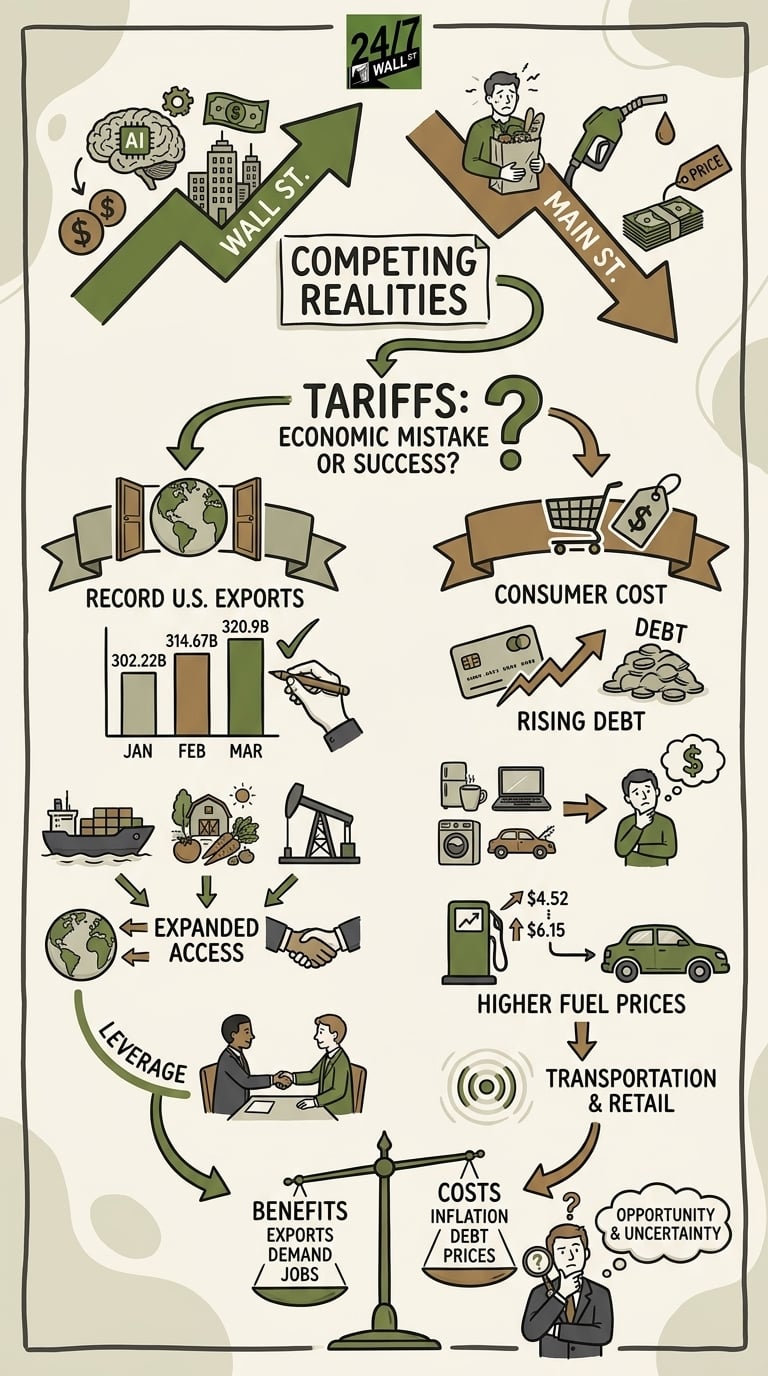
For months, investors have been caught between two competing realities. On Wall Street, the market keeps grinding higher, fueled by AI optimism, strong corporate earnings, and a labor market that refuses to crack. On Main Street, though, consumers are staring at grocery bills, rent hikes, and gasoline prices that feel like they belong in a luxury tax bracket.
So when President Donald Trump’s tariff policies were recently ruled unconstitutional by the Supreme Court, it raised an uncomfortable question: were the tariffs an economic mistake — or did they actually work?
The answer, surprisingly, may be both.
Tariffs Helped Open Markets for U.S. Goods
Trump’s tariffs were controversial from the start. Critics argued they distorted trade, raised prices, and invited retaliation. Supporters countered they forced other countries to finally negotiate after decades of trade imbalances.
There is evidence the strategy produced results.
According to U.S. Census Bureau trade data, American exports reached a record $320.9 billion in March, the highest monthly total in U.S. history. February exports totaled $314.67 billion, while January came in at $302.22 billion. That means every month in the first quarter topped $300 billion — something the U.S. has never done before.
That didn’t happen in a vacuum.
The Trump administration used tariffs as leverage in negotiations with roughly 20 countries. Several nations lowered tariffs on U.S. agricultural goods, industrial equipment, and manufactured products to avoid broader trade penalties. Tariffs became a bargaining chip and many U.S. companies benefited from the wider access.
Industrial exporters, energy producers, and agricultural businesses all saw expanding overseas demand. Companies involved in liquefied natural gas exports, machinery manufacturing, and aerospace components gained access to markets that previously imposed heavier import taxes on American goods.
Let’s look at what the numbers tell us:
| Metric | January 2026 | February 2026 | March 2026 |
| U.S. Exports | $302.22 billion | $314.67 billion | $320.9 billion |
Record exports don’t guarantee economic prosperity by themselves, but they do suggest foreign demand for U.S. products remains strong despite global economic uncertainty.
The Economy Is Benefiting — but Consumers Are Paying, Too
Strong exports may also help explain why the labor market continues to hold up better than many economists expected.
The Bureau of Labor Statistics reported unemployment remains relatively low at 4.3%, while hiring continues in healthcare, transportation, warehousing, and retail. Granted, many of those sectors are not directly tied to tariffs. Yet they still benefit indirectly from stronger shipping activity, consumer demand, and supply-chain expansion tied to higher trade volumes.
That said, tariffs are never free.
Wall Street hits record highs while your grocery bill hits a breaking point—is this a trade victory or a self-inflicted wound?
Companies rarely absorb the full cost of import taxes themselves. Instead, they pass those costs to consumers through higher prices. Americans are seeing it everywhere — appliances, electronics, auto parts, groceries, and household essentials.
Consumers have increasingly relied on credit cards to bridge the gap. Federal Reserve data shows revolving credit balances remain at record highs above $1.3 trillion as households struggle to keep pace with rising costs.
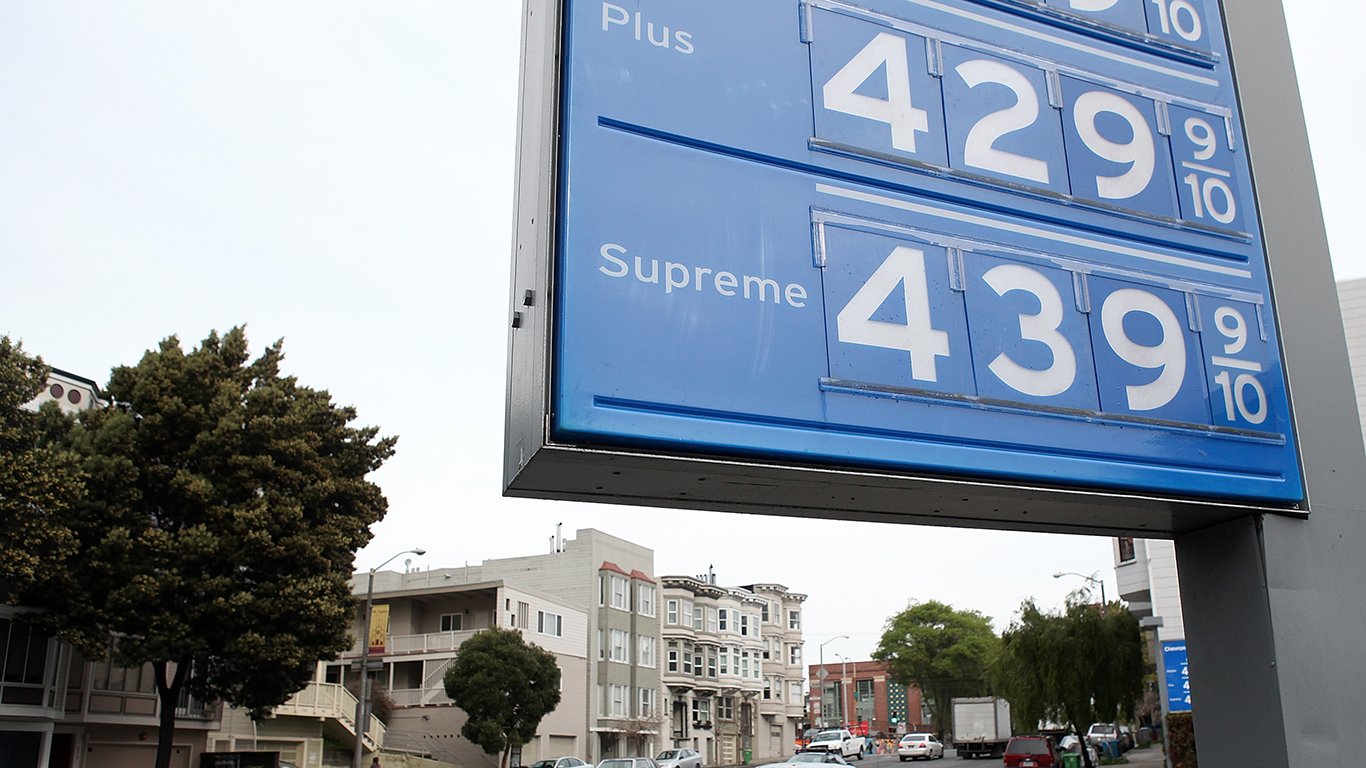
Energy illustrates the contradiction. The U.S. is exporting more oil and energy products than ever, yet gasoline prices continue climbing. According to AAA, the national average price for gasoline recently hit $4.52 per gallon. Ten states sit well above that figure, with prices in some areas topping $6.15 per gallon.
Regardless of how you look at it, higher transportation and fuel costs ripple through the economy. Food becomes more expensive to deliver. Retailers face higher shipping costs. Airlines raise fares. Consumers feel the squeeze everywhere.
That helps explain why many Americans say Trump’s economy isn’t working for them despite the stock market’s gains.
Trump Isn’t Done Fighting the Tariff Battle
The Supreme Court ruling created another major wrinkle. The federal government is now having to repay roughly $166 billion in tariff revenue collected under authorities the Court determined exceeded constitutional limits. That is a staggering figure, especially as Washington already faces mounting deficits and higher interest costs.
Yet Trump is not backing away. His administration is reportedly exploring alternative trade statutes and national security provisions that could allow tariffs to continue under different legal frameworks likely to survive future constitutional challenges.
For investors, this creates both opportunity and uncertainty. Companies benefiting from expanded export access could continue seeing revenue growth if trade deals remain intact. Manufacturers tied to industrial exports, agriculture, and energy may still gain market share abroad.
At the same time, persistent tariffs risk keeping inflation elevated. Higher consumer prices pressure household budgets, slow discretionary spending, and increase political frustration — particularly if wages fail to keep pace.
Key Takeaway
Trump’s tariffs produced real economic benefits — record exports, expanded trade access, and stronger demand for many U.S. industries. The numbers back that up. U.S. exports topping $320.9 billion in March is an economic fact.
But there has been a cost. Consumers are paying more for essentials, debt levels are climbing, and rising gasoline prices continue straining household budgets. When all is said and done, tariffs helped parts of corporate America while leaving many ordinary Americans wondering why their paycheck no longer stretches as far.
Savvy investors should recognize both sides of the equation. Export-driven businesses may continue benefiting if trade relationships hold. Yet persistent inflation and consumer fatigue remain real risks to the broader economy — and to the bull market itself.
Contact [email protected] for any questions or corrections.
After two decades of patrolling the dark corners of suburbia as a police officer, Rich Duprey hung up his badge and gun to begin writing full time about stocks and investing. For the past 20 years, he’s been cruising the markets looking for companies to lock up as long-term holdings in a portfolio while writing extensively on the broad sectors of consumer goods, technology, and industrials. Because his experience isn’t from the typical financial analyst track, Rich is able to break down complex topics into understandable and useful action points for the average investor. His writings have appeared on The Motley Fool, InvestorPlace, Yahoo! Finance, Money Morning, and, of course, 24/7 Wall St. He has been featured in both U.S. and international publications, including MarketWatch, Financial Times, Forbes, Fast Company, and USA Today.