Mizuho Just Hiked AMD Price Target to $515: Agentic AI Server Demand Powers the Bull Case
Mizuho just turned more bullish on Advanced Micro Devices (NASDAQ:AMD | AMD Price Prediction), raising its price target to $515 from $415 while keeping an Outperform rating. The firm cited agentic AI continuing to drive server demand as the catalyst…

Mizuho just turned more bullish on Advanced Micro Devices (NASDAQ:AMD | AMD Price Prediction), raising its price target to $515 from $415 while keeping an Outperform rating. The firm cited agentic AI continuing to drive server demand as the catalyst behind the call.
The price target raise is a sign that Wall Street views AMD as a primary beneficiary of the next phase of AI infrastructure buildout.
| Ticker | Company | Firm | Action | Old Rating | New Rating | Old Target | New Target |
|---|---|---|---|---|---|---|---|
| AMD | AMD | Mizuho | Price target raised | Outperform | Outperform | $415 | $515 |
The Analyst’s Case
Mizuho’s thesis hinges on what agentic AI actually requires under the hood. Unlike a simple chatbot reply, agentic systems run continuous inference, longer context windows, and multiple parallel agent instances, all of which lean heavily on both accelerators and general-purpose CPUs for orchestration.
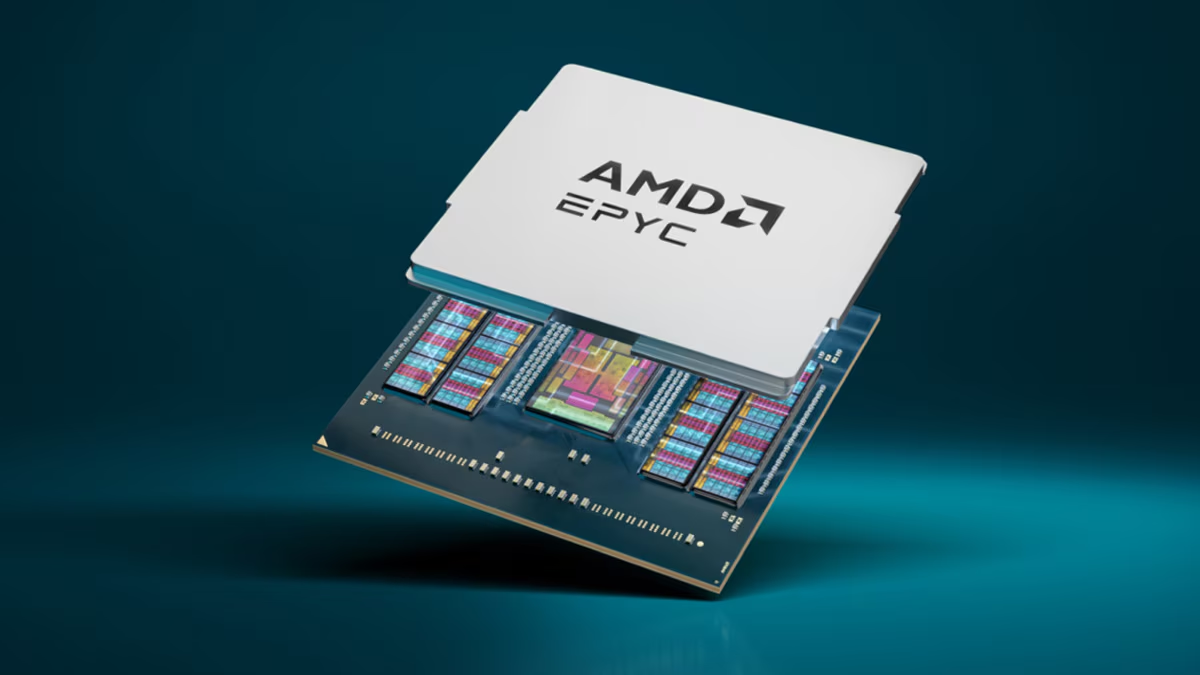
Advanced Micro Devices is positioned on both sides of that trade: EPYC server CPUs handle the orchestration and memory layer, while the Instinct MI300/MI350 accelerators compete for the inference workload itself. Mizuho’s broader semiconductor estimate hike followed the March quarter earnings season, suggesting this is a sector-wide rerating rather than an AMD-only call.
Company Snapshot
Advanced Micro Devices’ Q1 2026 report on May 5 reinforced the bull case. Revenue hit $10.253 billion, up 38% year over year, with non-GAAP EPS of $1.37 beating estimates.
The Data Center segment delivered $5.775 billion in revenue, up 57%, powered by EPYC and Instinct shipments. Advanced Micro Devices CEO Lisa Su told investors the company now expects “the server CPU TAM to grow at greater than 35% annually, reaching over $120 billion by 2030.”
Why the Move Matters Now
AMD stock has rallied hard in 2026, with shares closing at $458.79 on May 11. The valuation has expanded with it, leaving AMD trading at a P/E ratio of 152x with a market cap near $742 billion.
Su asserted that agentic workloads are “largely additive to the TAM,” with the CPU-to-GPU ratio shifting from 1:4 or 1:8 configurations toward something closer to 1:1. That structural shift is what Mizuho is underwriting with its $515 target.
What It Means for Your Portfolio
For prudent investors, the AMD bull case rests on continued server CPU share gains against Intel and a successful ramp of the MI450 Series and Helios platform, with the Meta partnership to deploy up to 6 gigawatts of AMD Instinct GPUs as the marquee customer win. This combination of accelerator ramp and hyperscaler commitment underpins the agentic AI server demand thesis behind Mizuho’s call.
The bear case is straightforward: NVIDIA (NASDAQ:NVDA) still dominates AI training, custom silicon from hyperscalers remains a long-term overhang, and the Client and Gaming segments carry cyclical risk. The analyst consensus target for AMD stock sits near $445.02, well below Mizuho’s $515, signaling that the firm is meaningfully ahead of the Street.
For long-term investors, the AMD stock story is increasingly tied to whether agentic AI scales as fast as management and Mizuho expect. Moderate position sizing and patience around volatility look more sensible than chasing the rally at current levels.
Contact [email protected] for any questions or corrections.
David Moadel is financial writer specializing in stocks, ETFs, options, precious metals, and Bitcoin. David has written well over 1,000 articles for leading online publications, helping investors understand markets, income strategies, and risk.His work has appeared in The Motley Fool, InvestorPlace, U.S. News & World Report, TipRanks, ValueWalk, Benzinga, Market Realist, TalkMarkets, Finmasters, 24/7 Wall St., and others.With a master’s degree in education, David has taught at the elementary, high school, and college levels. That teaching background shapes his writing style: clear, educational, and practical. David has also built a loyal social-media audience by providing trustworthy financial content on YouTube, X/Twitter, and StockTwits.