AMD Is Up 5% Today: Is It Outperforming Other Chip Stocks Like Intel and NVIDIA?
Shares of Advanced Micro Devices (NASDAQ:AMD | AMD Price Prediction) are up 5% in early Tuesday trading, leading a broad lift across the chip complex. Intel (NASDAQ:INTC) is up 2%, while NVIDIA (NASDAQ:NVDA) is essentially flat. The move follows a…

This post may contain links from our sponsors and affiliates, and Flywheel Publishing may receive compensation for actions taken through them.

Shares of Advanced Micro Devices (NASDAQ:AMD | AMD Price Prediction) are up 5% in early Tuesday trading, leading a broad lift across the chip complex. Intel (NASDAQ:INTC) is up 2%, while NVIDIA (NASDAQ:NVDA) is essentially flat.
The move follows a price target bombshell from UBS on Micron Technology (NASDAQ:MU) this morning. UBS raised its Micron target to $1,625 from $535, citing long-term memory supply agreements and durable AI-era memory economics with EPS above $100 through 2029. That magnitude of rerating is rippling through the semiconductor group.
Micron shares are up by more than 10% intraday, and that sentiment is lifting names that compete with or sit adjacent to the memory trade. AMD stock is leading the trio on the day, though the action looks broad-based rather than company-specific.
Why AMD Leads the Chip Basket
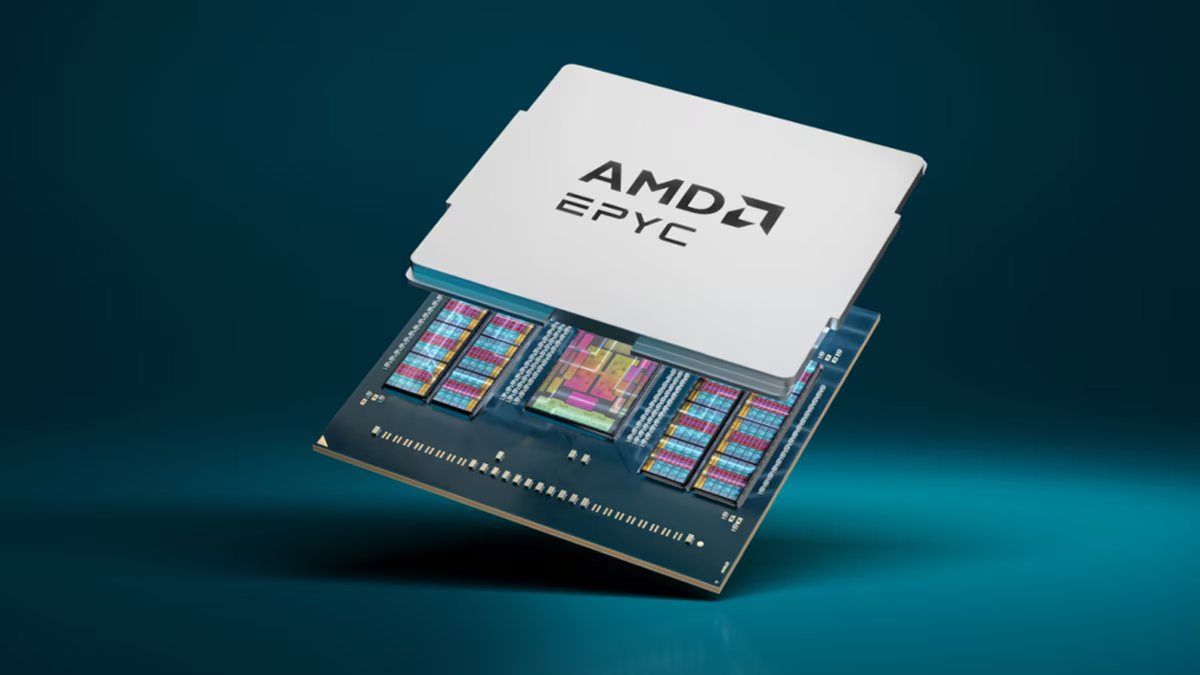
Advanced Micro Devices has the most diversified AI chip exposure among the three, spanning EPYC server CPUs, the Instinct accelerator line, and an emerging agentic CPU narrative. That breadth means a sentiment lift across the AI complex tends to translate most cleanly into AMD’s tape. Advanced Micro Devices’ Q1 2026 revenue grew 38% year over year to $10.25B, with Data Center revenue up 57%.
The stock is up 322% over the past year, a reminder that AMD has been one of the largest AI-era beneficiaries in the chip group. Advanced Micro Devices CEO Lisa Su described the quarter as “outstanding… driven by accelerating demand for AI infrastructure, with Data Center now the primary driver of our revenue and earnings growth.”
Intel Participates, but the Bar Is Higher
Intel is along for the rally, but more modestly. The stock is up 230% year to date, an almost vertical turnaround move powered by CEO Lip-Bu Tan’s restructuring, the Foundry build-out, and Intel’s pivot toward AI inference and agentic workloads.
The company’s Q1 2026 revenue rose 7% year over year to $13.58B, with Data Center and AI revenue up 22%. Intel Xeon 6 was also selected as the host CPU for NVIDIA’s DGX Rubin NVL8 systems, a strategic stamp on Intel’s renewed AI relevance.
After a year-to-date move of that size, however, the bar for fresh upside for Intel is materially higher than for AMD. Today’s modest gain reads as a stock that has already done much of its 2026 work and is consolidating on broader chip-group enthusiasm.
NVIDIA Is the Smallest Mover
NVIDIA stock is the relative laggard today, essentially breaking even for the day. The bellwether has gained 16% year to date, far below AMD’s run and a fraction of Intel’s turnaround tape. After multi-year gains that dwarf the peers, fresh catalysts need to materialize to move NVIDIA the way they move smaller chip names.
NVIDIA’s Q1 FY2027 revenue came in at $81.61B, up 85% year over year, with Data Center revenue up 92%. Even so, Reddit chatter captures the post-earnings paradox cleanly, with one top thread asking, “Am I the only one confused about why NVIDIA crushed earnings and the stock still went red?”
The Micron stock rerating is constructive for NVIDIA’s ecosystem, since high-bandwidth memory economics underpin AI accelerator margins. Yet, that read-through doesn’t translate to NVIDIA’s own valuation thesis the same way it does for less-rerated chip peers.
The Bull and Bear Setup
The bullish read is that AI infrastructure capex remains robust, and the Micron rerating signals investors are willing to pay more durable multiples for AI-era compute and memory. AMD’s agentic CPU narrative and Instinct ramp are direct beneficiaries of that thinking. Polymarket pricing puts NVIDIA stock’s odds of closing higher today at 58%, a modest tilt in line with the tape.
The bearish read is straightforward. The AMD, Intel, and NVIDIA chip group has had monstrous runs, and valuation discipline matters at these levels. A sentiment-driven lift can fade quickly if follow-up sell-side calls or hard fundamentals don’t reinforce it.
What to Watch
Dell Technologies (NYSE:DELL) reports later this week and provides a useful read-through on AI server demand. Whether other analysts pile onto the Micron rerating thesis will shape how durable today’s lift becomes for the broader chip basket.
For watchful investors, the headline answer is yes for today, with AMD outperforming Intel and NVIDIA in this session. The longer-frame picture, however, flips depending on the window. Intel leads year to date, AMD leads over one year, and NVIDIA is the relative 2026 laggard of the trio, even as it remains the AI bellwether of the group.
Contact [email protected] for any questions or corrections.
David Moadel is financial writer specializing in stocks, ETFs, options, precious metals, and Bitcoin. David has written well over 1,000 articles for leading online publications, helping investors understand markets, income strategies, and risk.His work has appeared in The Motley Fool, InvestorPlace, U.S. News & World Report, TipRanks, ValueWalk, Benzinga, Market Realist, TalkMarkets, Finmasters, 24/7 Wall St., and others.With a master’s degree in education, David has taught at the elementary, high school, and college levels. That teaching background shapes his writing style: clear, educational, and practical. David has also built a loyal social-media audience by providing trustworthy financial content on YouTube, X/Twitter, and StockTwits.