This Is the Only AI ETF You Need to Hold During the Capex Boom
The Invesco Dorsey Wright Technology Momentum ETF (NASDAQ:PTF) is up roughly 58% year to date in 2026, which is what happens when a rules-based momentum fund collides with the largest data center buildout in corporate history. PTF markets itself as…


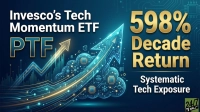
The Invesco Dorsey Wright Technology Momentum ETF (NASDAQ:PTF) is up roughly 58% year to date in 2026, which is what happens when a rules-based momentum fund collides with the largest data center buildout in corporate history. PTF markets itself as a technology momentum strategy that mechanically rotates into whatever tech stocks have been winning, and right now the winners are almost entirely AI hardware names. That is why PTF deserves a look from anyone trying to size their exposure to the capex cycle without picking individual chip stocks.
How the fund decides what to own
PTF runs on Dorsey Wright’s relative strength methodology, which ranks technology stocks against each other and overweights the ones outperforming their peers. The index has no analyst overlay and no AI screen. The index simply buys strength and sells weakness on a regular schedule. In a capex boom dominated by accelerators, optical components, and memory, that screen has effectively turned PTF into an AI hardware ETF by accident. The Zacks profile from late 2025 listed Lumentum (NASDAQ:LITE | LITE Price Prediction), Sandisk (NASDAQ:SNDK), and NVIDIA (NASDAQ:NVDA) among top holdings, a mix that captures optical interconnects, storage for training data, and the GPU layer itself.
Hyperscaler capex is not just expanding in unit terms. Mark Zuckerberg told investors on Meta’s latest earnings call that hyperscalers are paying more per component, which means the dollar value flowing into PTF’s underlying holdings is rising faster than the rack count. Momentum strategies tend to catch that pricing tailwind earlier than market-cap weighted funds because price action shows up first in smaller suppliers, not the megacaps.
Whether the strategy is delivering
PTF has returned about 91% over the past year and 193% over five years. The Invesco QQQ Trust (NASDAQ:QQQ) returned about 39% and 121% over those same windows. PTF has more than doubled QQQ’s one-year return during the AI ramp.
The harder comparison is against the VanEck Semiconductor ETF (NYSEARCA:SMH), the cleanest pure-play AI hardware vehicle. SMH is up about 134% over the past year and 411% over five years. PTF’s momentum engine wins against diversified tech, but a concentrated semiconductor basket has beaten it during this cycle. PTF is the right vehicle if you want AI hardware exposure with a built-in exit rule when momentum breaks. SMH is the right vehicle if you want maximum semiconductor beta and intend to ride it through any drawdown yourself.
What you are signing up for
Three real frictions matter before buying.
- Cost. PTF charges 0.6% annually, several times what a plain semiconductor or NASDAQ ETF charges. The momentum rebalance has to keep adding value to justify the gap.
- Size and turnover. AUM is around $582 million, which is small for a tech ETF and means rebalances can move underlying stocks. Frequent rotation creates taxable distributions in non-retirement accounts, even though the cash yield is trivial.
- Strategy regime. Seeking Alpha’s Fred Piard noted in April that PTF is showing recent outperformance against the sector benchmark XLK despite a historical underperformance and pointed out that it is good for “tactical allocation and swing trading.” Momentum works until leadership narrows to a few megacaps the index cannot fully load into, at which point PTF lags. PTF has underperformed historically whenever the mega caps pulled ahead.
Who should own it
PTF fits investors who want concentrated AI hardware exposure but want a mechanical rule to rotate them out when the trade stops working. A 5% to 10% sleeve alongside a broad index core is sensible sizing. If you already hold SMH or individual chip names, layering PTF on top mostly duplicates risk at a higher fee. If you are a long-term buyer who refuses to sell into a tech drawdown, the cheaper, lower-turnover XLK or QQQ probably serves you better. The capex boom is real, the momentum tape is real, and PTF is currently catching both. Owning it means accepting that the same rules that put it in NVIDIA today will pull it out the moment leadership shifts.
Contact [email protected] for any questions or corrections.
Omor Ibne Ehsan is a writer at 24/7 Wall St. He is a self-taught investor with a focus on growth, cyclical, and dividend equities that have strong fundamentals, value, and long-term potential. He also has an interest in high-risk, high-reward investments such as penny stocks.