Trump Personally Brokered the Apple-Intel Deal That Sent Intel from $20 to $125
On a recent TBPN segment, host John Coogan walked listeners through what he framed as the most consequential industrial policy intervention in semiconductors since the CHIPS Act, namely Commerce Secretary Howard Lutnick meeting repeatedly with Tim Cook, Elon Musk, and…

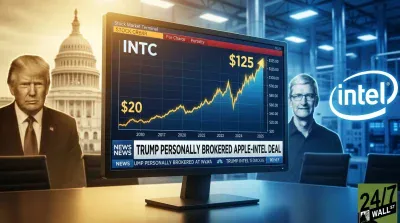
On a recent TBPN segment, host John Coogan walked listeners through what he framed as the most consequential industrial policy intervention in semiconductors since the CHIPS Act, namely Commerce Secretary Howard Lutnick meeting repeatedly with Tim Cook, Elon Musk, and Jensen Huang to push them to partner with Intel, with President Trump personally advocating for Intel in a White House meeting and telling Cook “I like Intel.” The result, per Coogan, took the stock from “roughly $20, $21 a share” to “$125 a share” following the government’s 10% equity stake.
The price action supports him. Intel closed at $124.92 on May 8, 2026, up 494.86% over the trailing year and 238.54% year to date. Nvidia’s piece of the trade, the $5 billion investment that came in at “$23 a share”, is now “up around a 5x.”
What Intel’s numbers actually say
Intel (NASDAQ:INTC | INTC Price Prediction) reported Q1 FY2026 revenue of $13.577 billion, beating estimates by 9.22%, with Data Center and AI up 22% year over year and Intel Foundry up 16%. CEO Lip-Bu Tan framed the moment around inference workloads, saying “the next wave of AI will bring intelligence closer to the end user, moving from foundational models to inference to agentic.” The official Q1 8-K details a $4.07 billion restructuring charge tied largely to Mobileye goodwill impairment, which is why GAAP looks ugly even as gross margin expanded to 41.0%
Data Center and AI revenue rose 22% year over year to $5.05 billion, while Intel Foundry grew 16% to $5.42 billion, the segment most relevant to any Apple reshoring scenario. Q2 guidance calls for $13.8 billion to $14.8 billion in revenue and non-GAAP EPS of $0.20 at roughly 39.0% gross margin, a sequential step down that management attributes to mix and ramp costs on Intel 18A.

Insiders are buying. Eight Intel directors simultaneously acquired common stock on May 7, 2026, mostly 12,552-share blocks tied to vesting events. The CHIPS Act escrow and federal equity stake remain real overhangs, and management has flagged that Intel 14A could be paused if customer demand fails to materialize. Offsetting that risk, Intel repurchased the 49% minority equity in its Fab 34 facility in Ireland and joined the Terafab consortium alongside SpaceX, xAI, and Tesla, both signals that the foundry roadmap is being defended capital-first rather than wound down.
Why Apple needed a second foundry
Apple’s pull is mostly about geography. The Wall Street Journal reported on May 8 that Intel and Apple reached a preliminary agreement after over a year of negotiations, with iPad Pro and entry-level MacBook Air chips expected to use Intel’s 18A node. Cook had already warned that “the Mac mini and the Mac Studio may take several months to reach supply-demand balance,” and Apple (NASDAQ:AAPL), now a $4.3 trillion company, cannot afford to be single-sourced through Taiwan indefinitely. The scale is staggering: fiscal Q2 2026 revenue hit $111.18 billion with iPhone alone contributing $56.99 billion and Services setting an all-time record at $30.98 billion. With $29.58 billion in quarterly net income and a fresh $100 billion buyback authorization, Apple has both the cash and the strategic motive to underwrioundry partner, even one still ramping leading-edge nodes.
A ten-stock market
Coogan’s framing is that the “AI Big Ten,” meaning the Mag 7 plus AMD (NASDAQ:AMD), Broadcom (NASDAQ:AVGO), and Micron (NASDAQ:MU), now represents 40% of the entire market. The performance gap is hard to argue with. AMD is up 347.58% over one year, Broadcom 108.62%, and Micron 779.18%. NVIDIA sits at a $5.23 trillion market cap with the stock up 83.39% year over year.
Coogan cited analysis showing “the AI economy grew 31% while the non-AI economy just 0.1%,” a figure that overstates BEA industry accounts but tracks the price action of these ten names. Concentration like this last showed up in the railroad era. Worth watching NVIDIA (NASDAQ:NVDA), AMD, and Broadcom together, because they now move the index. Nvidia’s Q4 revenue of $68.13 billion grew 73.2% year over year with Data Center contributing $62.31 billion.
AMD’s Q1 came in at $10.25 billion with Data Center up 57%, and Broadcom’s AI chip revenue hit $8.40B in Q1 FY26, more than doubling year over year. CEO Hock Tan is publicly targeting north of $100 billion in AI sales by 2027. If Coogan is right that Washington is now an active equity participant in the semiconductor supply chain, the political risk premium on this cohort has just changed shape, and the Apple-Intel arrangement is the template.
Contact [email protected] for any questions or corrections.
Omor Ibne Ehsan is a writer at 24/7 Wall St. He is a self-taught investor with a focus on growth, cyclical, and dividend equities that have strong fundamentals, value, and long-term potential. He also has an interest in high-risk, high-reward investments such as penny stocks.