Rocket Lab Has 2 Big Opportunities Ahead. Either One Could Change the Stock’s Trajectory

This post may contain links from our sponsors and affiliates, and Flywheel Publishing may receive compensation for actions taken through them.

Rocket Lab (NASDAQ:RKLB | RKLB Price Prediction) just reported Q3 2026 results. Chief Executive Peter Beck called Q3 2026 “a defining quarter for Rocket Lab”[1] after revenue reached $267.8 million, up 72.71% year over year, and backlog rose 52% from Q2 to $3.57 billion.
The stock has fallen behind the business. Shares are down 17.76% year to date at $57.37, well below the 52-week high of $151. Two events could change that: the Neutron rocket’s debut and the Iridium Communications (NASDAQ:IRDM) acquisition.

Analysts Already See 62% Upside
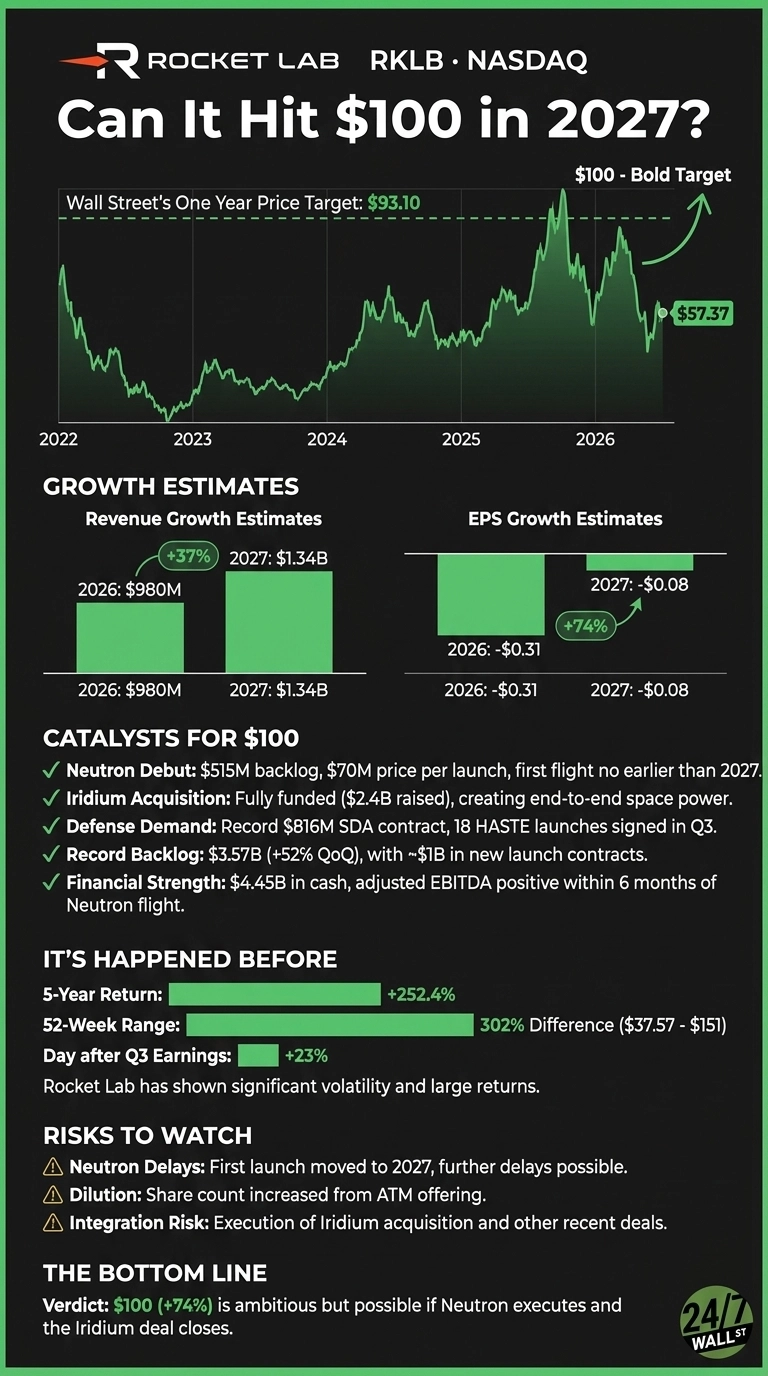
The consensus price target of $93.10 implies about 62% upside. The stock carries 5 strong buy and 13 buy ratings, 4 holds, and zero sells. Analysts expect revenue to grow from $980 million in 2026 to $1.34 billion in 2027, an increase of roughly 37%. The average 2027 EPS estimate is -$0.0761, but the high estimate of $0.12 shows that some analysts expect a profit.

The company has also topped revenue consensus in each of its last four quarters, including a 4.14%[1] beat in Q3. Its Q3 GAAP EPS of -$0.12[1] missed expectations because of one-time items: a $27.26 million loss on debt repayment and $21.34 million in Iridium transaction costs.

Here’s What It Takes for Rocket Lab to Reach $100
The company isn’t profitable yet, so I’m valuing it on sales. With roughly 681 million[1] shares, the stock trades at about 29x 2027 revenue estimates. At $100, that multiple rises to about 51x. That’s a high multiple, but the company is growing revenue at 37% and holds $4.45 billion[1] in cash.
What Could Push Rocket Lab to $100?
- Neutron’s first flight: Rocket Lab has booked 16[1] Neutron missions worth more than $515 million, and the base price is now $70 million per launch. Beck said “the next available slots are in the 2030s.”[2] Management expects adjusted EBITDA to turn positive within six months of Neutron’s first successful flight.
- Iridium: Rocket Lab raised about $2.4 billion[2] through its equity offering to pay for the deal, and Iridium shareholders have approved it. Once regulators sign off, Iridium’s satellite network would bring recurring cash flow. Beck called the deal a step toward becoming a “true end-to-end space company.”[2]
- Defense demand: Rocket Lab won an $816 million[3] Space Development Agency satellite contract, the largest in its history, and signed 18[2] HASTE launches for the Space Force in Q3.
Rocket Lab’s 52-Week Range Shows $100 Is Within Reach
Getting to $100 requires a 74% gain. Rocket Lab has moved by far more than that within a single year: over the past 52 weeks, shares traded between $37.57 and $151, a 302% difference from low to high.
The stock is up 252.4% over five years, and it rose 23% the day after its Q3 earnings report. Its beta of 3.176 means the stock tends to move about three times as much as the broader market, in both directions.

Is $100 Realistic? Here’s My Take
Analysts already see 62% upside, not far from the 74% needed for $100, revenue keeps beating estimates, and either events could change how investors value the stock. Still, Beck has declined to give a specific quarter for Neutron’s first launch.
Jim Cramer summed up this year’s selloff as “Some delays, some dilution.” If Neutron flies smoothly and the Iridium deal closes on schedule, the stock has room to rise. The blueprint for how Rocket Lab could deliver outsized returns in 2027 is clear (the same kind of early-signal setup we cataloged in a free guide on recognizing the next 100x tech winner: here).
Contact [email protected] for any questions or corrections.
Vandita Jadeja is a financial publisher with over a decade of experience writing about financial topics, including investment, savings, retirement, insurance and banking. Vandita is a Chartered Accountant who loves to debunk financial concepts for readers.
Her work has appeared on sites that include The Motley Fool, InvestorPlace, and Benzinga. She covers investing and focuses on stock picks and price prediction for 24/7 Wall St.
When not looking for the next stock investment opportunity, she can be found traveling, reading, chasing sunsets and enjoying her iced latte.