3 Robotics ETFs Positioned to Capitalize on America’s Reshoring Boom in 2026
The reshoring trade has moved from political talking point to capital expenditure line item, and the funds that own the picks and shovels of industrial automation have started to reflect it. Three robotics ETFs offer different ways into the theme:…

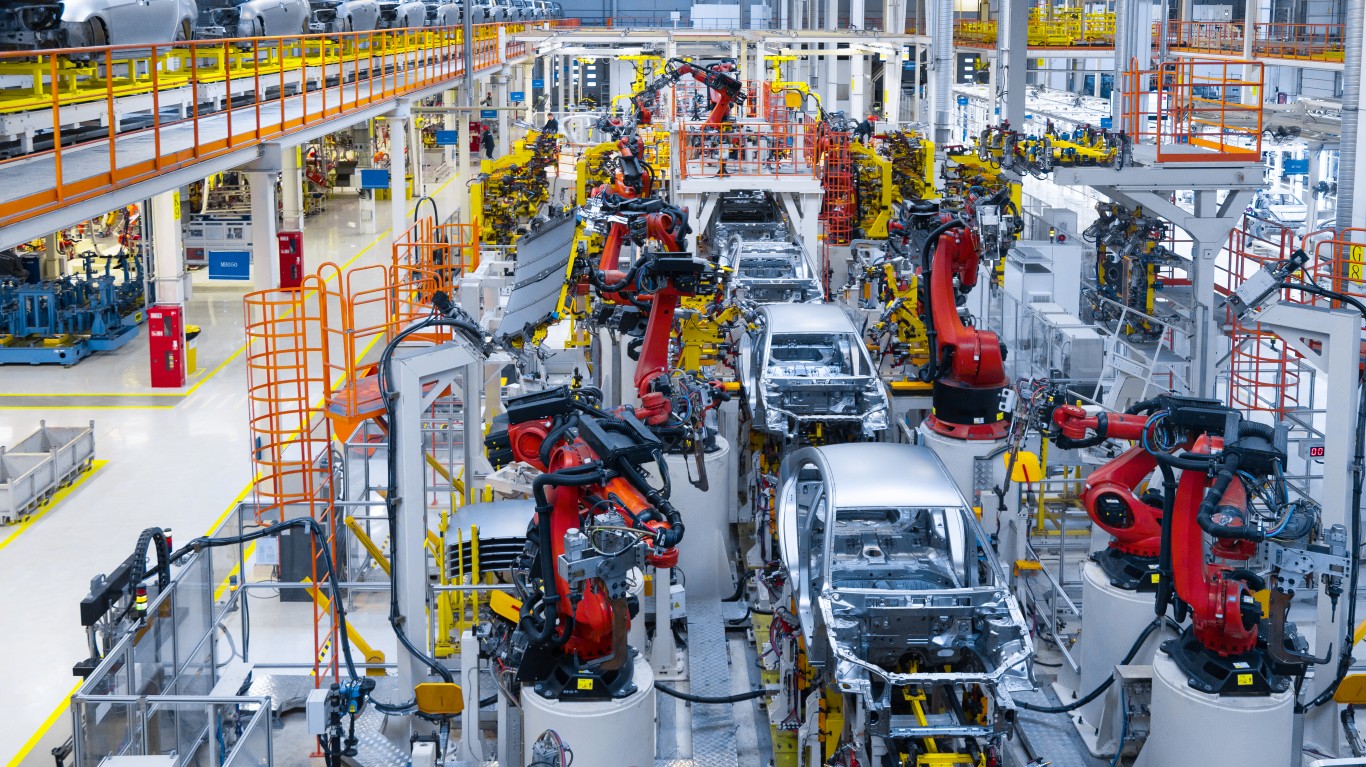
The reshoring trade has moved from political talking point to capital expenditure line item, and the funds that own the picks and shovels of industrial automation have started to reflect it. Three robotics ETFs offer different ways into the theme: Global X Robotics & Artificial Intelligence ETF (NASDAQ:BOTZ), ROBO Global Robotics & Automation Index ETF (NYSEARCA:ROBO), and iShares Robotics and Artificial Intelligence Multisector ETF (NYSEARCA:IRBO).
Each fund maps to a different version of the same overall investment thesis. The Global X Robotics & Artificial Intelligence ETF serves as the concentrated, large-cap pure-play for those seeking direct exposure. The ROBO Global Robotics & Automation Index ETF offers the broadest robotics-focused index in the category for investors who prioritize diversification.
The iShares Robotics and Artificial Intelligence Multisector ETF serves as the cheapest option, stretching the sector definition to include AI and automation names that sit one step removed from the physical factory floor. The performance gap between these three has been wide enough this year to make a real difference in your portfolio results.
Why the reshoring trade keeps showing up in robotics returns
Manufacturing value added reached $3,000.4 billion in the first quarter of 2026, growing about 1% sequentially and holding 9.4% of GDP, according to Bureau of Economic Analysis data. The share has slipped from 10.3% in early 2022, even as the dollar value of factory output has expanded, a sign that manufacturing is growing in absolute terms while the broader economy grows faster.
Behind that line sits roughly $200 billion in announced US factory buildouts tied to the CHIPS Act and the Inflation Reduction Act, including TSMC Arizona, Samsung Texas, Intel Ohio, and Hyundai Georgia. None of these sites can be staffed entirely with human labor at the scale required for material handling, inspection, and assembly, which is the mechanical link between policy dollars and demand for industrial robots.
Goldman Sachs Asset Management frames the backdrop in its 2026 outlook, writing that “tariffs are fundamentally reshaping global trade flows by incentivizing businesses to prioritize supply chain security, leading to a strategic shift towards shorter, more resilient, and reliable networks.” In practice, shorter supply chains run on automation.
BOTZ: the concentrated large-cap entry point
The fund most investors reach for first, BOTZ, the holdings explain why. The top three positions, ABB at roughly 11%, NVIDIA near 10%, and FANUC close to 10%, cover three different layers of the automation stack: power and process automation, the AI compute that lets robots see and decide, and the industrial arm builders themselves. Net assets stand at roughly $3.54 billion, and the portfolio runs 50 positions, making it the most liquid pure-play option.
Concentration is the obvious trade-off here. With Japanese names like KEYENCE, DAIFUKU, SMC, and YASKAWA alongside the top three, more than 40% of the fund is allocated to non-US issuers. A weak quarter at FANUC or ABB pulls the entire ETF lower in a way a broader index would absorb.
Returns reflect the lopsided exposure. BOTZ is up roughly 2% year-to-date and about 14% over the trailing year, trailing the S&P 500’s roughly 9% YTD gain. The fund delivers the cleanest exposure to industrial robotics, and pays for that purity when the heavyweights lag.
ROBO: broader diversification at a higher cost
This fund holds 86 equity positions, with the largest single-stock weight kept near 2% to effectively invert the concentrated structure found in its peers. The portfolio spans a wide array of companies, including Rockwell Automation, Teradyne, Emerson Electric, and Cognex, as well as logistics-adjacent names such as GXO Logistics and Daifuku. Net assets for this diversified vehicle currently sit at $1.77 billion.
The broader sweep has paid off recently. ROBO has returned about 20% year to date and roughly 40% over the trailing twelve months, outpacing both BOTZ and the S&P 500. Part of that comes from owning the warehouse and material-handling names that benefit when factories relocate, since reshored production rewires logistics networks alongside the production lines themselves.
The cost line is the catch. ROBO carries an expense ratio of 0.95%, the highest of the three, and a beta of 1.40, meaning roughly 40% more volatility than the broad market. The breadth helps in upcycles and amplifies drawdowns in down years.
IRBO: the cheapest way to own the wider automation thesis
This fund is the group’s contrarian choice because it does not insist on robotic purity. By pulling in AI software, semiconductor design, and enterprise names alongside traditional industrial robot makers, it broadens the investment thesis to include the digital layer running on top of the factory floor. The expense ratio is 0.47%, which is the lowest of the three, while total net assets currently hover at $788.1 million.
The looser definition has produced the strongest numbers in this group. IRBO has returned nearly 54% year to date and about 82% over the trailing year. Most of the lift traces back to AI and semiconductor exposure that BOTZ touches only through NVIDIA, and that ROBO touches only obliquely through Cadence and Ambarella. Beta sits at 1.33, in line with the rest of the group.
The trade-off cuts the other way from BOTZ. An investor buying IRBO for the reshoring story is also buying a meaningful slice of pure AI exposure, which can drive the fund higher or lower for reasons unrelated to factory automation.
How the three fit together
An investor who wants the cleanest read on industrial robotics demand would lean toward BOTZ, accepting that the fund will move with a small number of large names. ROBO suits an investor who wants the deepest bench of robotics companies and is willing to pay 0.95% a year for the diversification. IRBO appeals to a cost-sensitive investor comfortable with AI exposure layered atop the automation theme.
One sample three-way allocation cited in the research notes splits the exposure as 40% BOTZ, 35% IRBO, and 25% ROBO, combining the large-cap concentration of BOTZ with the lower cost base of IRBO and the diversification of ROBO. A purer robotics tilt would lean 60% BOTZ and 40% ROBO, while a cost-conscious version would invert toward 50% IRBO, 30% BOTZ, and 20% ROBO. The right mix depends less on which fund is best and more on how literally an investor takes the word “robotics”.
Contact [email protected] for any questions or corrections.
David Beren has been a Flywheel Publishing contributor since 2022. Writing for 24/7 Wall St. since 2023, David loves to write about topics of all shapes and sizes. As a technology expert, David focuses heavily on consumer electronics brands, automobiles, and general technology. He has previously written for LifeWire, formerly About.com. As a part-time freelance writer, David’s “day job” has been working on and leading social media for multiple Fortune 100 brands. David loves the flexibility of this field and its ability to reach customers exactly where they like to spend their time. Additionally, David previously published his own blog, TmoNews.com, which reached 3 million readers in its first year. In addition to freelance and social media work, David loves to spend time with his family and children and relive the glory days of video game consoles by playing any retro game console he can get his hands on.