VEU Quietly Outperformed ACWX in Every Time Period and Nobody Noticed
For investors building their first international allocation, the choice often narrows to two funds that look like twins on the surface: iShares MSCI ACWI ex U.S. ETF (NASDAQ:ACWX) and Vanguard FTSE All-World ex-US Index Fund ETF (NYSEARCA:VEU). Both promise the…


For investors building their first international allocation, the choice often narrows to two funds that look like twins on the surface: iShares MSCI ACWI ex U.S. ETF (NASDAQ:ACWX) and Vanguard FTSE All-World ex-US Index Fund ETF (NYSEARCA:VEU). Both promise the entire investable world minus the United States. Yet they ride on different index families, classify South Korea differently, charge wildly different fees, and have produced a measurable performance gap that compounds over time.
What each fund is actually betting on
ACWX tracks the MSCI ACWI ex USA Index, which captures only large- and mid-capitalization non-U.S. equities. MSCI also classifies South Korea as an emerging market, which tilts the fund’s emerging-markets weight higher.
VEU tracks the FTSE All-World ex US Index, covering stocks of companies located in developed and emerging markets outside of the United States. FTSE classifies South Korea as developed and FTSE’s All-World series reaches further down the cap spectrum, giving VEU thousands more names and a structural small-cap kicker that ACWX simply does not carry.
The implicit bets: ACWX is a cleaner pure-play on emerging Asia through its Korea classification. VEU is a broader, deeper slice of the global market that wins when small caps and Korean developed-market mechanics work in its favor.
Where the difference shows up
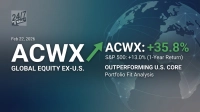
Over the past year, VEU returned 33.39% against ACWX’s 32.76%. Stretch the window and the gap widens: 54.80% for VEU versus 52.28% for ACWX over five years, and 159.73% versus 150.28% over ten. The cost differential alone explains a meaningful slice of that drift.
The practical comparison
| Factor | ACWX | VEU |
|---|---|---|
| Expense ratio | 0.32% | 0.04% |
| AUM | Not disclosed | $52.076B |
| Yield | Not disclosed | 2.81% |
| Distributions | Semi-annual | Quarterly |
| Korea classification | Emerging | Developed |
| Cap coverage | Large/mid | Large/mid/small |
| Inception | March 26, 2008 | March 2, 2007 |
VEU’s quarterly cadence smooths reinvestment for income-focused investors. ACWX’s June and December schedule, with a December 2025 distribution of $1.048761, lumps income into two payments.
The verdict
VEU is the cleaner vehicle for the vast majority of investors making a core ex-U.S. allocation. It costs eight times less, includes small caps, pays quarterly, and has quietly outperformed across every multi-year window in the data above. ACWX earns its place only for an investor who specifically wants South Korea categorized as emerging or who needs MSCI-indexed exposure to dovetail with an MSCI-tracking U.S. sleeve. Absent that, the fee gap and breadth advantage point one direction.
Contact [email protected] for any questions or corrections.
I am a long time investor and student of business, and believe finding good companies that can become great investments is the best game on earth. After 20 years of writing and researching the public markets it is clear that individuals have never had more tools and information to take control of their financial lives. From ETFs and $0 commissions to cryptos and prediction markets there has never been a greater democratization of access to investing.
I write to help people understand the investments available to them so they can make the best choice for their portfolio, whether they're starting out or looking for income in retirement.