Costco or Sprouts: Which Is the Better Short Bet Right Now?
Costco (NASDAQ: COST | COST Price Prediction) and Sprouts Farmers Market (NASDAQ: SFM) both look vulnerable for very different reasons. Costco is firing on all cylinders yet trades at a valuation that leaves no room for slippage. Sprouts is hitting…

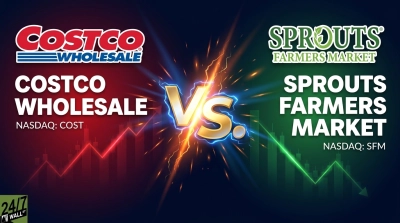
Costco (NASDAQ: COST | COST Price Prediction) and Sprouts Farmers Market (NASDAQ: SFM) both look vulnerable for very different reasons. Costco is firing on all cylinders yet trades at a valuation that leaves no room for slippage. Sprouts is hitting the wall on comps while still expanding aggressively. The question for short sellers is which crack widens first.
One Posts Picture-Perfect Numbers, the Other Hits a Wall
Costco’s Q2 FY2026 was clean. Revenue landed at $69.60 billion, comparable sales rose 7.4%, and membership fee income climbed 13.6% on 82.1 million paid members with an 89.7% worldwide renewal rate. Digitally-enabled comp sales jumped 22.6%. The flywheel works.
Sprouts is the opposite story. Q1 FY2026 comparable store sales came in at −1.7%, after running +10.2% only three quarters earlier. Net income fell 9.06%, and EBIT margin compressed 90 basis points to 9.2%. Capital spending surged 70.06% while operating cash flow dropped 21.33%. That’s the textbook setup for overexpansion risk.
Why Each Bear Case Has Teeth
| Lens | Costco | Sprouts |
| Trailing P/E | 56 | 17 |
| Forward P/E | 52 | 15 |
| Comp sales trend | Accelerating | Decelerating |
| YTD price | +24.6% | +11.0% |
Costco carries a tech-like multiple on a business with a 2.99% profit margin. A PEG ratio of 5.1 says investors are paying a steep premium for predictable growth. The Polymarket binary on the prior earnings report resolved “Down,” and a Reddit thread titled “weird piling into COST and CRWD” captured the overbought worry.

Sprouts looks cheaper, but insider selling is alarming. CEO Jack Sinclair sold 77,955 shares in March, including a 57,644-share block on March 16 at $80.82. Nearly every C-suite officer joined him. Management is guiding to −2% to 0% comps for Q2 while still planning 40+ new stores in 2026. Opening units into a shrinking comp base is the definition of stretched.

What Decides Each Trade From Here
For Costco, the next catalyst is any softening in renewal rates or membership growth. Strip out the $1.355 billion membership fee income and the earnings story thins out fast. For Sprouts, watch whether self-distribution of meat actually arrests gross margin compression from 39.4%, and whether the small-box format keeps pulling its weight as prior-year comparisons get tougher.
Why to Short Sprouts Over Costco
Between the two, Sprouts looks like the more vulnerable short candidate. Costco’s valuation is uncomfortable, but it’s a bet against an operator that just printed 9.1% net sales growth and 13.8% net income growth. Shorting strength rarely ends well, even when the multiple looks rich. Sprouts offers negative comps, falling cash flow, a 47.4% one-year drawdown that has not fully repaired, and an executive team unloading stock into rallies. That is a setup where the fundamentals and insider behavior point in the same direction. Costco screens as a name to avoid on the long side. Sprouts screens as the more compelling short setup.
Contact [email protected] for any questions or corrections.
Trey has been an editor and author at 24/7 Wall St. for more than a decade, where he has published thousands of articles analyzing corporate earnings, dividend stocks, short interest, insider buying, private equity, and market trends. His comprehensive coverage spans the full spectrum of financial markets, from blue-chip stalwarts to emerging growth companies.
Beyond 24/7 Wall St., Trey has created and edited financial content for Benzinga and AOL's BloggingStocks, contributing additional hundreds of articles to the investment community.
Trey's editorial expertise extends across multiple publishing environments. He served as production editor at Dearborn Financial Publishing and development editor at Kaplan, where he helped shape financial education materials. Earlier in his career, he worked as a writer-producer at SVE. His freelance editing portfolio includes work for prestigious clients such as Sage Publications, Rand McNally, the Institute for Supply Management, the American Library Association, Eggplant Literary Productions, and Spiegel.
Outside of financial journalism, Trey writes fiction and has been an active member of the writing community for years, moderating workshop sessions at regional conventions.