




The markets were stunned last July when the Trump administration announced it was investing $400 million into rare earths miner MP Materials (NYSE:MP) to bolster domestic rare earth production. A month later came an even bigger surprise: roughly $8.9 billion directed toward Intel (NASDAQ:INTC | INTC Price Prediction | INTC Price Prediction).
The stock market has spent decades operating under a simple assumption that, absent some national calamity such as after the 9-11 attacks or during the financial crisis, governments regulate industries, but private investors allocate capital. During Trump’s second term, that line is rapidly blurring.
Over the past 10 months, the Trump administration has taken direct equity stakes in six publicly traded companies — not during a recession or national emergency, but as a matter of industrial policy.
Now Trump is doing it again, extending the strategy into quantum computing by announcing $2 billion in investments across nine companies and effectively expanding the government’s stock portfolio by 150%. International Business Machines (NYSE:IBM) is emerging as the big quantum computing winner.
IBM Is Becoming the Face of Trump’s Quantum Push
According to a report from The Wall Street Journal, pure-play quantum companies including Rigetti Computing (NASDAQ:RGTI) and D-Wave Quantum (NASDAQ:QBTS) will reportedly receive about $100 million each. Other beneficiaries include GlobalFoundries (NASDAQ:GFS) and Infleqtion (NASDAQ:INFQ), but IBM is getting the lion’s share — reportedly around $1 billion.
This actually makes strategic sense. Unlike many quantum startups generating little revenue, IBM already operates a profitable enterprise business with decades of government and commercial relationships. It generated $67.5 billion in 2025 revenue and $14.7 billion in free cash flow. Its quantum division already operates more than 100 quantum systems through the IBM Quantum Network.
Surprisingly, IBM may be the safest way for taxpayers to fund quantum development. The company has the balance sheet, research infrastructure, and commercial customer base to scale the technology beyond the laboratory stage.
Granted, pure-play quantum stocks may offer more upside if the technology matures rapidly. But they also carry far more risk. Many still produce minimal revenue while burning cash each quarter.
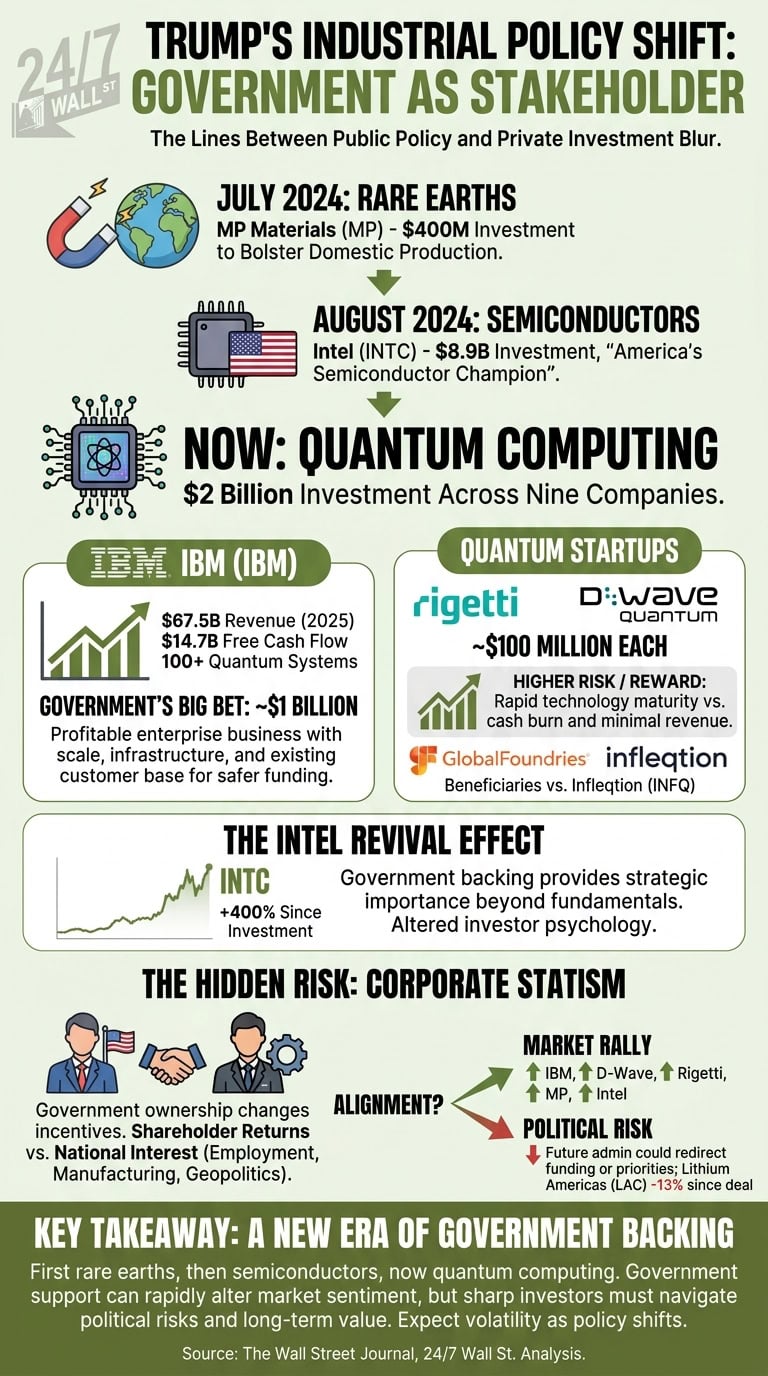
The wall between public policy and private profit has vanished, triggering massive surges in semiconductor and quantum stocks as the government takes a seat at the board table.
Intel Went From Turnaround Story to Government-Backed Revival
The Intel investment changed Wall Street’s perception of the company almost overnight.
Just last year, Intel’s competitors were openly discussing breaking apart pieces of the company. Taiwan Semiconductor Manufacturing (NYSE:TSM) is said to have pitched to Nvidia (NASDAQ:NVDA), Advanced Micro Devices (NASDAQ:AMD), and Broadcom (NASDAQ:AVGO), the idea of a joint venture to buy and operate Intel’s struggling foundry business. Then Washington stepped in.
Trump’s nearly $9 billion investment gave Intel something investors hadn’t assigned much value to before: strategic importance. Suddenly Intel wasn’t merely another chipmaker struggling to catch up in AI. It became America’s semiconductor champion.
Since the announcement of the investment on Aug. 22 last year, Intel stock has rocketed almost 400% higher. The turnaround wasn’t initially driven solely by fundamentals, but rather government backing altering investor psychology.
When all is said and done, markets often care less about what a company is today than what support system stands behind it tomorrow.
The Hidden Risk Investors Shouldn’t Ignore
That said, government ownership changes incentives.
Corporate statism — where business and government interests become intertwined — can distort management decisions. Shareholders want returns. Governments often want employment growth, domestic manufacturing, or geopolitical leverage. Those goals do not always align.
Let’s be clear: investors made money following most of these investment announcements. Intel more than tripled this year while MP Materials has doubled. The quantum stocks rallied hard after the investment news surfaced with D-Wave and Rigetti both rising approximately 30% on announcement day. IBM climbed 8%, likely because the $1 billion doesn’t represent as large of an investment to its business.
But savvy investors should ask a tougher question: what happens when political priorities change?
A future administration could redirect funding, pressure companies into unprofitable projects, or prioritize national interests over shareholder returns. Regardless of how you look at it, once Washington becomes a major stakeholder, politics enters the boardroom.
Key Takeaway
In short, Trump is reshaping how America funds strategic industries. First rare earths. Then semiconductors. Now quantum computing.
IBM may ultimately justify the investment because it already has scale, cash flow, and deep technical expertise. Intel’s revival also shows government backing can rapidly alter market sentiment.
Still, sharp investors shouldn’t mistake political support for guaranteed long-term value. Stocks tied too closely to Washington can benefit quickly — and unravel just as fast when policy shifts. Lithium Americas (NYSE:LAC) is down 13% since its deal was announced.
While the opportunity for a dramatic realignment is real, so is the new layer of risk.
Contact [email protected] for any questions or corrections.















 Top Gaining Stocks
 Top Losing Stocks