Why retirees are banking on SCHD’s 15-year unbroken dividend streak
The Schwab U.S. Dividend Equity ETF (NYSEARCA:SCHD) has built its reputation on paying reliable, growing quarterly distributions to income investors, and the latest data confirms why holders trust the fund. SCHD paid $0.2569 per share on March 30, 2026, continuing…

The Schwab U.S. Dividend Equity ETF (NYSEARCA:SCHD) has built its reputation on paying reliable, growing quarterly distributions to income investors, and the latest data confirms why holders trust the fund. SCHD paid $0.2569 per share on March 30, 2026, continuing an uninterrupted quarterly schedule that stretches back to 2011. For retirees and dividend-growth investors weighing whether SCHD’s payout can withstand the current rate environment, the underlying mechanics of this fund tell a reassuring story.
How SCHD Generates Its Income
SCHD tracks the Dow Jones U.S. Dividend 100 Index, a screen that requires consistent dividend payment history, financial strength, and yield quality. The fund passes through dividends from roughly 100 large-cap U.S. companies, charging an expense ratio of just 6 basis points. With $71.6 billion in net assets as of December 31, 2025, the fund has the scale to keep trading costs minimal and distributions predictable.
The Companies Doing the Heavy Lifting
The top holdings are a roll call of mature cash generators. The biggest position is Bristol-Myers Squibb near 4.3%, followed by Merck, ConocoPhillips, Lockheed Martin, and Chevron all clustered around 4%. These five names dominate the income stream and span pharmaceuticals, energy, and defense, three sectors with very different macro drivers.
Bristol-Myers and Merck both face patent cliff concerns on key drugs, but their dividends are backed by sturdy operating cash flow and disciplined payout ratios well below the levels that typically signal strain. Lockheed Martin’s dividend rests on a multi-year defense backlog, the most predictable revenue stream in the holdings list. ConocoPhillips and Chevron tie the fund’s income to oil prices, and Chevron in particular has raised its dividend for decades through commodity cycles. The remaining top holdings, including Verizon, AbbVie, Cisco, Coca-Cola, and Altria each near 4%, add staples and telecom ballast that historically keep paying through recessions.
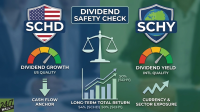
No single position exceeds 4.3% of assets, which means a dividend cut from any one company would shave only basis points off the fund’s total distribution. That structural diversification is the single most important safety feature SCHD offers.
Reading the Recent Distribution Pattern
One data point can confuse holders looking at raw history. SCHD paid $0.6110 in Q1 2024 and $0.8241 in Q2 2024, then normalized to the $0.2488 to $0.2782 range across 2025. The drop reflects a share-count adjustment that left the underlying per-share income intact. On a per-share basis adjusted for that change, the underlying income stream kept growing, consistent with the steady climb from $0.1217 in Q4 2011 to today’s level.
Total Return and Rate Backdrop
Price action has reinforced the income case. SCHD trades at $32, up 25% over the past year and 18% year to date. The 10-year Treasury yield at 4.61% raises the bar for dividend ETFs, but SCHD holders have collected total returns well above that hurdle.
Corporate profits hit a record $4.4 trillion in Q4 2025, up 10% year over year, giving the underlying companies room to keep raising payouts.
Why SCHD’s Payout Looks Durable From Here
SCHD’s distribution is among the safest in the dividend ETF universe. The index methodology screens out fragile payers before they enter the fund, diversification caps single-name risk, and the holdings list reads like a checklist of decades-long dividend payers. Reddit sentiment tracks the fundamentals, with 11 of 12 scored mentions registering bullish between April 21 and May 17, 2026. For income investors weighing single-stock risk against diversified exposure, SCHD’s structure addresses that trade-off directly. The trade-off is yield: those reaching for higher current income through covered-call funds will get more cash today but with NAV erosion that SCHD has avoided.
Contact [email protected] for any questions or corrections.
I am a long time investor and student of business, and believe finding good companies that can become great investments is the best game on earth. After 20 years of writing and researching the public markets it is clear that individuals have never had more tools and information to take control of their financial lives. From ETFs and $0 commissions to cryptos and prediction markets there has never been a greater democratization of access to investing.
I write to help people understand the investments available to them so they can make the best choice for their portfolio, whether they're starting out or looking for income in retirement.