The 10-Year Treasury Signal That Could End SCHD’s 2026 Rally
The Schwab U.S. Dividend Equity ETF (NYSEARCA:SCHD) has quietly become one of 2026’s best stories in income investing. SCHD is up roughly 19% year to date and about 26% over the past year, blowing past the S&P 500’s 6.9% YTD…


The Schwab U.S. Dividend Equity ETF (NYSEARCA:SCHD) has quietly become one of 2026’s best stories in income investing. SCHD is up roughly 19% year to date and about 26% over the past year, blowing past the S&P 500’s 6.9% YTD gain as investors rotate from richly valued growth names into defensive cash flow. With $71.6 billion in net assets and a roster of mature dividend payers, SCHD sits at an interesting crossroads heading into the second half of 2026.
The fund holds a concentrated book of roughly 100 names, with the top 10 representing about 40% of assets in a tight band between roughly 4.0% and 4.3%. Heavyweights include Bristol-Myers Squibb, Merck, ConocoPhillips, Lockheed Martin, Chevron, Verizon, AbbVie, Cisco, Coca-Cola, and Altria. That is a portfolio built for cash generation, which is why the macro setup matters so much right now.
The Macro Factor That Matters Most: The 10-Year Treasury Yield
The single most important variable for SCHD over the next 12 months is the 10-year Treasury yield. It sits at about 4.4%, down from a 12-month high of 4.7% reached in mid-May but still in the 79th percentile of the past year’s range. Every basis point matters here: when investors can collect 4.4% in a risk-free Treasury, the bar for owning equity income rises sharply, and SCHD’s distribution yield loses some of its relative appeal.
Watch the FRED DGS10 series weekly, and pay closest attention around the Fed’s scheduled meetings and the monthly CPI and BLS jobs reports. The Fed funds rate has held at 3.75% since December’s cut, but Core PCE keeps creeping higher, with the May reading at 130.08, the highest in the 12-month series. If the 10-year breaks back above 4.75% on a sticky inflation print, SCHD’s recent leadership over the S&P 500 is the first thing that historically fades. The 2022 episode is the template: rising long yields hit dividend equities harder than the broader index because the duration of their cash flows looks more bond-like.
The Fund-Specific Factor: The March Reconstitution and Dividend Pattern
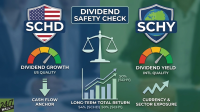
SCHD tracks the Dow Jones U.S. Dividend 100 Index, which reconstitutes once a year in March. That single event reshuffles sector weights and can swap out a tenth of the portfolio. The next signal to monitor is the dividend trajectory itself, because it tells you whether the underlying basket is still earning what it pays. Q2 2026 came in at $0.253 per share, slightly below the $0.26 paid in Q2 2025, and Q1 2026 of $0.26 also came in below the prior-year quarter.
That softness is the signal. SCHD’s reputation rests on dividend growth, and two consecutive quarters of year-over-year declines deserve scrutiny. Track the quarterly distribution announcements (Schwab publishes them roughly a week before each ex-date) and the post-reconstitution holdings file on Schwab’s fact sheet page. If the next two quarterly payouts continue to print below 2025 comparables, the dividend growth narrative that has anchored SCHD inflows will need a fresh defense, especially with energy names like ConocoPhillips and Chevron sitting near the top of the book.
What To Watch Next
The two signals that matter: a 10-year Treasury yield sustained above 4.75% would pressure SCHD’s valuation premium, and the Q3 2026 distribution announcement (expected in September) will reveal whether dividend growth has truly stalled or simply hit a timing quirk inside the March reconstitution.
Contact [email protected] for any questions or corrections.
Marc Guberti is a personal finance writer who has written for US News & World Report, Business Insider, Newsweek and other publications. He also hosts the Breakthrough Success Podcast which teaches listeners how to use content marketing to grow their businesses.