





On a recent All-In Podcast episode featuring guest Gavin Baker, the roundtable looked at the exact same economic data and came away with completely different investment outlooks. David Friedberg is highly focused on building a global bond crisis and a sovereign debt spiral. Gavin Baker is far more bullish, arguing that America’s energy independence and massive technological lead mean it is winning the most critical race in history. Meanwhile, Chamath Palihapitiya lands somewhere in the middle, preferring to narrow his portfolio down to a few high-conviction names. As you position your own capital for the back half of 2026, understanding this core framework matters a lot more than rooting for any single verdict.
Friedberg’s debt spiral
Friedberg’s bear case starts with a single number. “Global debt to GDP is 310%. Reserve currency status to the side. The spending problem at the federal, state, local level, the spending problem in every country… ultimately breaks.” He points to the long end of the curve as evidence that bond markets are pricing the problem, citing the 30-year Treasury at 5.2% and flagging a potential unwind of the Japanese carry trade as a possible catalyst.
The hard economic data completely backs up the concern, as the 30-year Treasury closed at a steep 5.11% on May 21, 2026, sitting right at the very top of its trailing 12-month range as the bond market grapples with expanding debt supply. Meanwhile, the 10-year yield has climbed to 4.58%, cementing a notable monthly surge that is driving up borrowing costs across the economy. At the same time, the spread between 2-year and 10-year yields has flattened out significantly near the bottom of its yearly range. Long-rate stress is becoming a major reality for investors, even if traditional recession signals are not flashing red just yet.
Baker’s American century
Baker’s pushback is the most aggressive of the three. “Three things can be true,” he argues, including the idea that rates can be concerning while AI remains unprecedented. He runs over 100 positions with a 30-person team, leans into America’s energy self-sufficiency, and points to a valuation comparison that matters for anyone underweight the AI complex: Cisco traded at 100x forward earnings during the tech bubble, while NVIDIA trades at a low to mid-teens multiple of real earnings.
NVIDIA: the proof point
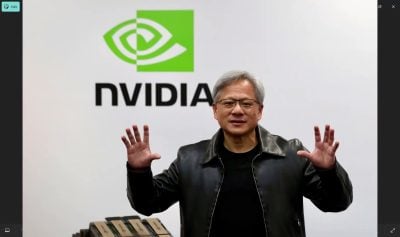
NVIDIA (NASDAQ:NVDA | NVDA Price Prediction) just delivered a monster quarter that adds a ton of weight to Baker’s bullish view, as Q1 FY2027 revenue hit $81.61 billion, up 85% year over year, with data centers alone bringing in $75.25 billion of that total. Non-GAAP EPS landed at $1.87, free cash flow hit $48.55 billion, and management guided Q2 to $91.0 billion while completely excluding Chinese data center compute sales. The board also layered a new $80 billion buyback program right on top of the $38.5 billion they already had remaining.
The stock trades at a trailing P/E of 33 and a forward P/E of 21, with shares remaining up significantly. CEO Jensen Huang frames the cycle perfectly, calling it the largest infrastructure expansion in human history.
Microsoft and Alphabet: financing the buildout
The big question the bears are asking is whether tech buyers can actually sustain this wild level of spending. Microsoft (NASDAQ:MSFT) just posted Q3 FY2026 revenue of $82.89 billion, powered by a stellar 40% growth rate in Azure. Their AI run rate hit $37 billion, marking a 123% jump year over year, while their commercial RPO reached a massive $627 billion. Still, the fact that capital expenditures hit $30.88 billion in a single quarter has investors on edge. Shares trade at a reasonable P/E of 24 and are down 13% year to date, which tells you the market is definitely pricing in some serious capex anxiety.
Alphabet (NASDAQ:GOOGL) serves as an even more interesting test for the market. In Q1 2026, their revenue grew 22%, Google Cloud expanded by 63%, and their cloud backlog nearly doubled quarter over quarter to top $460 billion. Management actually bumped up their 2026 capex guidance to a range of $180 to $190 billion, and they covered a portion of the bill by issuing $31.1 billion in senior unsecured notes. With shares up 22% year to date and 125% over the past year, Wall Street is clearly betting that Alphabet’s core cash engine has plenty of power to absorb the cost.
What the framework tells investors
Chamath’s middle path might actually be the most usable strategy for everyday investors. He openly concedes that serious economic signals are flashing while running an extremely concentrated portfolio of five or fewer names. This approach offers a smart, practical synthesis because rates sitting at the 98th percentile force portfolio discipline, booming AI economics force market participation, and heavy concentration in cash-generative leaders beautifully threads the needle. Polymarket traders currently have NVIDIA clustering around a comfortable $190 to $210 support level through late May, which perfectly matches where the company’s strong underlying fundamentals say the stock should sit. Watching that 30-year Treasury yield line is the ultimate tell.
Contact [email protected] for any questions or corrections.













 Top Gaining Stocks
 Top Losing Stocks