Despite Hitting a $1 Trillion Valuation, Micron Remains My Favorite Stock for 2026
For years, investors treated memory-chip companies like airlines or steelmakers — cyclical businesses that boomed when supply tightened and collapsed when too many competitors flooded the market with inventory. That’s why what’s happening with Micron Technology (NASDAQ:MU | MU Price…

For years, investors treated memory-chip companies like airlines or steelmakers — cyclical businesses that boomed when supply tightened and collapsed when too many competitors flooded the market with inventory. That’s why what’s happening with Micron Technology (NASDAQ:MU | MU Price Prediction) today feels so different.
The company just crossed a $1 trillion valuation after a blistering rally, yet the underlying story may still be in its early innings. The AI boom has created an insatiable appetite for memory, and unlike previous semiconductor cycles, supply still can’t keep up. That imbalance is exactly why Micron remains my favorite stock heading into 2026.
AI Isn’t Just Driving GPU Demand Anymore
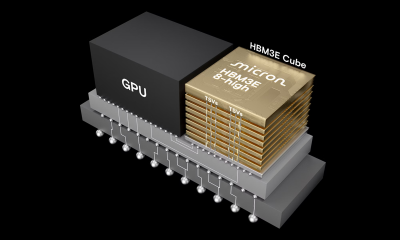
Most investors associate artificial intelligence with Nvidia (NASDAQ:NVDA) and its GPUs. Fair enough — Nvidia remains the face of the AI infrastructure buildout. But GPUs are only part of the equation. AI systems also require enormous amounts of high-bandwidth memory (HBM) to process data fast enough for large language models and advanced reasoning systems.
That’s where Micron’s expertise comes in. HBM has quietly become one of the most constrained parts of the semiconductor supply chain. Micron management recently disclosed that its entire HBM capacity for 2026 is already sold out. Not partially reserved — sold out.
That matters because hyperscalers continue spending at staggering levels:
| Company | 2026 Capex | AI/Data Center Spending Plans |
| Meta Platforms (NASDAQ:META) | Up to $145 billion | Internal AI infrastructure, possible new cloud computing business |
| Microsoft (NASDAQ:MSFT) | Up to $190 billion | Azure and OpenAI infrastructure |
| Amazon (NASDAQ:AMZN) | Up to $200 billion | Aggressive AI infrastructure expansion |
| Alphabet (NASDAQ:GOOG) | Up to $190 billion | Expanding TPU and AI cloud capacity |
Every new AI server requires advanced memory. And unlike CPUs, memory must constantly scale upward as AI models become larger and more sophisticated. AI isn’t running out of demand. It’s running out of memory.
The Numbers Behind Micron’s Momentum
Micron’s latest rally wasn’t fueled by meme-stock speculation or retail frenzy. Investors are responding to a business whose earnings power has changed dramatically over the past 18 months.
During prior memory cycles, pricing usually collapsed because suppliers added too much production capacity. This time looks different because AI demand is growing faster than new fabs can be built.
Here’s what sharp investors should focus on:
- HBM products carry higher margins than traditional DRAM
- AI server memory content is multiple times higher than standard servers
- Micron’s pricing power has improved significantly as supply tightened
- Data center demand continues expanding globally
Surprisingly, Micron may actually have more visibility into future revenue than many software companies right now because customers are locking in supply agreements well ahead of deployment. That changes the valuation discussion.
Granted, a $1 trillion market cap sounds expensive. But valuation alone tells investors very little unless it’s paired with future earnings potential. Wall Street forecasts Micron will grow earnings at 121% annually for the next five years. While the stocks trades at 43 times trailing earnings (and less than 9 times estimates), its PEG ratio is a microscopic 0.07. Today’s valuation looks far less aggressive in that light.
Why I Still Think Micron Still Wins in 2026
No stock rises forever in a straight line. Micron remains vulnerable to cyclical downturns, competitive pressure from Samsung Electronics and SK hynix, and the possibility that AI spending eventually cools.
That said, the broader setup still favors Micron. The company sits at the center of one of the largest infrastructure expansions the technology sector has ever seen. Governments, cloud providers, and enterprises are all racing to build AI capacity at the same time. Memory is no longer a commodity add-on — it’s mission-critical infrastructure.
In short, Micron doesn’t look like a late-cycle speculative trade to me. It looks like a company benefiting from a structural technology shift that could last the rest of the decade. Regardless of how high the stock has already climbed, demand trends, constrained supply, and rising profitability still point higher for 2026.
Contact [email protected] for any questions or corrections.
After two decades of patrolling the dark corners of suburbia as a police officer, Rich Duprey hung up his badge and gun to begin writing full time about stocks and investing. For the past 20 years, he’s been cruising the markets looking for companies to lock up as long-term holdings in a portfolio while writing extensively on the broad sectors of consumer goods, technology, and industrials. Because his experience isn’t from the typical financial analyst track, Rich is able to break down complex topics into understandable and useful action points for the average investor. His writings have appeared on The Motley Fool, InvestorPlace, Yahoo! Finance, Money Morning, and, of course, 24/7 Wall St. He has been featured in both U.S. and international publications, including MarketWatch, Financial Times, Forbes, Fast Company, and USA Today.