




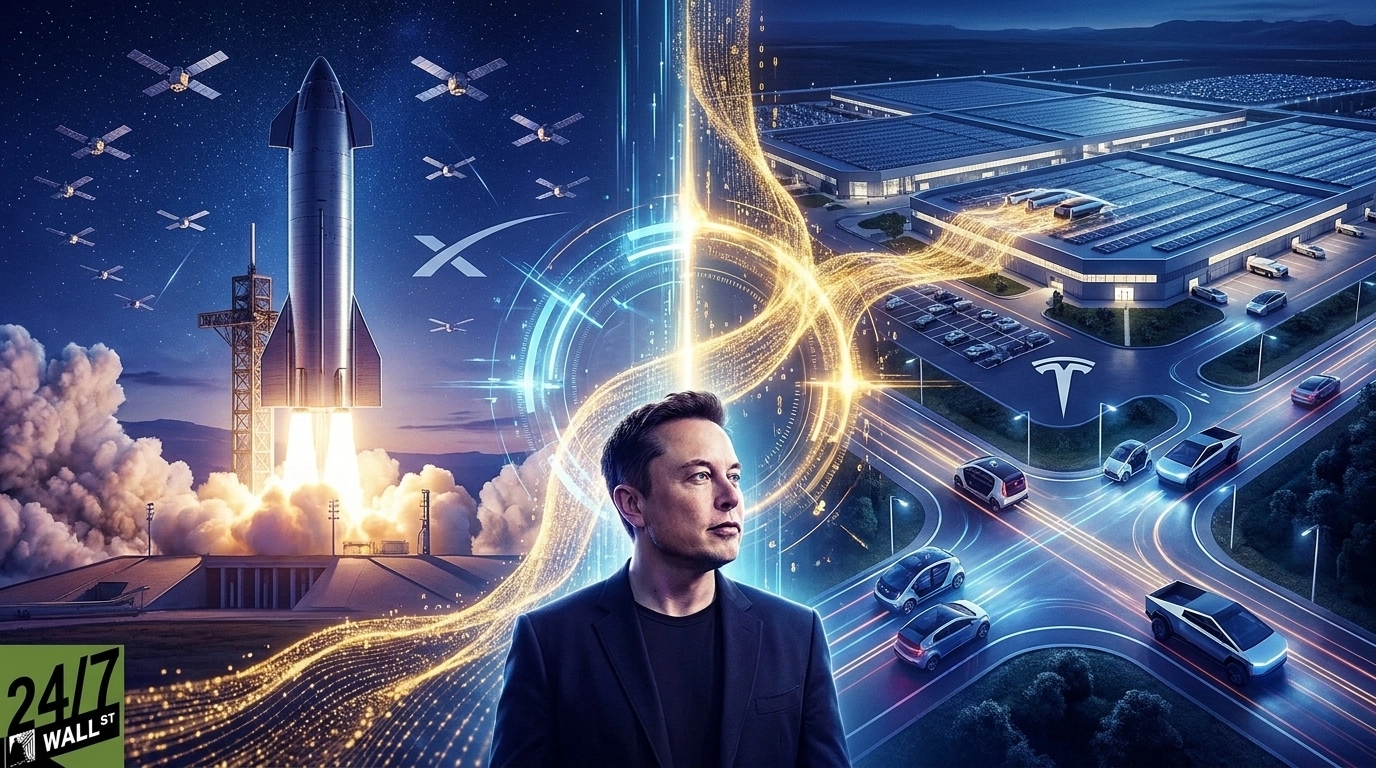
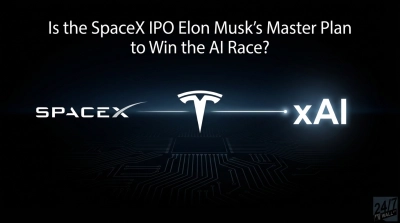
Elon Musk is talking openly about merging Tesla (NASDAQ:TSLA | TSLA Price Prediction) and SpaceX, and he is doing it at a strange and convenient moment. SpaceX filed its S-1 on May 20, 2026, targeting a $1.75 trillion valuation, which would be the largest IPO in human history. Tesla, the publicly traded half of the Musk universe, sits at $441.72 with a market cap of roughly $1.66 trillion. Stitch the two together and you get a single entity worth about $3.4 trillion, run by a man who would then, plausibly, become the first trillionaire on the planet.
What Musk is proposing
Musk has spent 2026 consolidating. xAI was folded into SpaceX. SolarCity was folded into Tesla years earlier, and the operational entanglement between Tesla and SpaceX is now hard to ignore. Tesla’s Q1 2026 filing disclosed a $2 billion equity investment in SpaceX, and the two companies are jointly building a semiconductor research fab at the Gigafactory Texas campus. Musk has separately announced a “Terafab” plant in Austin targeting one terawatt of computing capacity per year, the kind of infrastructure that only makes sense if you assume Tesla’s autonomy stack and SpaceX’s satellite compute ambitions share a roadmap.
So when Musk floats a merger, he is describing something that already half-exists in the plumbing. The question is whether shareholders get to vote on formalizing it, and on what terms. Polymarket bettors put the odds of a merger announcement by June 30 at 4.6%, but by May 1, 2027 at 52%. That second number has been going up.
The math behind a $3.4 trillion empire
SpaceX’s S-1 is the document worth reading closely. The company generated $18.7 billion in 2025 revenue, of which Starlink contributed $11.4 billion, or 61%. Starlink subscribers reached 10.3 million by the end of Q1 2026, up from 5.0 million a year earlier, with the Connectivity segment posting $1.19 billion in Q1 segment operating income. Twenty-three banks are underwriting the IPO, led by Goldman Sachs (NYSE:GS).
Tesla’s own quarter, by comparison, was a turn upward after a soft 2025. Q1 2026 revenue came in at $22.39 billion, up 15.78% year over year, with automotive gross margin expanding to 21.1% from 16.2% and FSD subscriptions hitting 1.28 million.
The full Q1 8-K is here. Tesla has also begun Cybercab production at a sub-$30,000 price point and is discontinuing the Model S and Model X to free capacity for Optimus robots. The combined entity, then, would be a robotaxi-and-rocket conglomerate with a humanoid-robot side bet and a vertically integrated chip fab. Sum the valuations and you land near $3.4 trillion.
How dual-class voting changes everything
Most coverage glosses over the governance mechanics. SpaceX is going public as a controlled company. Per the S-1, Class B shares carry ten votes each, Class A shares one, and Class B holders, voting separately, elect 51% of the board.
Musk holds 42% equity but 85% voting power at SpaceX. In any merger structured as SpaceX acquiring Tesla, public Tesla holders would convert into Class A stock with a fraction of the governance they have today. Tesla currently runs on a one-share-one-vote structure, with institutional ownership at 44.9% mattering at the ballot box.
What this means for Tesla shareholders
The bull case is straightforward. Tesla holders would own a slice of Starlink’s cash flow, SpaceX’s launch monopoly, and xAI’s Grok platform, alongside the existing auto and energy businesses. The bear case is governance dilution and a forward P/E that already sits at 215x, and 175x 2027 earnings.
Analyst consensus on Tesla alone is a $411.89 target, below the current price. The Tesla IR page has not addressed merger mechanics. Watch the SpaceX roadshow, the proxy language, and whether any combination is structured as a true merger or an asset swap. The vote, if it ever comes, will be the most consequential one Tesla shareholders have cast.







 Top Gaining Stocks
 Top Losing Stocks