Why Canada’s Warren Buffett Has Doubled and Tripled Down on This Struggling Apparel and Footwear Giant
When a value investor often called Canada’s Warren Buffett starts buying a beaten-down American brand in structured, multi-million-share blocks, retail investors should at least look at the ticker. Stocks trading under $10 are usually there for a reason, sometimes broken…


When a value investor often called Canada’s Warren Buffett starts buying a beaten-down American brand in structured, multi-million-share blocks, retail investors should at least look at the ticker. Stocks trading under $10 are usually there for a reason, sometimes broken business models, sometimes broken sentiment, and occasionally a turnaround story the market has not yet priced. Right now, one of the most aggressive accumulations on Wall Street is happening in an athletic apparel name whose shares have been under sustained pressure.
With that in mind, here is one stock trading under $10 where a legendary deep-value investor has doubled and tripled down, and where the fundamentals suggest a potential inflection ahead.
Under Armour (NYSE: UAA)
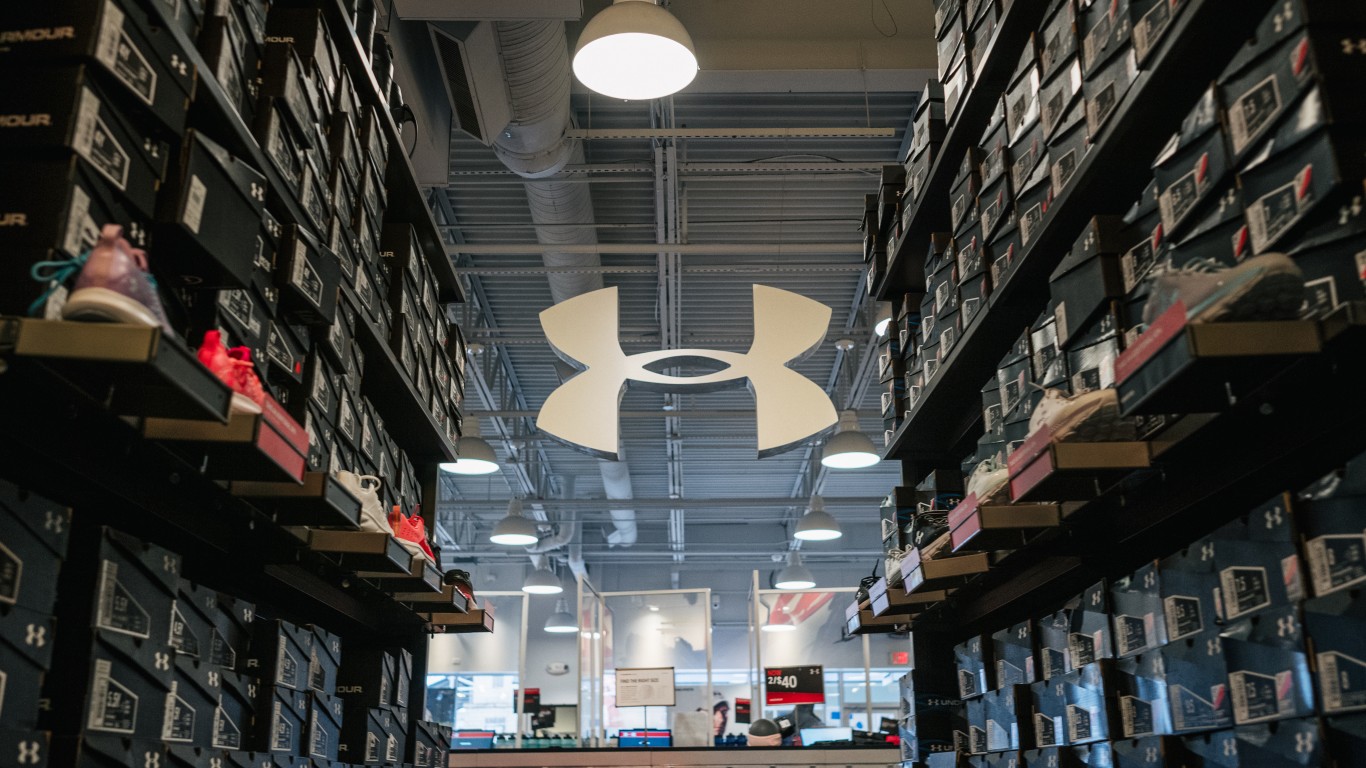
Under Armour (NYSE:UAA | UAA Price Prediction) is the Baltimore-based performance athletic brand that designs apparel, footwear, and accessories sold through wholesale partners and its own Brand House and Factory House stores. Shares closed at $5.78 on May 27, 2026, well within reach for retail investors and a fraction of the $8.15 52-week high. The market cap sits near $1.09 billion, a striking compression for a global apparel giant that generated $4.97 billion in trailing revenue.
The fundamentals tell a turnaround story still in motion. Q4 fiscal 2026 revenue came in at $1.17 billion, narrowly beating consensus, with an adjusted diluted loss per share of $0.03, marking a 4th consecutive quarter of beating expectations. International is doing the heavy lifting: EMEA grew 7.1%, Asia Pacific 12.7%, and Latin America 22.4%. Wall Street’s consensus price target sits at $6.28, with 5 Buy ratings against 18 Hold and 3 Sell calls, leaving modest upside on consensus but meaningful room if management hits its FY27 guide.
The bull case rests on Prem Watsa’s Fairfax Financial conviction. Likened to the Warren Buffett of Canada, Watsa has accumulated UAA in massive, structured blocks over the last few quarters, capped off by open-market insider buying. The footprint is concrete: on May 12, 2026, Fairfax disclosed an acquisition of 438,723 Class A shares at $4.9934, followed the next day by 739,521 shares at $4.9733. Management is guiding to its first positive adjusted EPS in the reset cycle of $0.08 to $0.12, with gross margin expansion of 220 to 270 basis points. CEO Kevin Plank framed the moment plainly: “We do believe the inflection point is upon us in fiscal ’27.”
The risks are real and worth respecting. North America, still the largest region, declined 7% in Q4, and the full fiscal year produced a net loss of $495.6 million that included a $247 million valuation allowance on U.S. deferred tax assets, a signal management itself sees limited near-term domestic profitability. Cash fell 38.33% year over year to $309 million, the company has $200 million drawn on its revolver, and the restructuring plan has been extended to $305 million in total costs. A forward earnings multiple of 52x on thin FY27 EPS leaves little margin for error.
For investors comfortable with execution risk, UAA offers a rare setup: a sub-$10 consumer brand where a disciplined value investor is buying at scale, international momentum is real, and management has set a credible bar for FY27. The thesis is patience, with Watsa’s accumulation acting as the anchor signal.
A real thesis requires more than a low share price or a famous name on a 13D filing. Under Armour still has to prove that its product engine, marketing pivot, and international growth can offset North American softness and a heavy debt load. Readers should treat this as a starting point for diligence, dig into the filings, weigh the restructuring timeline, and decide whether the risk profile matches their own portfolio goals before acting.
Contact [email protected] for any questions or corrections.
Alex Sirois is a financial writer with experience spanning both retail and institutional investing. He has written for InvestorPlace and held roles at BNY Mellon and Bernstein, giving him a perspective that bridges Main Street portfolios and Wall Street analysis.
Alex holds an MBA from George Washington University and has built his career across multiple industries, including e-commerce, education, and translation — a breadth of experience that informs how he breaks down complex financial topics for everyday investors. His writing is conversational, actionable, and grounded in long-term, buy-and-hold investing principles.
At 247 Wall St., Alex focuses on delivering analysis that is both accessible and useful, with a clear emphasis on helping readers make more informed decisions with their money.