After Caesars Deal, These 4 Struggling Companies Look Ripe for Acquisition
The Caesars deal just put a clock on the rest of corporate America. On May 28, 2026, Caesars Entertainment (NASDAQ: CZR | CZR Price Prediction) announced a definitive agreement to be acquired by Fertitta Entertainment in an all-cash transaction valued…


The Caesars deal just put a clock on the rest of corporate America. On May 28, 2026, Caesars Entertainment (NASDAQ: CZR | CZR Price Prediction) announced a definitive agreement to be acquired by Fertitta Entertainment in an all-cash transaction valued at approximately $17.6 billion, including the assumption of approximately $11.9 billion of Caesars’ outstanding debt. Shareholders take home $31.00 per share in cash, a 49% premium to the unaffected share price as of February 25, 2026, with no financing condition and a go-shop period running through July 11, 2026.
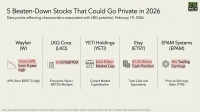
That premium signals opportunity. With credit markets open and sponsors holding dry powder, beaten-down public companies with clean cash flows, recognizable brands, or busted balance sheets are in scope. We screened four cross-sector names that match the take-private profile and ranked them from least likely to most likely to be acquired next.
4. Etsy
Etsy (NASDAQ: ETSY) carries the largest market cap on this list at $6.4 billion, which is the primary reason it ranks last. Marketplace network effects are notoriously hard to leverage in a leveraged buyout (LBO), and Etsy’s stock has already rallied 28.2% over the past year and 22.5% year to date to $67.92, narrowing the gap to the $72.28 analyst target.
Q1 2026 revenue of $631 million beat the $617.31 million estimate, with net income swinging to a profit year over year and marketplace GMS growing 5.5%. Insider activity argues against an imminent deal: 100% of the past 30 days of insider transactions were sales, including a 20,000-share director disposal on May 22 at $60.92 to $62.64. Sponsors do not typically pursue companies where insiders are heading for the exits.


3. Under Armour
Under Armour (NYSE: UAA) trades at $5.87, down 74% over five years. Founder Kevin Plank is back as CEO with a brand reset and a $305 million restructuring plan. Plank told investors, “Our fiscal 2026 performance reflects the ongoing intentional steps we’re taking to reset the business and restore the discipline required to operate as a best-in-class brand.”
The share register is the real signal. Prem Watsa’s group accumulated 1,178,344 Class A shares over three days in mid-May at roughly $5.00, the largest accumulation in the dataset. Forward EPS guidance of $0.08 to $0.12 is thin, but the asset (brand, North American footprint, international momentum at +10%) is cheap at 0.819x EV/revenue. Plank’s Class C share structure complicates a hostile bid, which is precisely what makes a friendly, founder-led take-private feasible.


2. Xerox
Xerox (NASDAQ: XRX) is the most beaten-down name on this list, with a market cap of just $423.7 million and a stock down 86.2% over five years. Q1 2026 revenue of $1.85 billion exceeded expectations of roughly $1.75 billion, helped by the Lexmark acquisition and a $300 million synergy target.
New CEO Louie Pastor framed his priorities as stabilizing revenue, lifting profitability, and reducing leverage. The leverage piece is the catch: total liabilities of $9.37 billion against only $305 million of equity. A sponsor would need debt restructuring as part of any deal. Yet at 0.605x EV/revenue and a 3x forward P/E, with FY26 guided free cash flow of roughly $250 million, the asymmetry is compelling. The stock has already doubled in the past month, hinting that someone is positioning early.
1. Dropbox
Dropbox (NASDAQ: DBX) is the cleanest LBO setup of the four. The math is hard to ignore: $1.0 billion of free cash flow in FY 2025 against $2.521 billion of revenue, with a 32.3% free cash flow margin in Q1 2026 and minimal capex. EV/EBITDA is just 11x against a forward P/E of 9x.
Founder and CEO Drew Houston has already run the buyback equivalent of a leveraged recap, having repurchased $1.7 billion of stock in FY25 and another $366.8 million in Q1 2026, shrinking the share count from 295.7 million to 236.7 million. Shareholders’ equity is negative $2.011 billion, meaning the balance sheet has been engineered for private ownership. Houston told investors, “We delivered a strong quarter, exceeding the high end of our guidance for revenue and operating margin.” Applying the 49% Caesars premium to the current $26.88 share price implies a deal price near $40, well within reach for a sponsor underwriting that cash flow stream.


The Cleanest Setup
Dropbox carries the take-private fingerprint: predictable cash flow, asset-light operations, a founder controlling the cap table, and a balance sheet restructured around debt rather than equity. Watch for a 13D filing from a private equity sponsor, a pause in the buyback program, or telling commentary from Houston on the next earnings call. Because Caesars has a go-shop period running until July 11, 2026, the window is open for taking additional public companies private. With its massive cash flow, Dropbox is almost certainly being evaluated as a takeover target by every major private equity firm on Wall Street.
Contact [email protected] for any questions or corrections.
Trey has been an editor and author at 24/7 Wall St. for more than a decade, where he has published thousands of articles analyzing corporate earnings, dividend stocks, short interest, insider buying, private equity, and market trends. His comprehensive coverage spans the full spectrum of financial markets, from blue-chip stalwarts to emerging growth companies.
Beyond 24/7 Wall St., Trey has created and edited financial content for Benzinga and AOL's BloggingStocks, contributing additional hundreds of articles to the investment community.
Trey's editorial expertise extends across multiple publishing environments. He served as production editor at Dearborn Financial Publishing and development editor at Kaplan, where he helped shape financial education materials. Earlier in his career, he worked as a writer-producer at SVE. His freelance editing portfolio includes work for prestigious clients such as Sage Publications, Rand McNally, the Institute for Supply Management, the American Library Association, Eggplant Literary Productions, and Spiegel.
Outside of financial journalism, Trey writes fiction and has been an active member of the writing community for years, moderating workshop sessions at regional conventions.