Wall Street Pounds the Table: Tesla’s Future Is Not in Cars — It’s Robotics
The stock market has spent most of the past two years rewarding companies tied to artificial intelligence. Nvidia (NASDAQ:NVDA | NVDA Price Prediction) became the world’s most valuable business because it supplies the chips powering the AI revolution. Yet a…

The stock market has spent most of the past two years rewarding companies tied to artificial intelligence. Nvidia (NASDAQ:NVDA | NVDA Price Prediction) became the world’s most valuable business because it supplies the chips powering the AI revolution. Yet a growing number of investors are looking beyond AI software and data centers toward the physical machines AI could eventually control.
That shift is putting Tesla (NASDAQ:TSLA) back at the center of the conversation. While the company still generates most of its revenue from electric vehicles, many on Wall Street increasingly view Tesla as a robotics company that happens to sell cars rather than a carmaker experimenting with robots.
The Car Business Funds the Bigger Opportunity
Tesla delivered roughly 1.6 million vehicles last year, but vehicle sales growth has slowed as competition intensified across the global EV market. Traditional automakers and Chinese rivals have narrowed the technology gap, forcing investors to rethink how Tesla should be valued.
That is why comments from Nvidia CEO Jensen Huang have attracted attention. Speaking about Elon Musk and Tesla’s AI capabilities, Huang highlighted the company’s unique position at the intersection of artificial intelligence, autonomous systems, and robotics. Nvidia’s earnings releases and conference presentations have repeatedly emphasized that physical AI — robots operating in the real world — represents the next major computing platform.
Tesla already possesses assets that many competitors lack:
- Millions of vehicles collecting real-world driving data.
- Proprietary AI training infrastructure.
- Custom-designed AI hardware.
- Manufacturing expertise capable of producing products at scale.
To put that into perspective, most robotics startups have advanced software but limited manufacturing capabilities. Traditional manufacturers have production expertise but lack massive AI datasets. Tesla sits in the middle of both worlds.
Optimus Could Be Worth More Than the Car Business
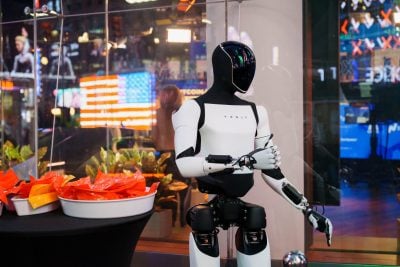
The clearest example is Tesla’s humanoid robot, Optimus. In the company’s recent AI and shareholder presentations, Musk reiterated his belief that Optimus could eventually become the company’s largest business. That sounds ambitious, but the economics are easy to understand.
The company believes humanoid robots could perform repetitive factory work, warehouse operations, logistics tasks, and eventually, household assistance. The global labor market represents tens of trillions of dollars in annual economic activity.
Here’s what the numbers tell us:
| Market Opportunity | Estimated Annual Value |
| Global Auto Market | $3.3 trillion |
| Global Labor Market (2026 forecast) | Trillions of dollars |
| Industrial Robotics Market (2030 forecasts) | $60 billion |
| Humanoid Robotics Market (2050 forecast) | $5 trillion |
Source: Tesla Investor Day presentations, Grand View Research, Morgan Stanley, and industry forecasts.
Surprisingly, Tesla does not need to dominate the entire robotics industry for Optimus to move the needle. Capturing even a small percentage of a multi-trillion-dollar labor market would create an opportunity far larger than selling vehicles alone.
That explains why some investors are beginning to value Tesla less on vehicle deliveries and more on its AI and robotics platform.
Why Tesla May Command a Premium Valuation
Tesla’s valuation has long frustrated traditional analysts because conventional auto metrics fail to explain it.
Consider the comparison:
| Company | Primary Business | Forward Narrative |
| Tesla | EVs, AI, Robotics | Autonomous systems |
| Ford (NYSE:F) | Automobiles | Vehicle manufacturing |
| General Motors (NYSE:GM) | Automobiles | Vehicle manufacturing |
| Nvidia | AI Infrastructure | AI computing platform |
Ford and GM are valued largely on expected vehicle sales and earnings. Nvidia trades at a premium because investors believe AI spending will continue expanding for years. Tesla increasingly falls into the second category.
Granted, the robotics thesis remains speculative. Optimus generates no revenue today, and large-scale deployment is still years away. Regulatory hurdles, technical challenges, and execution risks remain real.
That said, investors are not paying attention to Tesla because of what Optimus earns today. They are focused on what the technology could become if deployment scales across factories, warehouses, and eventually homes.
Key Takeaway
In short, Wall Street’s most bullish Tesla investors are no longer treating the company as an EV maker. They see a business building the hardware, software, AI models, and manufacturing infrastructure needed for a robotics future.
Whether that future arrives in five years or ten remains uncertain. But the investment thesis is becoming clearer. Tesla’s cars may generate today’s revenue, yet robotics and autonomous systems increasingly drive expectations for tomorrow’s value.
Ultimately, investors evaluating Tesla should spend less time comparing vehicle deliveries with Ford or GM and more time assessing whether Optimus can become a commercially viable labor platform. If it can, Tesla’s biggest business may not be transportation at all.
Contact [email protected] for any questions or corrections.
After two decades of patrolling the dark corners of suburbia as a police officer, Rich Duprey hung up his badge and gun to begin writing full time about stocks and investing. For the past 20 years, he’s been cruising the markets looking for companies to lock up as long-term holdings in a portfolio while writing extensively on the broad sectors of consumer goods, technology, and industrials. Because his experience isn’t from the typical financial analyst track, Rich is able to break down complex topics into understandable and useful action points for the average investor. His writings have appeared on The Motley Fool, InvestorPlace, Yahoo! Finance, Money Morning, and, of course, 24/7 Wall St. He has been featured in both U.S. and international publications, including MarketWatch, Financial Times, Forbes, Fast Company, and USA Today.