




Top Stock for AI’s Next Megatrend: Infineon
The development of AI data centers has pushed the limits of the industry in several categories. For instance, capex keeps increasing, as infrastructure expands. Energy might be one of the sectors with the fastest growth. Normally it grows at a steady pace, nonetheless to keep up with the enormous energy needs, the sector is expected to double by 2030. In fact, experts estimate that the demand will reach 950 TWh. Under conservative estimates that is around 120 GW of additional electricity capacity. Energy demand is expected to grow progressively. Companies that provide energy efficient solutions for the buildout are likely to benefit from the expected growth. Although generation is a big part of the energy value chain; however, distribution, transformation, and efficient power conversion are where companies such as Infineon Technologies ($IFNNY) play a critical role.
Infineon
Infineon is a German semiconductor company founded in 1999 as a spinoff from Siemens. The company is the global leader in power semiconductors and has a market share of around 17%, above companies such as OnSemi (ON) and STMicro (STM). Its products are used across a wide range of applications, the most relevant being the automotive sector. Infineon is a leader across major power semiconductor technologies, including silicon (Si), silicon carbide (SiC), and gallium nitride (GaN) power devices.
The automotive EV sector has faced significant challenges in recent years, due to the slowdown in EV demand and broader weakness in the automotive market. The automotive segment represents 50% of the company’s revenue, while the energy sector accounts for 29%. In fact, data center-related revenue accounts for approximately 8% of total revenue.
Infineon has a broad product portfolio, which includes several discrete power MOSFET families such as IGBTs, MOSFETs, SiC and GaN power transistors. Infineon’s products are vertically integrated for power solutions, not limited to transistor-level solutions. The company also provides microcontrollers used to manage these power solutions, embedded security solutions and low-level software for its products.
The company is a tier 2 provider to companies across the automotive, industrial and energy sectors. Essentially, Infineon supplies the semiconductors for the development of several products. For instance, in the automotive space, the company has components for EV inverter solutions. Infineon’s expertise in automotive has expanded to the energy sector. To illustrate, in the energy sector its applications extend across several categories such as Solid State Transformers (SST), Power Regulators, Uninterruptible Power Supply (UPS-ESS), Solid State Circuit Breaker (SSCB), battery management systems (BMS) and several other categories in server rack power distribution technologies. In fact, companies such as Delta Electronics and SolarEdge have collaborated closely with Infineon to codevelop power solutions for data centers.
The company is vertically integrated, holds research and development centers and semiconductor fabs. Moreover, the deep integration between research and manufacturing enables the company to design products that are at least 15% more efficient than competitors, not only because of design and fabrication techniques, but also due to its advanced packaging technologies. In addition, the company claims to have the largest and most efficient SiC power semiconductor fab in the world.
Power electronics and the cumulative effect on efficiency
Power generation is arguably the most discussed topic in the energy sector. Mostly the discussion centers around what is the most efficient way of producing energy. In fact, efficiency starts to have a snowball effect as the required energy use increases. For instance, a 40%-efficient energy source, such as combustion engine based electricity generation, with a required output of 100 MW for a data center, would require an installed capacity of 250 MW just to balance the loss in efficiency. Power losses increase the need for thermal dissipation because most of the lost 150 MW is ultimately released as heat. Cooling systems required to dissipate this heat also consume additional electricity.
Data centers and the new dc voltage standard
In the last generation of Nvidia GPUs, NVIDIA’s Rubin architecture, 800 volts DC is the norm, and the whole so-called AI factory ecosystem will be based on such power needs. NVIDIA adopted the standard to reduce power losses in data centers. By moving from the previous 48 V DC architecture to 800 V DC, the required current can be reduced by a factor of 16. This change can lower resistive losses by nearly 280 times. Power efficiency is becoming increasingly crucial as rack-level energy consumption continues to grow. A CPU based server rack can be between 20 and 80 kW. Vera Rubin-based GPU servers can reach up to 600 kW per rack. In this kind of rack, each percentage point of efficiency represents roughly 6 kW. Energy losses directly translate to higher operating costs.
The voltage transformations and power electronics
Power electronics refers to electronic systems used for the control and conversion of electric power. Today, power electronics use active components such as SiC MOSFET or GaN MOSFET transistors. Compared to traditional approaches with passive electronic components, power electronics tend to be more efficient and have reduced weight. Power electronics are used to convert between AC and DC, referred to as rectifiers, inverters, or converters.
As power electronics offer control and higher efficiency in the electric power conversion, several traditional products such as transformers are being replaced by solid state transformers. architectures based on power electronics.
Efficiency is critical
Moreover, power generation is only one part of the puzzle. To meet growing demand, companies must also distribute, transform, and deliver electricity into server racks. Each step must be power efficient, as the losses cascade. Even at 99% of efficiency, 10 sequential conversion stages end up with an overall efficiency of 90.4%. At envisioned GW-scale data centers, this translates to 100 MW losses per GW. In fact, the current overall efficiency of a data center is 85%, while with Infineon solutions it could potentially increase toward 90%.
Infineon’s role in the power distribution future
Infineon envisions deploying its products across the entire AI power delivery chain. The company targets applications from 800 V rack-level distribution to point-of-load regulation at the silicon level. Its solutions aim to enable efficient multi-stage power conversion throughout the system. Product families like Infineon’s Silicon carbide CoolSiC™ MOSFETs claim efficiencies between 97-99.5%, while its GaN-based CoolGaN™ can reach similar efficiencies. Both technologies are essential as discrete components for several power solutions.
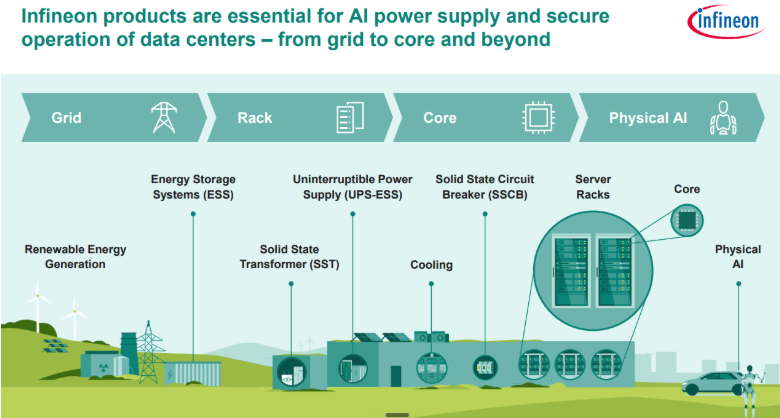
Broad category of solutions by Infineon in the AI data center era
Infineon envisions a future in which the server rack reaches up to 1 MW. This will require several power solutions, including voltage step-down, cooling solutions, battery storage solutions, super capacitor solutions, and voltage bus distribution.
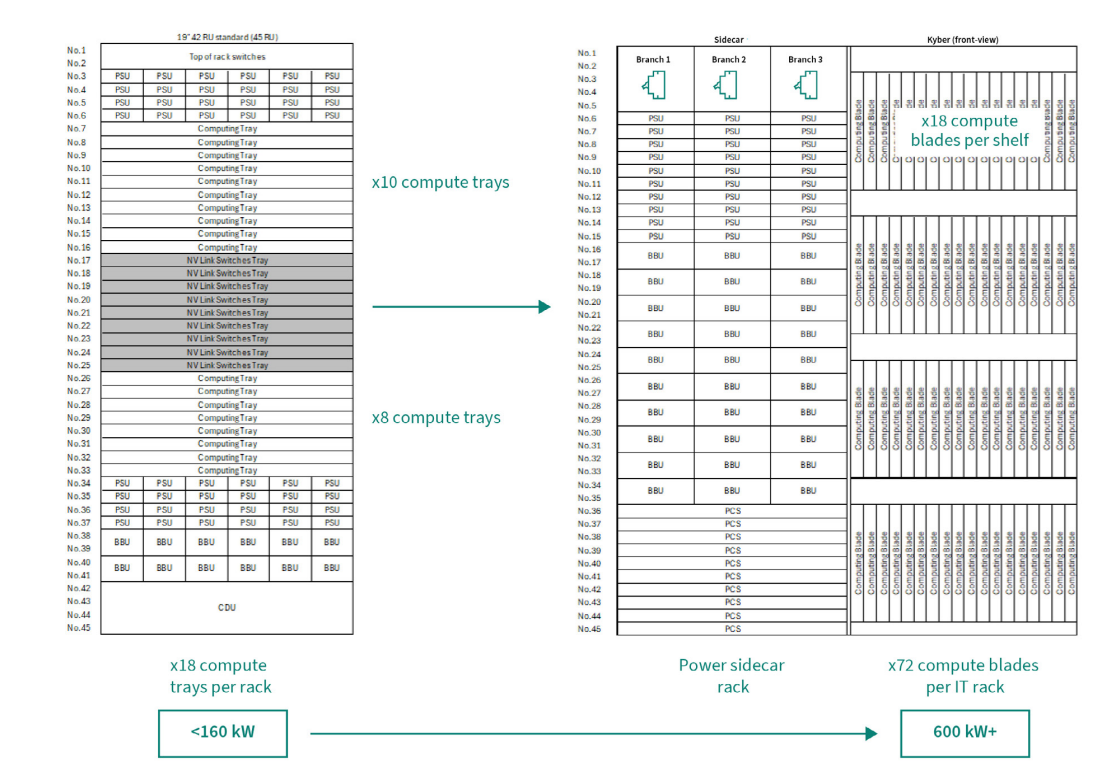
Evolution of the server rack in the AI era
Micro grids
Finally, Infineon envisions its products playing a key role in upcoming microgrid power architectures. Microgrids are becoming an important enabler for integrating multiple energy sources, including renewables, nuclear, and traditional combustion-based generation. These systems could efficiently distribute power across the future AI server racks while providing a scalable and future-proof solution for the evolving data center energy demands. Such demands may include different voltage levels, active power quality management, bidirectional power flow, and highly efficient multi-stage power conversion.
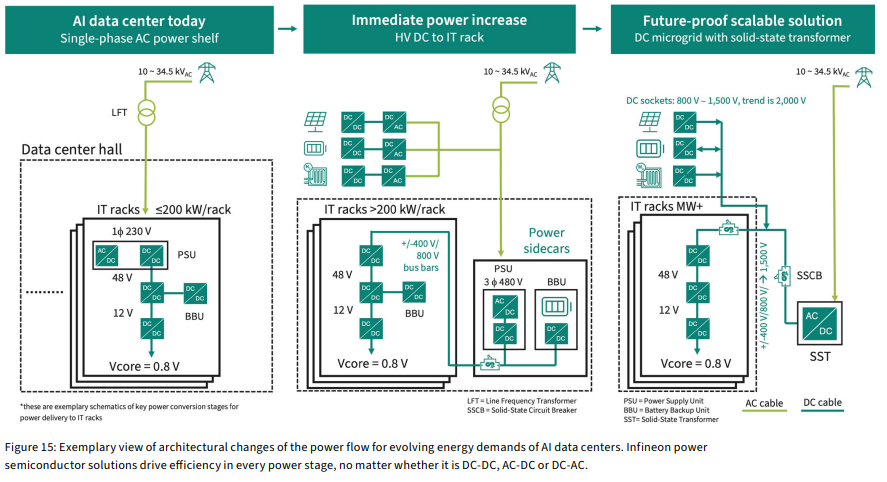
Microgrid architecture in the AI data center era
Earnings and current valuation of the company
In the last fiscal year, Infineon reported revenue of €14.6B, representing a 2% YoY decline. Approximately 50% of total revenue came from the automotive segment, while around 16% was related to data centers and power infrastructure applications. Notably, power infrastructure revenue increased from 6% to 8% of total company revenue during the last quarter.
Management expects significant long-term growth opportunities across energy generation, storage, and power conversion infrastructure. In particular, the company views SiC power semiconductors as one of its most attractive growth areas, driven by increasing power density and efficiency requirements in renewable energy systems.
In solar infrastructure applications, Infineon estimates SiC content between €1,500 and €5,000 per MW. The company expects annual demand growth of approximately 17%. For battery energy storage systems, Infineon estimates SiC content between €2,500 and €3,500 per MW.
Additionally, management highlighted that energy storage systems could represent BOM opportunities exceeding €2,500 per MW, further reinforcing the long-term growth potential of power semiconductors in next-generation energy infrastructure. Moreover, growing demand from AI server infrastructure is expected to turn Infineon’s Power & Sensor Systems division into one of the company’s fastest-growing business segments. The division, which primarily serves AI server and power delivery applications, is expected to grow from approximately €1.5B in revenue in 2026 to around €2.5B in 2027, representing roughly 67% YoY growth.
Future expectations
Looking further ahead, management estimates that the opportunity in AI power infrastructure could reach up to €12B by the end of the decade. Equivalent to nearly 85% of the company’s current annual revenue. Infineon expects its semiconductor and power management content per AI server rack to increase substantially. The company estimates growth from roughly €15K today to more than €100K per rack by the end of the decade.
Rapidly growing rack-level power consumption mainly drives this increase. Next-generation AI racks could approach 1 MW of power demand.
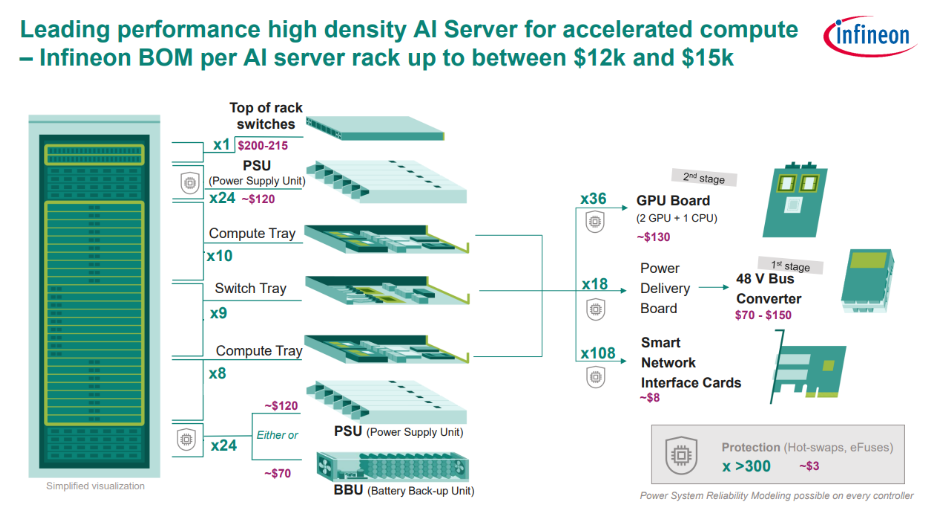
BOM content in a server rack in the AI data center era
Customers
Infineon is a diversified company and counts several industry leaders among its customers. Bloom Energy (BE), Delta Electronics (2308.TW) and SolarEdge (SEDG) are some of the relevant customers in the energy generation and distribution steps, key to the AI data center buildout.
Author’s opinion
In conclusion, Infineon Technologies is a key enabler of next-generation power and intelligent infrastructure systems. Its collaborations across the power electronics ecosystem reinforce the company’s relevance in the evolving energy and AI infrastructure landscape.
Although the automotive sector, particularly electric vehicles, has faced a weaker environment in recent years, it has also pushed Infineon to adapt. As a result, the company has further strengthened and expanded its power electronics capabilities. The demanding requirements of automotive applications have helped the company develop highly reliable and efficient solutions. These solutions include power semiconductors, battery management, and energy conversion systems. The company uses this technical expertise to expand its market share in the energy industry.
Management has highlighted strong long-term demand for power generation, distribution, and conversion infrastructure for AI data centers. The company expects this demand to grow significantly by the end of the decade. Infineon believes the data center power architecture opportunity could equal around 85% of its current annual revenue.
Beyond power semiconductors, Infineon has a strong presence in sensors, microcontrollers, and embedded software. All with strategic value for the emerging physical AI era. Finally, the company already develops encryption chips for the post-quantum computing era.
Another important strength is its diversification. Unlike many semiconductor companies with heavy customer concentration, no single customer accounts for more than 10% of Infineon’s total revenue.
Infineon is one of the leading suppliers of power electronics. These technologies are becoming increasingly important as AI infrastructure requires much higher energy consumption. That is why I consider it a top stock in the next megatrend.
Contact [email protected] for any questions or corrections.











 Top Gaining Stocks
 Top Losing Stocks