2 CEOs, 1 AI Empire: Why Jensen Huang and Lisa Su Are on a Collision Course
When it comes to Nvidia (NASDAQ: NVDA | NVDA Price Prediction) and Advanced Micro Devices (NASDAQ: AMD), for a retirement-focused investor allocating capital today, which CEO and which silicon empire deserves the slot? Distant cousins Jensen Huang and Lisa Su run…

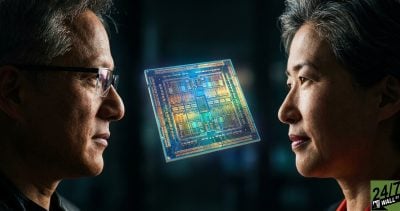
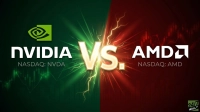
When it comes to Nvidia (NASDAQ: NVDA | NVDA Price Prediction) and Advanced Micro Devices (NASDAQ: AMD), for a retirement-focused investor allocating capital today, which CEO and which silicon empire deserves the slot? Distant cousins Jensen Huang and Lisa Su run the two companies defining the artificial intelligence (AI) buildout, and the stocks have rewarded patience in very different ways. Nvidia is up 63.7% over the past year, while AMD has ripped 356.8% over the same span. Past returns aside, here is the head-to-head on the three dimensions that actually matter for a retirement portfolio.
1. Competitive Moat and Platform Breadth: Nvidia
Huang’s pitch is that Nvidia sells the only AI architecture that runs every AI workload, in every cloud, on every model. The Q1 FY2027 numbers back that up. Data Center revenue hit $75.246 billion, up 92% year over year, with Data Center Networking alone growing 199% year over year. Huang told investors that “the buildout of AI factories, the largest infrastructure expansion in human history, is accelerating at extraordinary speed” and that “agentic AI has arrived, doing productive work, generating real value and scaling rapidly across companies and industries.”
Lisa Su’s counterpunch carries weight. AMD’s Meta partnership covers up to 6 gigawatts of AMD Instinct GPU deployment, and she expects “tens of billions of dollars in annual Data Center AI revenue in 2027.” But CUDA, NVLink, Spectrum-X and a fully integrated rack-scale stack still define the spec sheet hyperscalers buy against.
Nvidia’s non-GAAP gross margin of 75% versus AMD’s 55% is the cleanest read of moat strength. So the winner is Nvidia.
2. Growth Trajectory and Hyperscaler Exposure: Nvidia
AMD’s Q1 2026 was excellent, with revenue of $10.253 billion, up 37.9% year over year. Data Center revenue was $5.775 billion (up 57% year over year), and Q2 guidance near $11.2 billion, implying about 46% year-over-year growth. Lisa Su called out that “Data Center [is] now the primary driver of our revenue and earnings growth.”
Nvidia is bigger and growing faster. Q1 FY2027 revenue was $81.615 billion, up 85.23% year over year, with Q2 guidance of $91.0 billion. Full-year FY2026 free cash flow totaled $96.58 billion, up 58.7%. Nvidia’s hyperscaler exposure includes Microsoft, AWS, Google Cloud, Oracle, Meta, OpenAI, Anthropic, and CoreWeave, with $119.0 billion in total supply commitments signaling multiyear demand visibility.
Growing faster than a company a fraction of your size is the rarer feat. The winner here is Nvidia.
3. Valuation and Risk: Nvidia
AMD trades at a trailing P/E of 156 and a forward P/E of 67, with a beta of 2.399 and no dividend. Nvidia, despite a $5.2 trillion market cap, trades at a trailing P/E of 33 and a forward P/E of 25, with a PEG of 0.66.
The retirement-relevant kicker: Nvidia just raised its quarterly dividend from $0.01 to $0.25 per share and authorized an additional $80.0 billion in buybacks, returning about $20.0 billion to shareholders in Q1 alone. AMD pays no dividend and repurchased $1.316 billion in FY2025. On execution risk, AMD still carries China MI308 export-control exposure and an MI450/Helios ramp that has yet to fully prove out.
And again, the winner is Nvidia.
Verdict
For a retirement-focused investor, Nvidia is the clear pick. Higher margins, a newly meaningful dividend, an $80 billion buyback, a lower forward multiple, and faster growth despite being roughly six times larger than AMD make for an unusual stack of advantages in one ticker. Wall Street agrees: analysts overwhelmingly recommend buying shares, and their $295.34 consensus price target signals more than 37% upside over the next 12 months.


AMD is the better choice for a different investor: one in the accumulation phase, comfortable with a 2.4 beta, betting that Lisa Su’s “greater than 80% CAGR” Data Center AI target is achieved. For someone drawing down a portfolio in the next decade, Huang’s empire is the steadier compounder.


Contact [email protected] for any questions or corrections.
Trey has been an editor and author at 24/7 Wall St. for more than a decade, where he has published thousands of articles analyzing corporate earnings, dividend stocks, short interest, insider buying, private equity, and market trends. His comprehensive coverage spans the full spectrum of financial markets, from blue-chip stalwarts to emerging growth companies.
Beyond 24/7 Wall St., Trey has created and edited financial content for Benzinga and AOL's BloggingStocks, contributing additional hundreds of articles to the investment community.
Trey's editorial expertise extends across multiple publishing environments. He served as production editor at Dearborn Financial Publishing and development editor at Kaplan, where he helped shape financial education materials. Earlier in his career, he worked as a writer-producer at SVE. His freelance editing portfolio includes work for prestigious clients such as Sage Publications, Rand McNally, the Institute for Supply Management, the American Library Association, Eggplant Literary Productions, and Spiegel.
Outside of financial journalism, Trey writes fiction and has been an active member of the writing community for years, moderating workshop sessions at regional conventions.