Chipotle vs Starbucks: One Turnaround Is Real, One Is Just Smoke
Two beaten-down restaurant names, one decision: should a retirement-focused investor put fresh capital into Starbucks (NASDAQ: SBUX | SBUX Price Prediction) or Chipotle Mexican Grill (NYSE: CMG) right now? Both stocks have been punished, but for opposite reasons. Starbucks has…

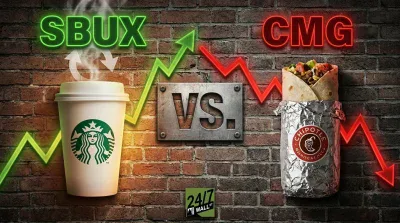
Two beaten-down restaurant names, one decision: should a retirement-focused investor put fresh capital into Starbucks (NASDAQ: SBUX | SBUX Price Prediction) or Chipotle Mexican Grill (NYSE: CMG) right now? Both stocks have been punished, but for opposite reasons. Starbucks has rallied off its lows as a turnaround takes hold, while Chipotle has cratered as its growth story collapsed into its first full year of negative same-store sales in over two decades. Here is how they stack up on the three dimensions that actually matter for an income-and-stability investor.
Growth Trajectory and Same-Store Sales
Starbucks is inflecting. In Q2 FY2026, the company posted global comparable store sales of 6.2%, with transactions up 3.8% and ticket up 2.3%, and North America comps of +7.1%. Operating income jumped 21.9% year over year to $802.4 million, and management raised FY2026 guidance to comp growth of at least 5.0% and non-GAAP EPS of $2.25 to $2.45. CEO Brian Niccol called it “the turn in our turnaround.”

Chipotle is moving in the opposite direction. Q4 2025 comparable restaurant sales were −2.5%, with transactions down 3.2%, capping the first full year of negative comp sales in the modern era. Restaurant-level margin compressed to 23.4% from 24.8%. Management is guiding 2026 comps to approximately flat. Revenue growth is being carried almost entirely by a record 334 new restaurants opened in 2025, masking the underlying traffic weakness.

Edge: Starbucks.
Valuation
On the surface, Chipotle looks like the cheaper stock. Trailing P/E is 26, forward P/E around 27, with a market cap of $38.5 billion at $29.10. Starbucks trades at a trailing 73 P/E on depressed earnings, though forward P/E drops to 33 on the FY2026 guidance. Analyst targets reinforce the gap: Chipotle’s consensus target is $42.97 (47.7% upside) versus Starbucks at $106.25 (+12.6%).


The catch: Chipotle’s earnings are flat to declining, with quarterly EPS growth of −17.9% year over year, while Starbucks just delivered +32.6% earnings growth. A lower multiple on shrinking profits offers less value than it appears on the surface.
Edge: Chipotle.
The Recent Move and Income Profile
The price action tells the real story. Over the past year, Starbucks is up 9.4% and up 13.0% year to date, cooling 9.3% over the past month as the rally consolidates. Chipotle is down 43.4% over the past year and 19.5% year to date, near its 52-week low of $28.16. Starbucks’ recent decline reflects profit-taking on a recovering business. Chipotle’s decline is a structural rerating tied to deteriorating fundamentals.
For retirees, the income gap is decisive. Starbucks pays a $0.62 quarterly dividend, has 64 consecutive quarters of payouts with a 17% CAGR, and yields 2.59%. Chipotle pays no dividend, returning capital exclusively through buybacks: $2.43 billion repurchased in 2025 at an average of $42.54, well above today’s price.
Edge: Starbucks.
The Verdict
For a retirement-focused investor, Starbucks is the better buy right now. The dividend yield, payout history, and a turnaround producing visible comp acceleration give retirees both income and a stabilizing fundamental story. The recent pullback offers entry into a business inflecting upward.
Chipotle is a different animal: a growth-oriented bet for younger investors with a long horizon who can stomach zero income, declining traffic, and the possibility of further multiple compression if 2026 comps disappoint the flat guide. The long-term unit story toward 7,000 restaurants may eventually reward patience, but it is the wrong profile for a portfolio prioritizing capital preservation and reliable cash flow.
The decisive call is Starbucks for retirees, Chipotle for risk-tolerant growth investors. Keep an eye on Starbucks’ next earnings report for confirmation that the turnaround is sustaining momentum.
Contact [email protected] for any questions or corrections.
Trey has been an editor and author at 24/7 Wall St. for more than a decade, where he has published thousands of articles analyzing corporate earnings, dividend stocks, short interest, insider buying, private equity, and market trends. His comprehensive coverage spans the full spectrum of financial markets, from blue-chip stalwarts to emerging growth companies.
Beyond 24/7 Wall St., Trey has created and edited financial content for Benzinga and AOL's BloggingStocks, contributing additional hundreds of articles to the investment community.
Trey's editorial expertise extends across multiple publishing environments. He served as production editor at Dearborn Financial Publishing and development editor at Kaplan, where he helped shape financial education materials. Earlier in his career, he worked as a writer-producer at SVE. His freelance editing portfolio includes work for prestigious clients such as Sage Publications, Rand McNally, the Institute for Supply Management, the American Library Association, Eggplant Literary Productions, and Spiegel.
Outside of financial journalism, Trey writes fiction and has been an active member of the writing community for years, moderating workshop sessions at regional conventions.