USD Implodes 17% And June 8th Could Be Worse
A 2x leveraged semiconductor ETF will eventually give you a day like June 5, 2026. ProShares Ultra Semiconductors (NYSEARCA:USD), which seeks twice the daily return of the Dow Jones U.S. Semiconductors Index, closed at $88.68 on Friday, down roughly 17%…


A 2x leveraged semiconductor ETF will eventually give you a day like June 5, 2026. ProShares Ultra Semiconductors (NYSEARCA:USD), which seeks twice the daily return of the Dow Jones U.S. Semiconductors Index, closed at $88.68 on Friday, down roughly 17% from $106.64 the day before. A holder who walked in Friday morning with $10,000 walked out with about $8,316 by the close. A holder who entered on May 29 at $102.12 was down about 13% on the week, even though the same starting point a month ago would still have them roughly flat.
For context on what the wrapper does and does not do, the unleveraged iShares Semiconductor ETF (NASDAQ:SOXX) fell roughly 10% on the same day, from $602.72 to $539.77. The leveraged fund actually fared slightly worse than a straight doubling, which is how the math is supposed to work on a sharp single-day drop, and it is the first thing worth understanding before deciding whether the chart is a buying opportunity or a warning.
The arithmetic of a 2x daily reset
USD is engineered to deliver twice the daily price change of its semiconductor benchmark, not twice the cumulative return over any longer period. Each day the fund rebalances its swap exposure back to 2x of the new, smaller (or larger) net asset value. On a day when the underlying index falls in the high single digits, that reset is unforgiving. The semiconductor index proxy fell roughly 10%, and USD printed a loss in the high teens. That is the wrapper doing exactly what the prospectus says it will do, not a tracking error.
The flip side of this same machinery is why the year-to-date number still looks heroic. USD is up about 69% year to date, from $52.45 on December 31, and 196% over one year, from $29.94 on June 5, 2025. SOXX, the 1x version of the same exposure, is up about 79% year to date and roughly 152% over one year. The leveraged fund did not deliver a clean 2x of those longer numbers, partly because of fees and financing costs, but mostly because the underlying climbed in a long, low-volatility line for most of the past twelve months. Daily-reset leverage compounds beautifully up the right side of a smooth uptrend, and it bleeds in chop. June 5 was the first day in a while that the chop showed up.
What actually broke on Friday
The catalyst arrived Wednesday after the close, when Broadcom (NASDAQ:AVGO | AVGO Price Prediction) reported fiscal Q2. The print itself was fine. Revenue came in at $22.19 billion, up 47.9% year over year, and AI semiconductor revenue hit $10.80 billion, up 143%. The problem was the guide. Management told the Street to expect Q3 AI semiconductor revenue of $16.0 billion, against a buy-side whisper closer to $17.2 billion, a roughly 7% miss against the number that mattered most. CEO Hock Tan also noted on the call that Google may end up using multiple chip suppliers for its custom accelerator program, a sentence that introduced vendor-concentration risk to a story that had been priced as if Broadcom owned that socket outright.
Broadcom shares fell about 8% Friday to $385.73, capping a roughly 14% drop on the week from $446.77. That alone would have hurt USD. But Friday morning, the May payrolls report printed 172,000 jobs against an 80,000 estimate, more than double the consensus, and rate-hike chatter that had been dormant for months came back to life. The 2-year Treasury yield jumped 12 basis points in a single session to 4.17%, the 10Y-2Y spread compressed to 0.38%, the lowest in twelve months, and long-duration equity got repriced in a hurry. Semiconductors, which trade like the longest-duration equity in the index, took the hit.
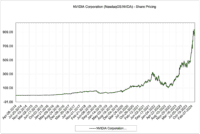
NVIDIA (NASDAQ:NVDA), the largest weight in any U.S. semiconductor index, fell 6.2% from $218.66 to $205.10. Micron Technology (NASDAQ:MU) was worse, down roughly 13% to $864.01 from $996, surrendering some of a year-to-date run that still sits at about 203%. The chip complex shed roughly $1.2 trillion in market cap in a single session. Doubled and reset daily, that becomes a 17% wrapper loss.
What is actually scaring the people who were paying attention
The reason Broadcom’s guide rattled the entire complex, rather than just AVGO, is that it was the first hard data point in a year that challenges a quiet assumption underneath every chip multiple. The assumption is that hyperscaler AI capex is effectively uncapped through 2027. Strip that out, and the forward earnings power of NVIDIA, Broadcom, and the memory names looks very different. Broadcom’s own forward PE sits at 38, trailing PE at 64, and the analyst target average is $512.73, well above Friday’s close. Those numbers only work if AI revenue keeps compounding at the rates management has been guiding to. The Q3 number was still +200% year over year, but the gap between $16.0 billion and the buy-side $17.2 billion is the gap between “accelerating” and “merely huge,” and at these multiples the difference is meaningful.
Worth noting that the VIX closed Thursday at 15.40, the bottom of the normal range. The S&P held steady through the session. This was a sector unwind inside a calm tape, which is the cleanest read possible that the selling was specifically about AI semiconductor expectations rather than anything systemic.
Whether the retail crowd is treating this as a regime change
By Saturday morning, Reddit sentiment on Broadcom had already recovered to a bullish 60, from a very bearish 13 in the first hours after the print. The most-upvoted post in r/wallstreetbets was titled “wealthsimple exercised AVGO puts after hours. i’m down 1.2 million. is it over,” with 5,229 upvotes and 743 comments. NVIDIA threads were dominated by a capitulation post titled “Fuck everyone. 4.5 years to get to a million without options and I’m done,” which grew to 14,822 upvotes by Friday evening. The combination of capitulation language at the top of the leaderboard and a same-week recovery in aggregate sentiment is the classic shape of a tactical washout rather than a structural break. Retail has decided this is a dip to buy. That does not make them right, but it tells you where the marginal demand is sitting heading into Monday.
Prediction markets are saying something similar with more discipline. On Polymarket, the probability NVIDIA closes June above $170 is 91.5%, above $190 is 76.5%, and above $200 is 54.5%. The crowd expects stabilization above current levels but is not pricing a full round trip back to the pre-selloff highs by month-end. That is a reasonable read.
What to actually watch from here
The AI buildout is real, and that is not the question for anyone looking at USD at $88. The Q1 2026 worldwide semiconductor revenue print was $298.5 billion, up 79.2% year over year. NVIDIA’s most recent quarter put Data Center revenue at $75.25 billion, up 92%, with the company guiding next quarter to $91.0 billion in total revenue. The question is whether the second derivative is still positive at the rate already priced into the index. Three specific indicators will answer that, and you can watch all of them without a Bloomberg terminal.
First, Micron’s fiscal Q3 earnings, confirmed for after the close on Wednesday, June 24. Management guided last quarter to $18.70 billion ± $400 million in revenue with non-GAAP EPS of $8.42 ± $0.20 and 68% gross margin. HBM pricing and the hyperscaler order book are the read-throughs that matter, because memory is the cleanest barometer of whether AI infrastructure orders are being pulled forward, held flat, or trimmed. A clean beat with a stable forward guide reframes Friday as a Broadcom-specific event. A miss or a softer guide validates the bear case.
Second, TSMC’s monthly revenue release, which lands in the first week of every month and is one of the only mid-quarter data points the entire complex respects. June numbers reported in early July will tell you whether hyperscaler chip pulls weakened in real time.
Third, the actual capex commentary from the hyperscalers on their next round of earnings. Alphabet, Microsoft, Meta, and Amazon between them set the demand curve that ultimately funds every line in the semi index. The AI Investor Podcast pointed out in early June that Alphabet’s $80 billion equity raise was already oversubscribed multiple times, with capital flowing in to fund the next leg of compute spending. That is the bull case in one data point. If the next round of capex guides confirms 2027 spending plans intact, the Broadcom guide gets reframed as a one-quarter calendar issue rather than a peak signal.
The honest read is that USD at $88 is not obviously cheap or obviously broken. The mechanism that delivered the 196% one-year return is the same mechanism that delivered the 17% Friday, and on any sustained downtrend or volatile sideways tape the decay will work against you in a way the year-to-date chart has not yet shown. The structural story (AI infrastructure is the largest capex cycle in modern technology history) is still intact at a now lower valuation, which mathematically improves the forward expected return. The cyclical story (the buy side just got its first negative surprise on AI semiconductor growth in a year) is what you have to weigh against it. Watch Micron on June 24. Watch TSMC’s monthly. If both come in clean, Friday was a tactical reset inside an ongoing regime. If either disappoints, the question stops being about the 2x wrapper and starts being about the underlying.
Contact [email protected] for any questions or corrections.
Austin Smith is a financial publisher with over two decades of experience as an investor, analyst, and advisor. He covers stocks, ETFs, Artificial intelligence and personal finance for 24/7 Wall St. Previously, he spent over a decade at The Motley Fool as a senior editor for Fool.com, portfolio advisor for Millionacres, and launched The Ascent to help reader take control of their personal finances.
His work has been featured on Fool.com, NPR, CNBC, USA Today, Yahoo Finance, MSN, AOL, Marketwatch, and many other publications. He is as an advisor to private companies, and co-hosts The AI Investor Podcast with Eric Bleeker.
When not looking for investment opportunities, he can be found skiing, running, or playing soccer with his children. Learn more about Austin's investment approach here.