3 Utility Stocks That’ll Pay Your Bills For Years
Earned income requires trading hours for pay. Passive income arrives on schedule whether markets are open or closed, whether you’re working or sleeping. For investors building a paycheck without a timesheet, dividend stocks remain the cleanest path to that goal.…


Earned income requires trading hours for pay. Passive income arrives on schedule whether markets are open or closed, whether you’re working or sleeping. For investors building a paycheck without a timesheet, dividend stocks remain the cleanest path to that goal.
Utilities sit at the conservative end of the passive income spectrum. Regulated electric companies operate under state-approved rate structures that turn capital spending into predictable earnings and predictable earnings into dependable quarterly checks. With U.S. electricity consumption growing 2.1% per year on average over the last five years and data center load driving the next leg higher, the three names below are positioned to fund rising dividends from rising rate bases. Real estate cannot match this liquidity, and a savings account cannot match the growth.
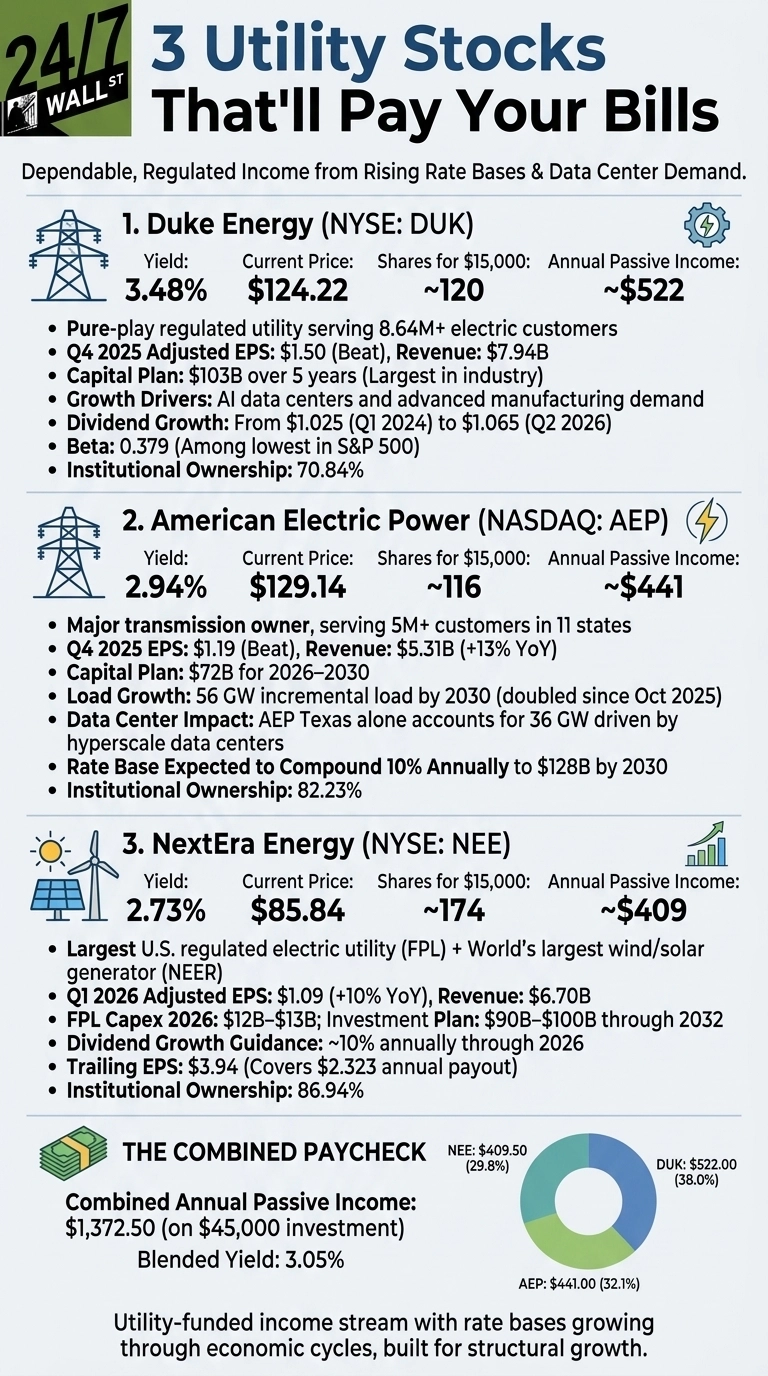
We screened our 24/7 Wall St. dividend equity research database for stocks that pay massive dividends and found companies that combined can generate over $1,300 a year in passive annual income on a $15,000 investment in each stock at the time of this writing.
NextEra Energy
- Yield: 2.73%
- Shares for $15,000: 174
- Annual Passive Income: $409
NextEra Energy (NYSE:NEE | NEE Price Prediction) pairs Florida Power & Light, the largest regulated electric utility in the United States, with NextEra Energy Resources, the world’s largest generator of wind and solar power. The combined platform delivered Q1 2026 adjusted EPS of $1.09, up 10% year over year, on revenue of $6.70 billion.
The dividend is structurally supported by rate-base growth: FPL plans to invest $12 billion to $13 billion in 2026 and $90 billion to $100 billion through 2032. Management guides for 10% dividend growth annually through 2026, then 6% per year through 2028. Trailing EPS of $3.94 covers the $2.323 annual payout, and institutional ownership sits at 86.94%.
American Electric Power
- Yield: 2.94%
- Shares for $15,000: 116
- Annual Passive Income: $441
American Electric Power (NASDAQ:AEP) operates one of the largest transmission systems in the country and serves more than five million customers across 11 states through subsidiaries including AEP Ohio, AEP Texas, and Appalachian Power. Q4 2025 EPS of $1.19 beat the $1.14 estimate, and revenue of $5.31 billion rose 13% year over year.
The dividend is funded by a regulated rate base set to compound at roughly 10% annually to $128 billion by 2030, backed by a $72 billion capital plan for 2026 through 2030. Load growth is the bigger story: AEP has signed agreements for 56 GW of incremental load by 2030, doubled from 28 GW in October 2025, with AEP Texas alone accounting for 36 GW driven by hyperscale data centers. Institutions hold 82.23% of the float.
Duke Energy
- Yield: 3.48%
- Shares for $15,000: 120
- Annual Passive Income: $522
Duke Energy (NYSE:DUK) is a pure-play regulated utility serving more than 8.64 million electric customers across the Carolinas, Florida, Indiana, Ohio, and Kentucky, plus natural gas customers through Piedmont Natural Gas. Q4 2025 adjusted EPS came in at $1.50, beating the $1.49 estimate, on revenue of $7.94 billion.
Duke’s dividend has climbed from $1.025 in early 2024 to $1.045 later that year to the current $1.065 quarterly rate, paid without interruption since well before 1999. The $103 billion five-year capital plan, billed as the largest in the regulated utility industry, targets 9.6% earnings base growth through 2030 and is anchored by AI data center and advanced manufacturing demand.
The Combined Paycheck
Combined, these three positions generate $1,372.50 in annual passive income on a $45,000 investment, a blended yield of 3.05%. Duke Energy contributes $522, American Electric Power adds $441, and NextEra Energy rounds out the portfolio with $409.50.
| Ticker | Annual Income | Share of Total |
|---|---|---|
| DUK | $522.00 | 38.0% |
| AEP | $441.00 | 32.1% |
| NEE | $409.50 | 29.8% |
A utility-funded income stream leaves principal liquid, distributions taxable as ordinary qualified dividends, and reinvested checks compounding on top of rate bases that grow whether the next quarter is recessionary or expansionary. With electricity demand entering its strongest structural growth cycle in decades, the dividend math here is built to do more in five years than it does today.
Contact [email protected] for any questions or corrections.
Vandita Jadeja is a financial publisher with over a decade of experience writing about financial topics, including investment, savings, retirement, insurance and banking. Vandita is a Chartered Accountant who loves to debunk financial concepts for readers.
Her work has appeared on sites that include The Motley Fool, InvestorPlace, and Benzinga. She covers investing and focuses on stock picks and price prediction for 24/7 Wall St.
When not looking for the next stock investment opportunity, she can be found traveling, reading, chasing sunsets and enjoying her iced latte.