3 Utility Stocks For Years of Passive Income
Passive income arrives whether you work, sleep, or travel. Dividend income depends on a company writing a check four times a year. For investors covering utility bills, property taxes, or groceries, the math must be concrete and the underlying businesses…


Passive income arrives whether you work, sleep, or travel. Dividend income depends on a company writing a check four times a year. For investors covering utility bills, property taxes, or groceries, the math must be concrete and the underlying businesses must be boring in the best possible way.
Utilities sell essential services under regulated rate structures, recover capital investment through approved riders, and return predictable cash flow to shareholders quarterly.
With U.S. electricity demand growing 2.1% per year on average over the last five years and residential electricity prices averaging 18.2 cents per kilowatthour in 2026, the cash flows backing these dividends are arguably more durable than at any point in the last two decades. Data center load is the new growth engine, and regulated utilities sitting on top are passing rate-base expansion straight through to dividend growth.
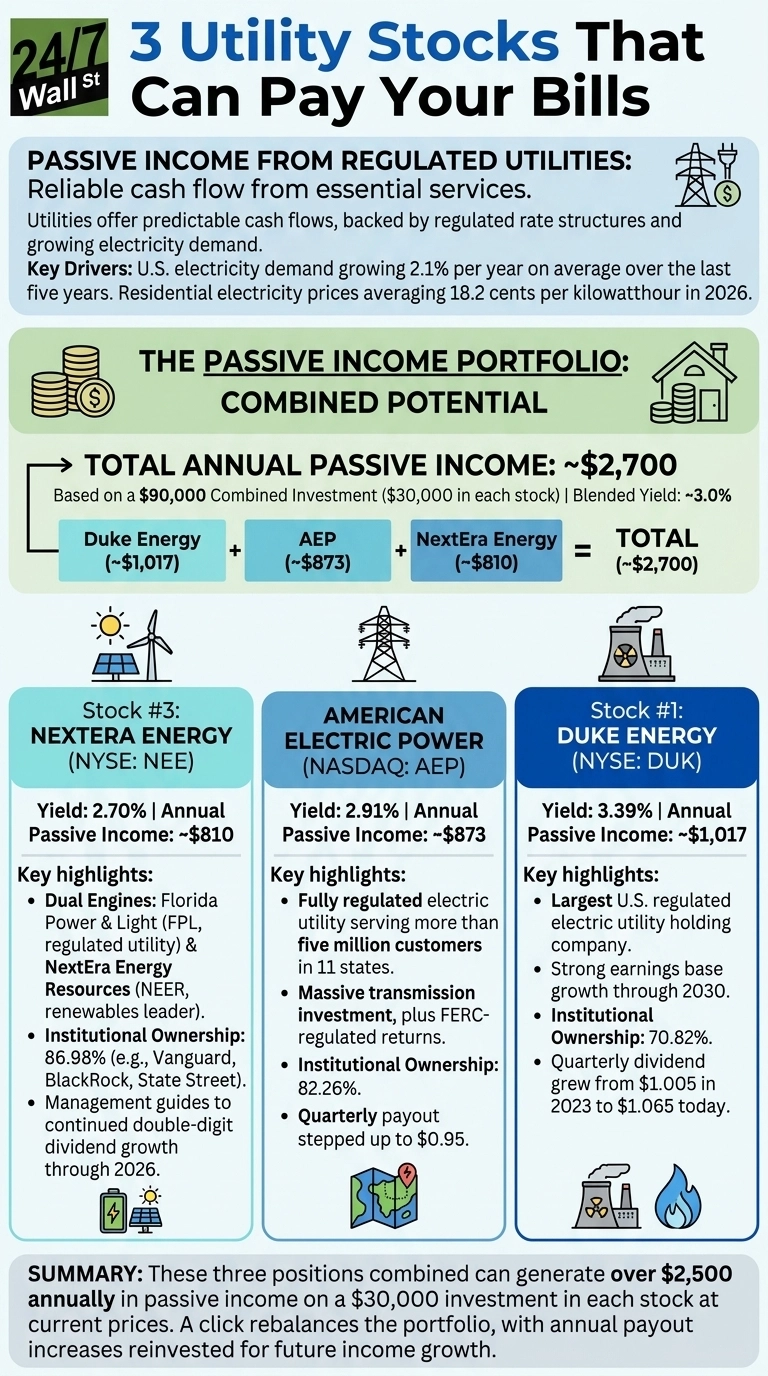
Screening our 24/7 Wall St. dividend equity research database for massive dividend payers, we found companies that combined can generate over $2,500 annually in passive income on a $30,000 investment in each stock at current prices.
NextEra Energy
- Yield: 2.70%
- Shares for $30,000: 348
- Annual Passive Income: $810
NextEra Energy (NYSE:NEE | NEE Price Prediction) combines two engines under one ticker. Florida Power & Light is one of the largest regulated electric utilities in the country, generating strong Q1 revenue and adding new customers in the quarter. NextEra Energy Resources is the world’s largest wind and solar generator, with a a substantial renewable project backlog after record Q1 origination.
The dividend is funded by regulated FPL cash flows plus contracted, long-dated power purchase agreements at NEER. Management guides to continued double-digit dividend growth through 2026, unusual for a name this size.
Institutional ownership sits at 86.98%, led by Vanguard, BlackRock, and State Street. The recent recommissioning of the Duane Arnold nuclear plant under a Google PPA illustrates the deal pipeline behind the payout.
American Electric Power
- Yield: 2.91%
- Shares for $30,000: 231
- Annual Passive Income: $873
American Electric Power (NASDAQ:AEP) is a fully regulated electric utility serving more than five million customers in 11 states through subsidiaries like AEP Ohio, AEP Texas, and Appalachian Power. The dividend is backed by rate-base recovery in every jurisdiction, plus FERC-regulated returns on a massive transmission portfolio.
The capital plan drives the story. AEP raised its five-year capex program to a sizable multi-year capex program, with a large share earmarked for transmission, and signed agreements for substantial incremental load by 2030, much from data centers. The quarterly payout stepped up to $0.95, and institutional ownership runs at 82.26%, with Vanguard and BlackRock among the largest holders.
Duke Energy
- Yield: 3.39%
- Shares for $30,000: 238
- Annual Passive Income: $1,017
Duke Energy (NYSE:DUK) is the largest regulated electric utility holding company in the United States, with operating subsidiaries across the Carolinas, Florida, Ohio, and Indiana, plus Piedmont Natural Gas. Electric Utilities and Infrastructure generated the bulk of Q1 revenue, with Gas Utilities adding meaningful additional revenue.
The high payout sits on a large five-year capital plan and high-single-digit earnings base growth through 2030, with multi-jurisdiction rate cases contributing a meaningful per-share contribution in Q1. The quarterly dividend stair-stepped from $1.005 in 2023 to $1.065 today, and institutions own 70.82% of the float, anchored by Vanguard, BlackRock, and State Street.
The bottom line
Combined, these three positions generate $2,700 in annual passive income on a $90,000 investment, a blended yield of 3%. Duke Energy contributes $1,017, American Electric Power adds $873, and NextEra Energy rounds out the portfolio with $810.
Unlike rental property, this income stream needs no tenant, no roof repair, and no closing costs to enter or exit. A click rebalances the portfolio. Because all three raise payouts annually, every dividend reinvested today buys a slightly larger claim on tomorrow’s check, eventually covering more than just the electric bill.
Contact [email protected] for any questions or corrections.
Vandita Jadeja is a financial publisher with over a decade of experience writing about financial topics, including investment, savings, retirement, insurance and banking. Vandita is a Chartered Accountant who loves to debunk financial concepts for readers.
Her work has appeared on sites that include The Motley Fool, InvestorPlace, and Benzinga. She covers investing and focuses on stock picks and price prediction for 24/7 Wall St.
When not looking for the next stock investment opportunity, she can be found traveling, reading, chasing sunsets and enjoying her iced latte.