These 3 Utility Stocks Have Been Paying Dividends for Decades and AI Data Centers Just Made Them More Valuable
Wages fluctuate. Bonuses get cut. Side hustles burn out. Dividend income, by contrast, lands in a brokerage account on a schedule the holder did not negotiate and a boss cannot revoke. For investors building a portfolio that pays them regardless…


Wages fluctuate. Bonuses get cut. Side hustles burn out. Dividend income, by contrast, lands in a brokerage account on a schedule the holder did not negotiate and a boss cannot revoke. For investors building a portfolio that pays them regardless of what the broader market is doing in any given week, regulated utilities remain one of the most durable income engines in the U.S. equity market.
Electric and gas utilities collect cash from millions of customers who keep the lights on, the AC running, and increasingly, the AI data centers humming. That revenue is recovered through state-regulated rate bases, which is precisely why utility dividends tend to keep flowing through recessions, rate cycles, and political turnover. Add in the liquidity advantage over rental real estate, no tenants, no roof repairs, no closing costs, and the appeal of a utility dividend portfolio comes into focus.
We screened our 24/7 Wall St. dividend equity research database, looking for stocks that pay massive dividends, and we found a collection of companies that, combined, can generate over $2,500 a year in passive annual income if you invest just $30,000 in each stock at the time of this writing.
NextEra Energy
- Yield: 2.43%
- Shares for $30,000: 337
- Annual Passive Income: $729
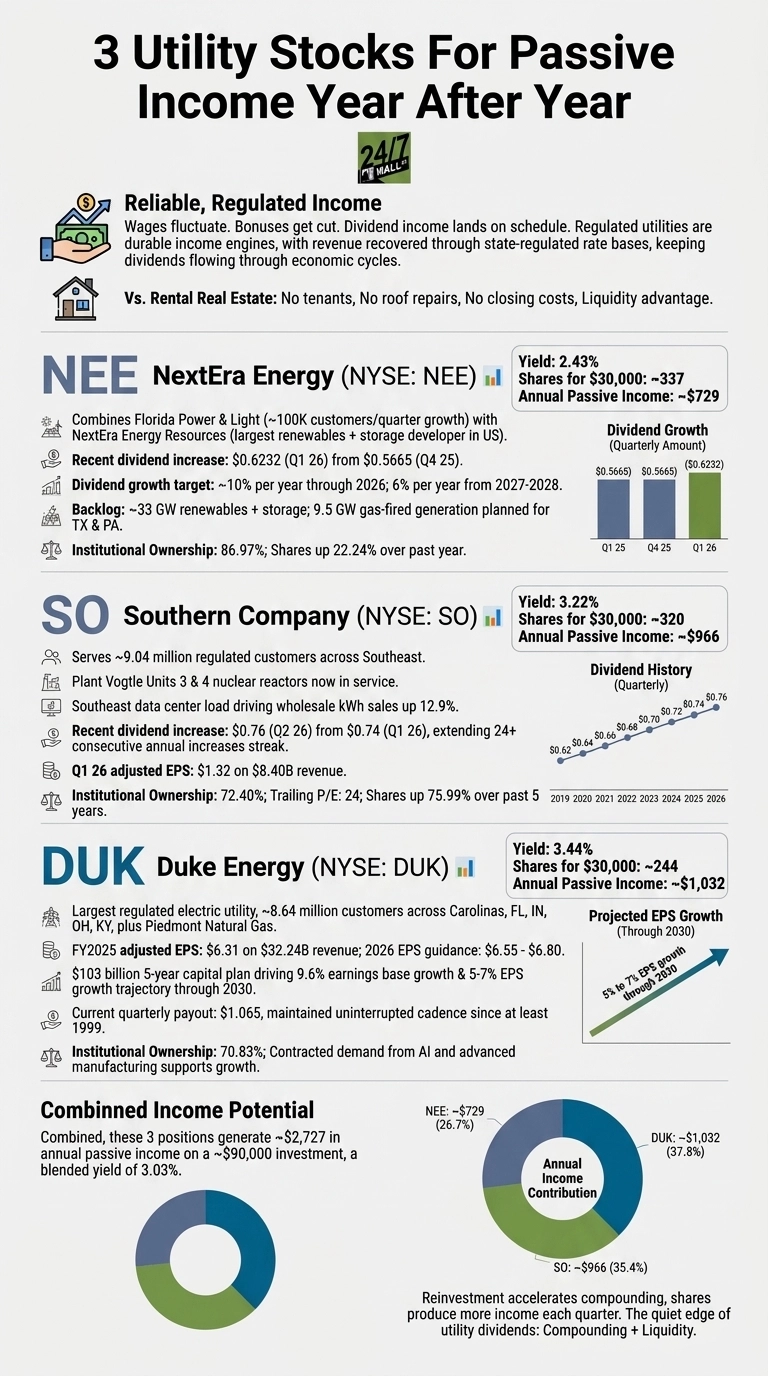
NextEra Energy (NYSE:NEE | NEE Price Prediction) pairs Florida Power & Light, the regulated Florida electric utility adding roughly 100,000 customers per quarter, with NextEra Energy Resources, the largest renewables and storage developer in the United States. The combination produces both rate-base stability and contracted long-term cash flow, which is the structural reason the dividend keeps climbing.
The most recent quarterly payment rose to $0.6232 from $0.5665, consistent with management’s roughly 10% dividend growth target through 2026. Backlog stands near 33 GW of renewables and storage, and NEER was selected to build 9.5 GW of gas-fired generation in Texas and Pennsylvania. Institutional ownership is 86.97%, with Vanguard, BlackRock, and State Street the largest holders. Shares are up 22.24% over the past year.
Southern Company
- Yield: 3.22%
- Shares for $30,000: 320
- Annual Passive Income: $966
Atlanta-based Southern Company (NYSE:SO) owns Alabama Power, Georgia Power, Mississippi Power, and Southern Company Gas, serving roughly 9.04 million regulated customers. The Plant Vogtle Units 3 and 4 nuclear reactors are now in service, and Southeast data center load is driving wholesale kWh sales up 12.9%. Q1 26 adjusted EPS reached $1.32 on revenue of $8.40 billion.
Southern just lifted its quarterly dividend to $0.76 from $0.74, extending a streak of consecutive annual increases that stretches back more than two decades. The trailing P/E sits at 24, and shares are up 75.99% over the past five years.
Duke Energy
- Yield: 3.44%
- Shares for $30,000: 244
- Annual Passive Income: $1,032
Charlotte-based Duke Energy (NYSE:DUK) is one of the largest regulated electric utilities in the country, serving roughly 8.64 million electric customers across the Carolinas, Florida, Indiana, Ohio, and Kentucky, plus Piedmont Natural Gas. FY2025 adjusted EPS came in at $6.31 on revenue of $32.24 billion, and management guided 2026 to $6.55 to $6.80.
The dividend math is anchored by a $103 billion five-year capital plan that supports 9.6% earnings base growth and a 5% to 7% EPS growth trajectory through 2030. The current quarterly payout of $1.065 reflects a payment cadence Duke has maintained without interruption since at least 1999. CEO Harry Sideris said the company is positioned to deliver “5% to 7% EPS growth through 2030” on contracted demand from AI and advanced manufacturing.
The bottom line
Combined, these 3 positions generate $2,727 in annual passive income on a $90,000 investment, a blended yield of 3.03%. Duke Energy contributes $1,032, Southern Company adds $966, and NextEra Energy rounds out the portfolio with $729.
| Ticker | Annual Income | Share of Total |
|---|---|---|
| DUK | $1,032 | 37.8% |
| SO | $966 | 35.4% |
| NEE | $729 | 26.7% |
Reinvested at current yields, the income stream itself buys more shares each quarter, and those shares produce more income the next quarter. That compounding loop, combined with the ability to sell a partial position in minutes if life calls for cash, is the quiet edge utility dividends hold over almost every other income vehicle a retail investor can access.
Contact [email protected] for any questions or corrections.
Vandita Jadeja is a financial publisher with over a decade of experience writing about financial topics, including investment, savings, retirement, insurance and banking. Vandita is a Chartered Accountant who loves to debunk financial concepts for readers.
Her work has appeared on sites that include The Motley Fool, InvestorPlace, and Benzinga. She covers investing and focuses on stock picks and price prediction for 24/7 Wall St.
When not looking for the next stock investment opportunity, she can be found traveling, reading, chasing sunsets and enjoying her iced latte.