Emerging Markets Are Delivering Over 22 Percent Returns and Most American Investors Are Missing It Entirely
The S&P 500 is up about 8% year to date. The same money parked in iShares MSCI Emerging Markets ex China ETF (NASDAQ:EMXC) is up roughly 29.2%. Broad emerging markets funds like iShares Core MSCI Emerging Markets ETF (NYSEARCA:IEMG) and…

This post may contain links from our sponsors and affiliates, and Flywheel Publishing may receive compensation for actions taken through them.

The S&P 500 is up about 8% year to date. The same money parked in iShares MSCI Emerging Markets ex China ETF (NASDAQ:EMXC) is up roughly 29.2%. Broad emerging markets funds like iShares Core MSCI Emerging Markets ETF (NYSEARCA:IEMG) and iShares MSCI Emerging Markets ETF (NYSEARCA:EEM) sit between those poles, up about 20% and about 19% respectively.
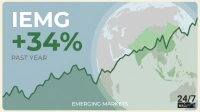
That is a structural gap. Over the trailing year, IEMG is up roughly 39% and EMXC is up about 60%, against about 23% for the S&P 500. Most U.S. investors hold none of it. The average American portfolio is still concentrated in domestic large caps, and the EM allocation that academic models suggest belongs in a global portfolio has been chipped away by a decade of U.S. exceptionalism. Three ETFs offer three different ways to fix that.
Why the gap exists in 2026
Several forces are working in EM’s favor at once. Franklin Templeton’s 2026 outlook flags a weakening U.S. dollar, synchronized monetary easing across emerging central banks, and earnings growth in EM that is expected to match the United States over the next 12 months. A weaker dollar mechanically lifts dollar-denominated returns on foreign equities, and falling local rates support EM bond and stock valuations at the same time.
The wrinkle is China. China is the single largest country weight in a standard EM index, and how a fund treats it has become the dominant driver of returns. IEMG holds about 23% in China. EMXC holds zero. That single decision explains most of the roughly 12-point YTD performance gap between the two funds.
IEMG: the cheap, broad core holding
IEMG belongs on this list because it is the lowest-cost way to buy the whole asset class. The expense ratio is 9 basis points, which puts it among the cheapest international funds in existence. For a buy-and-hold investor who wants EM exposure as a permanent slice of a global portfolio, fee drag compounds for decades, and 9 basis points versus 69 is real money.
The fund tracks the MSCI Emerging Markets Investable Market Index, which includes large, mid, and small caps. The portfolio is dominated by Asian technology, with top holdings led by Taiwan Semiconductor at about 13%, Samsung at 6.8%, Tencent at 2.3%, SK Hynix at 6%, and Alibaba at 1.8%.
Geographic weights run 23% China, 22% Taiwan, 15% South Korea, and 13% India, and information technology alone is about 30% of the fund. Investors should understand what they are actually buying. “Emerging markets” in IEMG is largely a bet on Asian semiconductor and platform companies, with China policy risk baked in. The trailing dividend yield is about 2.2%. The tradeoff: IEMG gives you the full asset class at the lowest possible price, which means you also get every China-specific regulatory shock that comes with it.
EMXC: the contrarian outperformer
EMXC is the differentiated pick on this list. It owns the same emerging market universe with one surgical exclusion: China. That single choice has produced the standout return profile of the group. EMXC is up about 29% year to date and roughly 60% over the past year, versus IEMG’s 20% and 39%.
Removing China rebalances the portfolio in ways that matter. Taiwan, South Korea, and India become the dominant weights instead of competing with a 23% China block. The fund tilts harder toward the EM countries where earnings growth, currency strength, and capital inflows have actually been showing up. South Korean memory makers, Taiwanese chip foundries, and Indian banks have all done the heavy lifting in EM returns in 2026.
The case for EMXC over IEMG comes down to a view on China. If you believe Chinese equities face persistent structural headwinds, policy unpredictability, and demographic drag, you do not want a 23% involuntary allocation to them in your EM fund. The tradeoff cuts both ways: EMXC will lag badly if Chinese stocks mean-revert sharply, and the fund is more concentrated in Taiwan tech, which raises geopolitical tail risk. This is a deliberate active bet inside a passive wrapper.
EEM: the traders’ choice
EEM is the original BlackRock EM fund. It tracks an index nearly identical in spirit to IEMG’s, but limited to large and mid caps. The holdings overlap is heavy: Taiwan Semiconductor is about 14.7% of the fund, Samsung is 7.8%, SK Hynix is 6.8%, Tencent is 2.6%, and Alibaba is 2%. The YTD return of about 19% tracks IEMG closely.
The reason EEM still has a place on this list despite a 69 basis point expense ratio, more than seven times IEMG’s, is liquidity. EEM is the institutional and trader vehicle. The options market on EEM is deep, the bid-ask spreads are tight in size, and large positions can move in and out without friction. For a hedge fund hedging EM exposure, an advisor running a short-dated tactical position, or anyone who wants to write covered calls on EM, EEM is the practical choice.
For a long-term holder, that expense ratio is a tax on convenience that is hard to justify. The tradeoff is straightforward: EEM is built for trading.
Which one fits which investor
The decision framework is cleaner than it looks. If you want a permanent EM allocation in a long-term portfolio and you accept that China is part of the asset class, IEMG is the default answer. The fee is the lowest, the exposure is the broadest, and small-cap inclusion adds modest diversification you do not get in EEM.
If you have a specific view that China’s structural problems will continue to weigh on its equity market, EMXC is the cleanest expression of that view. It has captured the EM rally without the China drag, and its trailing returns reflect that. The question every EMXC buyer needs to answer honestly is whether they are making a tactical call on China for the next year or a structural call for the next decade. The fund works as either, but the position size should differ.
EEM is for tactical use: short-dated trades, options strategies, or institutional positions that need liquidity. Most retail investors do not need it.
The bigger point is that the choice exists at all. American portfolios that skip EM entirely are inheriting a home-country bias by default. With the dollar weakening and EM earnings catching up, the cost of that bias is showing up in 2026 returns.
Contact [email protected] for any questions or corrections.
After 15 years on Wall Street with 7 of them as Director of Corporate and Municipal Bond Trading for a NYSE member firm, I started my own project and corporate finance consultancy. Much of the work involves writing business plans, presentations, white papers and marketing materials for companies seeking budgetary allocations for spinoffs and new initiatives or for raising capital for expansion or startup companies and entrepreneurs. On financial topics, I have been published under my own byline at The Motley Fool, 247wallst.com, DealFlow Events’ Healthcare Services Investment Newsletter and The Microcap Newsletter, among others. Additionally, I have done freelance ghostwriting writing and editing for several financial websites, such as Seeking Alpha and Shmoop Financial. I have also written and been published on a variety of other topics from music, audiophile sound and film to musical instrument history, martial arts, and current events. Publications include Copper Magazine, Fidelity (Germany), Blasting News, Inside Kung-Fu, and other periodicals.