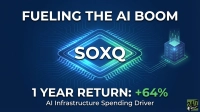
SOXQ Semiconductor ETF Surges 181.74% as AI Chip Boom Lifts NVIDIA, Broadcom, AMD
The Invesco PHLX Semiconductor ETF (NASDAQ:SOXQ) has emerged as one of the cleanest, lowest-cost vehicles for direct semiconductor exposure during the AI capex cycle. The fund tracks the PHLX Semiconductor Sector Index, which represents the 30 largest U.S.-listed semiconductor companies,…

This post may contain links from our sponsors and affiliates, and Flywheel Publishing may receive compensation for actions taken through them.

The Invesco PHLX Semiconductor ETF (NASDAQ:SOXQ) has emerged as one of the cleanest, lowest-cost vehicles for direct semiconductor exposure during the AI capex cycle. The fund tracks the PHLX Semiconductor Sector Index, which represents the 30 largest U.S.-listed semiconductor companies, and carries a 0.19% expense ratio, materially cheaper than the older iShares competitor. Since launching in June 2021, it has crossed $1 billion in assets under management as of February 2026.
The performance picture is striking. SOXQ closed at $109.58 on June 3, 2026, capping a 181.74% one-year return and a 96.71% year-to-date advance. The benchmark comparison is iShares Semiconductor ETF (SOXX), which returned 190.03% over the same one-year window. The gap is narrow enough that the expense-ratio savings remain a real edge for long-term holders.
The Concentration Problem (and Why It Worked)
SOXQ is a market-cap-weighted fund, and that math matters. The top 10 holdings account for 59% of assets as of February 2026, which makes the fund highly sensitive to the performance of a few key AI accelerator leaders. In the current cycle, that concentration has been the engine of returns. Published holdings disclosures identify NVIDIA, Broadcom, Advanced Micro Devices, and Micron as the dominant positions, with the first three driving the bulk of the index’s gain over the past year.
1. NVIDIA
NVIDIA (NASDAQ:NVDA | NVDA Price Prediction) is the anchor holding and the single largest contributor to SOXQ’s one-year return. The stock carries 0.893846 relevance to SOXQ in news sentiment analysis, the highest of any constituent, reflecting how tightly the fund’s narrative tracks the GPU leader. NVIDIA has absorbed real headwinds, including an anticipated $8 billion impact from U.S. chip-export restrictions to China, yet hyperscaler demand from Microsoft, Amazon, and Google has more than offset the loss. With the AI chip market potentially reaching $500 billion by 2026, NVIDIA’s weight inside SOXQ is the primary reason the fund has outpaced the broader tech tape.
2. Broadcom
Broadcom (NASDAQ:AVGO) is the second pillar. Its custom ASIC business for hyperscalers, paired with networking silicon, has positioned it as the most direct beneficiary of the build-out beyond NVIDIA’s GPUs. Sentiment data flags AVGO at 0.704059 relevance with a bullish rating. Broadcom has shown resilience despite tariff concerns, with the direct tariff exposure for semiconductors limited by exemptions. The position has compounded the fund’s gains as data center capex has migrated from training to inference workloads.
3. Advanced Micro Devices
Advanced Micro Devices (NASDAQ:AMD) rounds out the top contributors. The company’s server CPU franchise has continued to take share from Intel, with server CPU market share exceeding 40% with firmer pricing as of April 2026. The stock posted a 168.31% 12-month gain heading into mid-2026, and Citi views AMD as a near-term opportunity within an otherwise cautious semiconductor earnings stance. AMD’s MI-series accelerators have created a credible second source for AI compute, and its weight in SOXQ has lifted the fund disproportionately during sector-wide rallies.
What This Means for the Fund’s Behavior
The trio above explains the run. Semiconductor stocks recently completed a 17-consecutive-day winning streak, gaining over 40% during the run, an unprecedented event in the PHLX Semiconductor Index’s 32-year history. Historical data shows an 87% success rate for positive returns in the three-to-six-month period following such streaks, though past patterns are not guarantees.
The flip side of concentration is fragility. A profitability scare in March 2026 drove a broader sell-off tied to AI profitability, capital spending, macroeconomic factors, and geopolitical tensions. SOXQ also pays a modest distribution, with a quarterly $0.0706 per share payout, ex-dividend March 26, 2026.
What to Watch
The fund’s next leg depends on three variables: hyperscaler capex guidance from the Big Four cloud operators, the trajectory of U.S. export controls into China, and whether wafer-fab equipment spending follows through on the roughly 25% annual growth for datacenter equipment that institutional outlooks now treat as baseline. With a 32.12% gain in the past month alone, valuation cushion has thinned, even if the underlying earnings stream keeps expanding.
Contact [email protected] for any questions or corrections.
I am a long time investor and student of business, and believe finding good companies that can become great investments is the best game on earth. After 20 years of writing and researching the public markets it is clear that individuals have never had more tools and information to take control of their financial lives. From ETFs and $0 commissions to cryptos and prediction markets there has never been a greater democratization of access to investing.
I write to help people understand the investments available to them so they can make the best choice for their portfolio, whether they're starting out or looking for income in retirement.