Why This Semiconductor ETF Is the Only Bet You Need Before the Next AI Wave
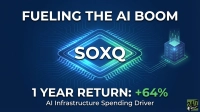
Invesco PHLX Semiconductor ETF (NASDAQ:SOXQ) has roughly doubled this year, and that single fact is the reason to slow down rather than chase. SOXQ is up 89% year to date and 157% over the past year, which is what happens…


Invesco PHLX Semiconductor ETF (NASDAQ:SOXQ) has roughly doubled this year, and that single fact is the reason to slow down rather than chase. SOXQ is up 89% year to date and 157% over the past year, which is what happens when an industry projected to clear $1.3 trillion in annual revenue this year runs into a memory supply shortage at the same time hyperscaler capex breaks records. The real question SOXQ poses is whether you want this particular slice of the AI engine, at this price, with this much concentration in five names.
What SOXQ actually owns
The fund tracks the PHLX Semiconductor Sector index, holding 30 of the largest U.S.-listed semiconductor companies on a market-cap weighting. Top positions read like a roll call of the AI trade, NVIDIA (NASDAQ:NVDA | NVDA Price Prediction), Broadcom (NASDAQ:AVGO), AMD (NASDAQ:AMD), Micron (NASDAQ:MU), and ASML (NASDAQ:ASML). The top ten names carry 59% of assets, so this is effectively a leveraged bet on the handful of firms selling picks and shovels into the hyperscaler capex cycle, with a long tail of equipment and analog names along for the ride.
The return engine is straightforward. SOXQ owns the chipmakers, the chipmakers sell into data center buildouts, and Microsoft, Amazon, and Google keep writing the checks. There is almost no dividend cushion. The Q1 2026 distribution was $0.0706 per share, which is rounding error against a $105 share price. You own this for capital appreciation, full stop.
Does the strategy deliver
It has, by an embarrassing margin. SOXQ has returned 335% over five years, an annualized 32%. A thousand dollars put in at the 2021 launch is now worth $4,350. Compare that to QQQ, the standard tech proxy, which returned 118% over the same five years and 17.6% year to date. SOXQ has roughly tripled the broader tech basket because it skipped the consumer software middlemen and went straight to the silicon.
The expense ratio is the quiet reason to prefer SOXQ over its better-known sibling SOXX. Invesco charges 0.19% annually, materially below the iShares product for what amounts to the same shopping list. On $1 billion-plus in assets, that gap compounds.
The tradeoffs you accept
Concentration cuts both ways. The same NVIDIA weighting that delivered the run-up is what made the March 2026 selloff bite, and a Seeking Alpha review called the portfolio “highly volatile, richly valued, and concentrated.” When AI capex blinks, SOXQ does not have ballast.
Then there is the memflation question. Memory pricing is currently a tailwind, with Taiwan’s memory and other manufacturing segment up 152% year on year in Q1, but memory has historically been the most violent cycle in chips. Micron sits in your top holdings either way. And the non-AI side of the sector, autos, industrial, consumer, has been sluggish even as data center logic chips boom, so the fund’s recent results are essentially one trade dressed up as diversification.
Geopolitics is the third constraint. NVIDIA’s $8 billion China drag from export restrictions is a reminder that policy can erase a quarter of demand with a memo.
Who SOXQ fits
SOXQ works as the AI-exposed growth sleeve inside a diversified portfolio, probably in the 5% to 10% range for investors who already own broad equity index funds and want a sharper instrument for the semiconductor cycle. The title’s framing aside, treating any single-sector fund as the “only bet you need” is how concentrated portfolios meet 40% drawdowns.
Anyone within a few years of retirement, or anyone who would sell on a 30% pullback, should stay with QQQ or a total-market fund and accept the smaller upside. For everyone else, the lower fee and cleaner construction make SOXQ the more rational way to own this thesis than its more expensive competitor.
Contact [email protected] for any questions or corrections.
Omor Ibne Ehsan is a writer at 24/7 Wall St. He is a self-taught investor with a focus on growth, cyclical, and dividend equities that have strong fundamentals, value, and long-term potential. He also has an interest in high-risk, high-reward investments such as penny stocks.