CNBS Rallied Triple Digits On One Regulatory Bet, Not Dividends
The Amplify Seymour Cannabis ETF (NYSEARCA:CNBS) has rallied sharply in 2026, with shares up 105% over the past year and 9% in just the last week. Income-focused investors eyeing that chart and the fund’s actively managed cannabis basket may assume…


The Amplify Seymour Cannabis ETF (NYSEARCA:CNBS) has rallied sharply in 2026, with shares up 105% over the past year and 9% in just the last week. Income-focused investors eyeing that chart and the fund’s actively managed cannabis basket may assume the rally comes with a real distribution. It does not. CNBS pays an irregular, year-end-only distribution that functions as a tax housekeeping event rather than a budgetable income stream.
How CNBS Actually Generates Cash
CNBS is an actively managed fund run by Tim Seymour, the CNBC Fast Money co-host, with a portfolio focused exclusively on U.S. cannabis and hemp companies after a January 2026 realignment that included a 1-for-12 reverse share split. Its gross expense ratio is 0.76%, steep but consistent with thematic active funds.
The income problem starts with the holdings. U.S. cannabis operators do not pay dividends. They are cash-constrained, capital-hungry growth companies burdened by Section 280E of the federal tax code, which blocks them from deducting ordinary business expenses as long as cannabis remains a Schedule I substance. There is no underlying yield for CNBS to pass through. The fund’s distribution, when it appears, is almost entirely a pass-through of realized capital gains and interest earned on cash.
The Distribution History
CNBS has paid four distributions in its life. The most recent was $0.892604 per share on December 31, 2024, almost entirely a capital-gains pass-through. Before that came $0.00016135 in December 2021, a token amount, and $0.10103 in December 2020 and $0.077 in December 2019. There were no distributions in 2022, 2023, or 2025.
For an investor, that pattern is a once-a-year, lumpy, unpredictable payment driven entirely by whether the portfolio manager realized net gains in that calendar year. Treating CNBS as an income vehicle would be a category error. The 2024 distribution, sized against current shares around $32, looks like a roughly 3% backward-looking payment, but there is no reason to expect it to repeat in 2026, and the prior dry years prove it.
The Rally Is a Regulatory Trade
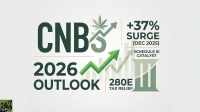
CNBS is up triple digits because of a single policy bet on federal cannabis reclassification. President Trump’s plan to reclassify marijuana from Schedule I to Schedule III via executive order drove cannabis ETFs double-digit gains in December 2025, with CNBS sentiment scoring 0.836 on December 13, 2025, the highest reading in the dataset. Reclassification would eliminate the 280E tax penalty and could finally let institutional capital touch the sector.
If that happens, operators become more profitable and CNBS holdings could keep running. None of that mechanically translates into a higher or more reliable distribution from the ETF. The companies would reinvest the tax savings into growth long before they cut dividend checks.
Total Return Context
The five-year picture is the sobering counterweight to the one-year chart. CNBS is still down roughly 85% over five years on an adjusted basis, even after the 2026 surge. A 1% sliver of irregular distribution income would not have changed that math. Sungarden Investment Publishing in December 2025 flagged a trailing P/E around 12x and price-to-sales near 3x, and recommended only a 1% to 3% portfolio allocation because of volatility.
The Verdict
CNBS is a capital-appreciation vehicle wearing an ETF wrapper. The distribution question is settled: there is no durable income to assess because there is no durable income to begin with. The fund’s payments are sporadic capital-gains pass-throughs tied to whatever Seymour realizes in a given year. Investors who own CNBS for a Schedule III reclassification trade are owning the right thing for the right reason. Investors who bought it expecting yield are holding the wrong instrument for that goal. A diversified dividend or covered-call ETF will deliver predictable income; CNBS will deliver a policy bet and occasionally a tax form in late December.
Contact [email protected] for any questions or corrections.
After 15 years on Wall Street with 7 of them as Director of Corporate and Municipal Bond Trading for a NYSE member firm, I started my own project and corporate finance consultancy. Much of the work involves writing business plans, presentations, white papers and marketing materials for companies seeking budgetary allocations for spinoffs and new initiatives or for raising capital for expansion or startup companies and entrepreneurs. On financial topics, I have been published under my own byline at The Motley Fool, 247wallst.com, DealFlow Events’ Healthcare Services Investment Newsletter and The Microcap Newsletter, among others. Additionally, I have done freelance ghostwriting writing and editing for several financial websites, such as Seeking Alpha and Shmoop Financial. I have also written and been published on a variety of other topics from music, audiophile sound and film to musical instrument history, martial arts, and current events. Publications include Copper Magazine, Fidelity (Germany), Blasting News, Inside Kung-Fu, and other periodicals.