Dividend Safety Check: CNBS and Income in the Cannabis Sector
CNBS carries a distribution, but nearly every dollar of it flows from a single cannabis landlord whose payout currently exceeds the cash it generates. Before buying this ETF for income, investors need to see what that dependency actually looks like…

The Amplify Seymour Cannabis ETF (NYSEARCA:CNBS) sits at the awkward intersection of a thematic sector bet and an income wrapper. CNBS holds a concentrated basket of cannabis operators, and its distribution profile is shaped almost entirely by one name: a struggling REIT. With CNBS trading near $29 and an expense ratio of 0.76%, anyone considering CNBS for income needs to understand that the fund’s payout sustainability hinges on a single tenant-stressed cannabis landlord rather than on a diversified pool of dividend payers.
Where the Income Actually Comes From
Cannabis is a growth-stage sector, and that shows up in CNBS’s holdings. Of the four named positions, only one writes a meaningful check to shareholders. Innovative Industrial Properties (NYSE:IIPR) pays $7.60 annually, currently yielding roughly 12.3% on its own share price. The three large multi-state operators in the fund, Trulieve, Green Thumb, and Cresco Labs, pay nothing. Green Thumb returns capital exclusively through buybacks, repurchasing roughly 29 million shares for about $200 million since September 2023. That is shareholder-friendly, but none of it flows into CNBS distributions.
What that means in plain terms: CNBS’s distribution rides on IIPR. If IIPR cuts, the fund’s payout shrinks materially.
The IIPR Problem
IIPR’s dividend has held steady at $1.90 per quarter for eight straight quarters, and the company has never cut. That track record matters. The issue is current coverage.
In Q1 2026, IIPR reported AFFO of $1.88 per share against a $1.90 dividend, an AFFO payout ratio of roughly 101%. The dividend is, by a hair, exceeding the cash metric it is supposed to be funded from. Operating cash flow of $56 million barely covered the $54.9 million quarterly dividend, and for full-year 2025, OCF of $198.2 million fell short of $219.5 million in distributions. That is the definition of a stretched payout.
The pressure is real. Tenants PharmaCann, 4Front Ventures, and Battle Green are in default, costing about $6.9 million in Q1 revenue, and the top 10 tenants account for 67% of base rent. IIPR also faces $291.2 million in unsecured notes maturing in May 2026, with CEO Alan Gold pursuing nearly $130 million in additional debt to refinance. Interest expense jumped to $6.4 million from $4.5 million year over year.
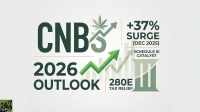
There is one offset worth naming. IIPR’s up-to-$270 million IQHQ life-science investment is already generating $5 to $6.7 million per quarter in interest and dividend income, providing diversification away from cannabis tenants. And the April 2026 reclassification of medical cannabis to Schedule III removes the 280E tax burden for IIPR’s tenant base, which should improve their ability to pay rent.
Price Performance and the Total Return Picture
Any income discussion has to confront what CNBS has done to capital. Shares are up roughly 97% over the past year on rescheduling optimism, but the five-year picture is brutal: down about 86%. The underlying names tell the same story. Cresco Labs trades at $0.82, down roughly 93% over five years, and burned $13.2 million in free cash flow last quarter while servicing a $325 million term loan at 12.5%.
The Verdict
CNBS functions as a growth and regulatory-catalyst vehicle that happens to carry a distribution. Its distribution is a byproduct of holding IIPR, whose payout is currently uncovered by AFFO, threatened by tenant defaults, and pressured by a near-term debt refinancing. Polymarket traders currently assign just a 27% probability of full rescheduling by year-end 2026, so the regulatory rescue is not a sure thing on any near-term timeline.
Owning IIPR directly offers investors who want cannabis exposure with a side of income a more transparent 12.3% yield, with the risks unfiltered by a fund wrapper. CNBS makes sense for thematic upside, with the distribution treated as a secondary consideration rather than a reliable income stream.
Contact [email protected] for any questions or corrections.
After 15 years on Wall Street with 7 of them as Director of Corporate and Municipal Bond Trading for a NYSE member firm, I started my own project and corporate finance consultancy. Much of the work involves writing business plans, presentations, white papers and marketing materials for companies seeking budgetary allocations for spinoffs and new initiatives or for raising capital for expansion or startup companies and entrepreneurs. On financial topics, I have been published under my own byline at The Motley Fool, 247wallst.com, DealFlow Events’ Healthcare Services Investment Newsletter and The Microcap Newsletter, among others. Additionally, I have done freelance ghostwriting writing and editing for several financial websites, such as Seeking Alpha and Shmoop Financial. I have also written and been published on a variety of other topics from music, audiophile sound and film to musical instrument history, martial arts, and current events. Publications include Copper Magazine, Fidelity (Germany), Blasting News, Inside Kung-Fu, and other periodicals.