Dan Ives’ Own ETF Is Up 27% YTD. The AI Revolution Trade Is Real.
The pitch behind the Dan Ives Wedbush AI Revolution ETF (NASDAQ:IVES) was simple when it launched. Wall Street’s loudest AI bull would put his name on a basket of the companies he had been pounding the table about for three…


The pitch behind the Dan Ives Wedbush AI Revolution ETF (NASDAQ:IVES) was simple when it launched. Wall Street’s loudest AI bull would put his name on a basket of the companies he had been pounding the table about for three years, and you could buy the basket. The honest read on the first few months of 2026 is that the basket has worked, and worked clearly better than the broad market, even after a rough week.
What the YTD number actually is
The headline you may have seen floating around was 27% YTD. That was real, but it was the peak. Through Tuesday’s close on June 9, 2026, IVES sits at $36.94, which works out to a 17% year-to-date gain from a December 31 starting price of $31.61. The fund peaked closer to $41.40 a week ago and has since given back 11% in five trading days, which is the kind of move you should expect when a concentrated megacap-tech fund hits a turbulent market.
For comparison, the SPDR S&P 500 ETF Trust (NYSEARCA:SPY) is up 8% YTD, closing at $737. So even after the air came out of IVES last week, the Ives basket is outpacing the S&P 500 by roughly 9 percentage points YTD and by 44% vs 23% over the trailing year. That is the “position just did X” story in one sentence. A thematic ETF, run with a heavy hand and a personality attached, is doing roughly twice the market in a year when the market itself is fine.
One housekeeping note. IVES carries a 0.75% net expense ratio, which is what you pay for an actively curated AI book rather than an index. That is not cheap, and you should factor it into any longer-hold thesis.
The mechanism, which is the whole article
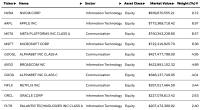
Look at what is inside. The top ten holdings, as of May 25, 2026, are Tesla (5.34%), Taiwan Semiconductor (4.89%), Alphabet (4.62%), Apple (4.62%), Nvidia (4.54%), Alibaba (4.53%), Broadcom (4.51%), Oracle (4.41%), Microsoft (4.32%), and Meta (4.07%). The top five alone are 24% of the fund. This is a concentrated bet on AI infrastructure and the hyperscalers paying for it, with a token sleeve of consumer-facing AI exposure (Tesla, Apple, Meta) and one wildcard (Alibaba) for Chinese AI optionality.
The mechanism producing the outperformance is the same one that ate up most of the financial press in 2025 and 2026. The companies inside IVES are the ones receiving, building, or selling into the AI capex cycle, and that cycle has not slowed. NVIDIA (NASDAQ:NVDA | NVDA Price Prediction) printed Q1 FY27 revenue of $81.6 billion, up 85% year over year, with the data center segment alone at $75.2 billion and networking up 199%. Jensen Huang’s framing on the call, that “the buildout of AI factories, the largest infrastructure expansion in human history, is accelerating at extraordinary speed,” is exactly the sentence Ives has been repeating on television for two years.
Alphabet (NASDAQ:GOOGL) is up 17% YTD on the back of a Google Cloud quarter that grew 63% with a backlog of more than $460 billion. Taiwan Semiconductor (NYSE:TSM), the largest holding in the fund at 4.89%, is up 41% YTD, which is a chunk of the IVES return all by itself. Broadcom (NASDAQ:AVGO) guided Q3 AI semiconductor revenue to $16 billion, up more than 200% year over year, with CEO Hock Tan calling out that the momentum continues. And Oracle (NYSE:ORCL) is sitting on $553 billion of remaining performance obligations, a number that grew 325% year over year. That is contracted future cloud revenue, signed.
Put plainly, the basket caught the right side of an enormous capex cycle. Ives picked names, weighted them with conviction, and the underlying market did the work. It is a plain-vanilla stock-picker’s bet, with no leverage or derivatives overlay, that worked because the underlying companies are generating record cash flow on the AI buildout.
Why last week happened
The 11% one-week drawdown is the part of the story you should not skip. Broadcom fell 19% in the same week. Oracle fell 16%. NVIDIA dropped 6%. When a fund’s top eight names are this correlated to a single thesis, a market that turns on the thesis (valuation worries, GPU rental prices declining, Burry-style bubble takes circulating on Reddit) hits everything at once. Reddit sentiment around NVDA dipped to scores in the low-20s on June 6, with a viral post collecting more than 15,000 upvotes, the kind of sentiment flip that moves prices without moving fundamentals.
This is the cost of concentration. You get the upside cleanly. You also get the downside cleanly.
What to watch from here
The forward case for IVES rests on whether AI capex stays at the pace the headline holdings are guiding to. The specific indicators worth watching are line items the companies themselves publish.
- NVIDIA’s $119 billion in supply commitments and the Q2 FY27 guide of $91 billion. If that guide holds in August, the capex thesis is intact.
- Google Cloud’s $460 billion backlog. If it keeps growing quarter on quarter, hyperscaler AI demand is real and durable.
- Broadcom’s Q3 AI semi number. The company has guided to $16 billion. Hitting it confirms custom silicon demand from a second hyperscaler base.
- Oracle’s RPO trajectory. The current $553 billion figure has to convert into actual cloud revenue without margin compression. Prediction markets give Oracle a 92% chance of beating this quarter’s earnings, but the longer story is whether the bookings turn into cash.
- TSMC’s advanced-node utilization. If Arizona ramps and the top-10 customer concentration (84% of AR) does not unwind, the foundry chokepoint stays a profit center for the basket.
The honest read is that IVES is doing exactly what it advertised. It is a high-conviction bet on a specific capex cycle, and that cycle is still pouring concrete. Polymarket gives NVIDIA a 90% probability of finishing June above $190 and an 84% probability of staying above $200 through month-end, which is the crowd’s way of saying the regime has not flipped. The risk you are taking, if you buy IVES at $36.94 instead of $31.61, is that you are paying up for a thesis that is no longer a contrarian call. The setup is broadly intact at a much higher valuation, and the same volatility that gave you a 27% peak in five months will give you weeks like the last one.
The single thing to remember. The AI Revolution trade is real, the basket built around it is working, and the things to watch are the capex line items, not the price of the ETF.
Contact [email protected] for any questions or corrections.
I am a long time investor and student of business, and believe finding good companies that can become great investments is the best game on earth. After 20 years of writing and researching the public markets it is clear that individuals have never had more tools and information to take control of their financial lives. From ETFs and $0 commissions to cryptos and prediction markets there has never been a greater democratization of access to investing.
I write to help people understand the investments available to them so they can make the best choice for their portfolio, whether they're starting out or looking for income in retirement.