3 Stocks With a Yield Over 6% For Passive Income Investors
Passive income arrives while you sleep, commute, or vacation. That appeal drives dividend investing: a paycheck every quarter regardless of market conditions or work hours.Layoff announcements have rattled white-collar industries through the first half of 2026, and essentials costs climb…

Passive income arrives while you sleep, commute, or vacation. That appeal drives dividend investing: a paycheck every quarter regardless of market conditions or work hours.
Layoff announcements have rattled white-collar industries through the first half of 2026, and essentials costs climb faster than most household raises. Building a cash-flowing portfolio is one of the few defenses an individual investor controls directly. Unlike rental real estate, a high-yield dividend portfolio is liquid, requires no tenant management, and lets you redirect capital with a single trade.
We screened our 24/7 Wall St. dividend equity research database for stocks that pay massive dividends. A collection of companies can generate over $1,900 a year in passive annual income if you invest $10,000 in each stock at the time of this writing.
Verizon Communications
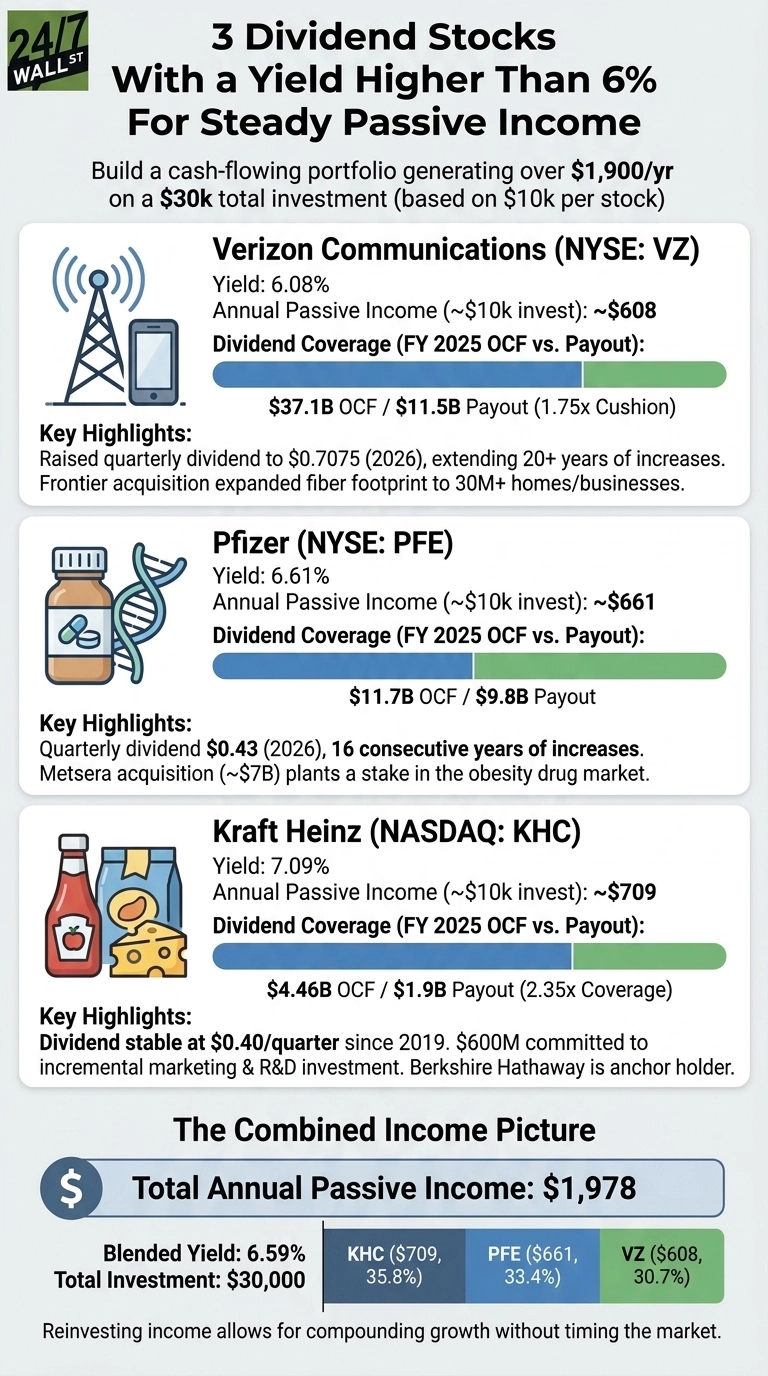
- Yield: 6.08%
- Shares for $10,000: 213
- Annual Passive Income: $608
Verizon (NYSE:VZ | VZ Price Prediction) is the largest U.S. wireless carrier and fiber broadband powerhouse following the January 20, 2026 close of the Frontier Communications acquisition, which expanded its fiber footprint to more than 30 million homes and businesses.
The dividend is fueled by predictable subscriber cash flow: FY 2025 operating cash flow of $37.1 billion covered $11.5 billion in common dividends with a 1.75x cushion.
Telecom is a regulated, capital-heavy industry where mature operators return excess cash through dividends rather than reinvest for hypergrowth. Verizon raised its quarterly payout to $0.7075 per share in 2026, extending annual increases spanning over two decades. Management completed $2.5 billion in buybacks in Q1 2026 while paying down Frontier-related debt.
Pfizer
- Yield: 6.61%
- Shares for $10,000: 390
- Annual Passive Income: $661
Pfizer (NYSE:PFE) is a global biopharmaceutical company spanning Primary Care, Specialty Care, and Oncology, with blockbuster brands including Eliquis, Prevnar, Vyndaqel, Ibrance, Padcev, and Nurtec ODT.
The high yield reflects post-COVID revenue normalization rather than business distress: FY 2025 operating cash flow of $11.7 billion covered $9.8 billion in dividends, and management reaffirmed FY 2026 guidance for adjusted EPS of $2.80 to $3.
Big Pharma pays large dividends because mature drug franchises throw off enormous free cash flow exceeding reinvestment needs. Pfizer has raised the payout for 16 consecutive years, moving the quarterly dividend from $0.32 in 2017 to $0.43 in 2026.
A Vyndamax patent settlement extends U.S. exclusivity to June 2031, and the roughly $7 billion Metsera acquisition plants a stake in the obesity drug market. Institutional ownership sits at 69.4%.
Kraft Heinz
- Yield: 7.09%
- Shares for $10,000: 415
- Annual Passive Income: $709
Kraft Heinz (NASDAQ:KHC) owns Heinz, Kraft, Philadelphia, Primal Kitchen, Lunchables, and Ore-Ida, selling packaged food across North America, International Developed Markets, and Emerging Markets.
The yield is elevated because the share price has compressed: KHC trades down 29.17% over the past five years as volume softness in coffee, cold cuts, and frozen meals weighed on the multiple.
The dividend has held at $0.40 per quarter since 2019 and is well covered by cash: FY 2025 operating cash flow of $4.46 billion against a $1.9 billion payout works out to 2.35x coverage.
New CEO Steve Cahillane paused the previously announced company split and committed $600 million in incremental marketing and R&D investment. Berkshire Hathaway remains the anchor institutional holder, with insiders owning 27.78% of shares.
The Combined Income Picture
Combined, these 3 positions generate $1,978 in annual passive income on a $30,000 investment, a blended yield of 6.59%. Kraft Heinz contributes $709, Pfizer adds $661, and Verizon rounds out the portfolio with $608.
| Ticker | Investment | Yield | Annual Income | Share of Total |
|---|---|---|---|---|
| KHC | $10,000 | 7.09% | $709 | 35.8% |
| PFE | $10,000 | 6.61% | $661 | 33.4% |
| VZ | $10,000 | 6.08% | $608 | 30.7% |
| Total | $30,000 | 6.59% | $1,978 | 100% |
Reinvested at the same blended yield, that $1,978 would buy roughly another $130 of annual income next year, then another $138 the year after. Cash flow arriving on a schedule lets a portfolio compound without forcing the investor to time entries, exits, or earnings reactions.
Contact [email protected] for any questions or corrections.
Vandita Jadeja is a financial copywriter who loves to read and write about stocks. She believes in buying and holding for long term gains. Her knowledge of words and numbers helps her write clear stock analysis. She has contributed to several publications, including the Joy Wallet, Benzinga, The Motley Fool and InvestorPlace.