AbbVie Stock Will Hit $300 on This Date
AbbVie (NYSE:ABBV | ABBV Price Prediction) has quietly become one of healthcare’s most underrated growth stories. CEO Robert A. Michael told investors after Q1, “We are off to an excellent start in 2026, with first-quarter results exceeding our expectations.” The…

AbbVie (NYSE:ABBV | ABBV Price Prediction) has quietly become one of healthcare’s most underrated growth stories. CEO Robert A. Michael told investors after Q1, “We are off to an excellent start in 2026, with first-quarter results exceeding our expectations.”
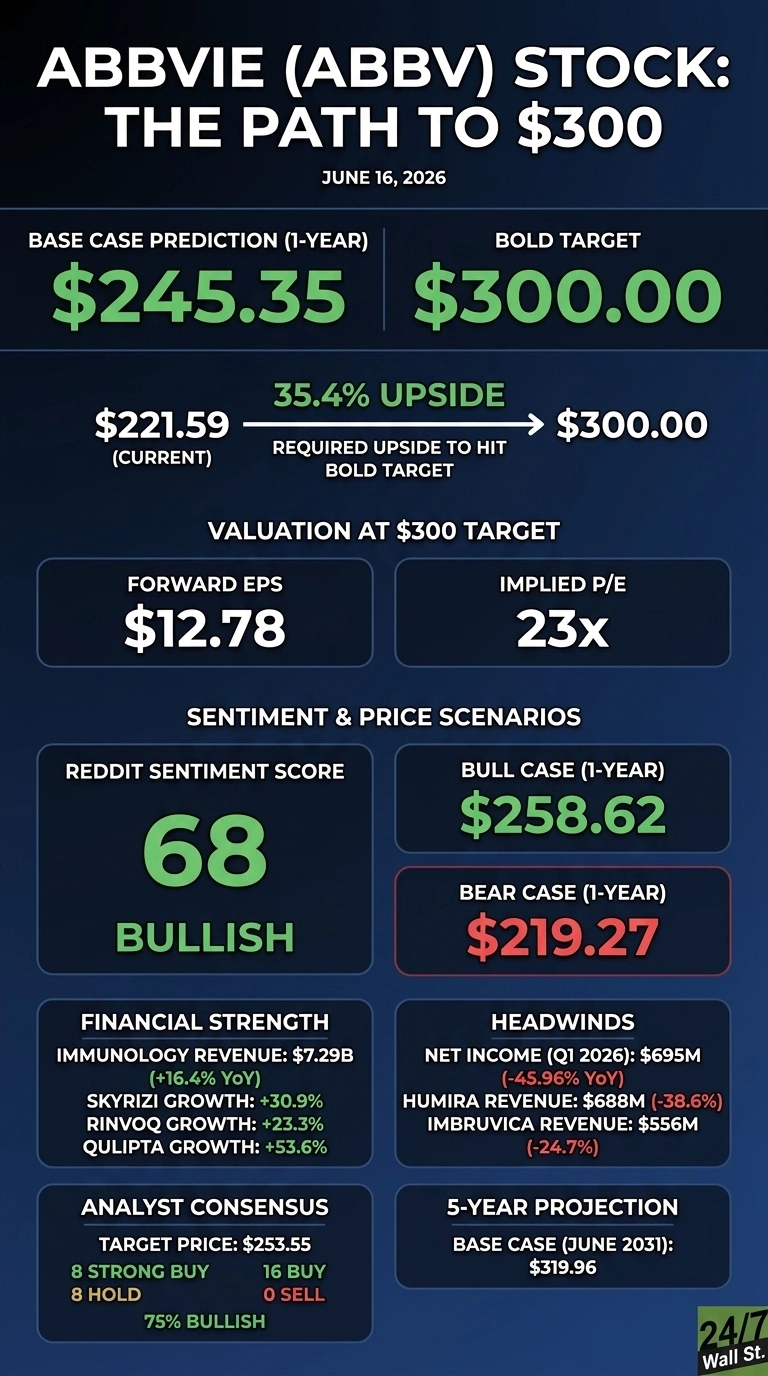
The numbers back him up. Immunology revenue hit $7.29 billion, with Skyrizi up 30.9% and Rinvoq up 23.3%. Yet shares trade at just $221.59, down 1.43% YTD. Can AbbVie hit $300 by 2030?
What’s Holding AbbVie Back Right Now
The disconnect is real. Shares are off 0.66% over the past week despite revenue accelerating to +12.4% YoY in Q1 2026.
Net income fell 45.96% YoY, largely due to a $744 million acquired in-process R&D charge that clipped EPS by $0.41. The market treats those charges as recurring damage rather than pipeline investment.
Add the structural Humira biosimilar decline (revenue fell 38.6% to $688 million) and Imbruvica’s 24.7% decline, and you have a stock investors keep underwriting at a discount. With a beta of just 0.309, this trades as a low-volatility defensive name.
Wall Street Sees 14% Upside. I Think That’s Too Cautious
The consensus target is $253.55, implying roughly 14.4% upside. Ratings split: 8 Strong Buy, 16 Buy, 8 Hold, zero sells. Our base case 247Factor model lands at $245.35 (10.72% upside), with an optimistic case at $258.62 and a bear case of $219.27. Confidence on the base case is 90%.

Bullish sentiment sits at 75%, yet earnings growth gets penalized because of IPR&D noise. Strip those charges, and management already raised full-year guidance to $14.08 to $14.28. Analysts and our model anchor on a one-year window. $300 is a multi-year question.
The Path to $300 Per Share
Reaching $300 from today’s price of $221.59 requires a gain of 35.4%. With forward EPS of $12.78, a price of $300 implies a forward P/E of 23x. Our base case of $245.35 already implies 22x, meaning the bold target requires only about 2x additional multiple expansion.
The adjustment factor in our model is 1.103, lifted by healthcare sector momentum and 75% bullish analyst consensus, but capped by mega-cap dampening.

Skyrizi crossed $5.01 billion last quarter and is still growing 30%+. Qulipta is up 53.6%. Michael told investors, “Our pipeline progress and solid business fundamentals position AbbVie for robust long-term growth.” Our 5-year bull case models $301 by June 2030. The primary risk is faster-than-expected erosion across the legacy oncology franchise.
Where AbbVie Trades Today vs Its Earnings Power
At $221.59 against forward EPS of $12.78, ABBV trades at a forward P/E of 17x. That looks cheap for a business growing top-line at +12.4% with operating margins above 32%.
Shares sit between a 52-week range of $176 and $239.13, currently about 6% off the high. ABBV has returned 457.85% over 10 years and 131.55% over five. A 35% climb to $300 over roughly four years is well within that historical pace.
Is $300 Realistic? Here’s My Take
Reaching $300 requires a 35.4% gain, realistic on a multi-year timeline rather than a 12-month sprint.
Three things need to go right: Skyrizi and Rinvoq need to keep compounding at 20%+, IPR&D charge noise must fade so reported EPS converges with adjusted EPS, and the neuroscience franchise needs to sustain its +26% growth trajectory. A faster collapse in Humira and Imbruvica revenue than next-gen drugs can absorb would derail it. We’ve outlined the blueprint for how AbbVie could reach $300 in 2030.
Contact [email protected] for any questions or corrections.
Vandita Jadeja is a financial publisher with over a decade of experience writing about financial topics, including investment, savings, retirement, insurance and banking. Vandita is a Chartered Accountant who loves to debunk financial concepts for readers.
Her work has appeared on sites that include The Motley Fool, InvestorPlace, and Benzinga. She covers investing and focuses on stock picks and price prediction for 24/7 Wall St.
When not looking for the next stock investment opportunity, she can be found traveling, reading, chasing sunsets and enjoying her iced latte.