Two Paths to Growth: Johnson & Johnson vs AbbVie
Johnson & Johnson (NYSE:JNJ | JNJ Price Prediction) and AbbVie (NYSE:ABBV) both posted Q1 2026 results that beat revenue expectations and prompted raised full-year guidance. JNJ leaned on a diversified pharma plus MedTech engine. AbbVie leaned almost entirely on immunology.…


Johnson & Johnson (NYSE:JNJ | JNJ Price Prediction) and AbbVie (NYSE:ABBV) both posted Q1 2026 results that beat revenue expectations and prompted raised full-year guidance. JNJ leaned on a diversified pharma plus MedTech engine. AbbVie leaned almost entirely on immunology. Both face biosimilar headwinds, yet each chose a different way to outgrow them.
TREMFYA and Cardiovascular Carry JNJ. Skyrizi Carries AbbVie.
JNJ delivered revenue of $24.06 billion (+9.9% YoY) and adjusted EPS of $2.70, a fourth straight beat. Innovative Medicine led with 11.2% growth, powered by DARZALEX at $3.96 billion (+22.5%) and TREMFYA leaping 68.3% as it absorbs STELARA patients.
MedTech Cardiovascular climbed 13%, with Shockwave up 18.5%. CEO Joaquin Duato called the quarter “a strong start to 2026”, and the company raised its FY26 revenue outlook to a midpoint of $100.8 billion.
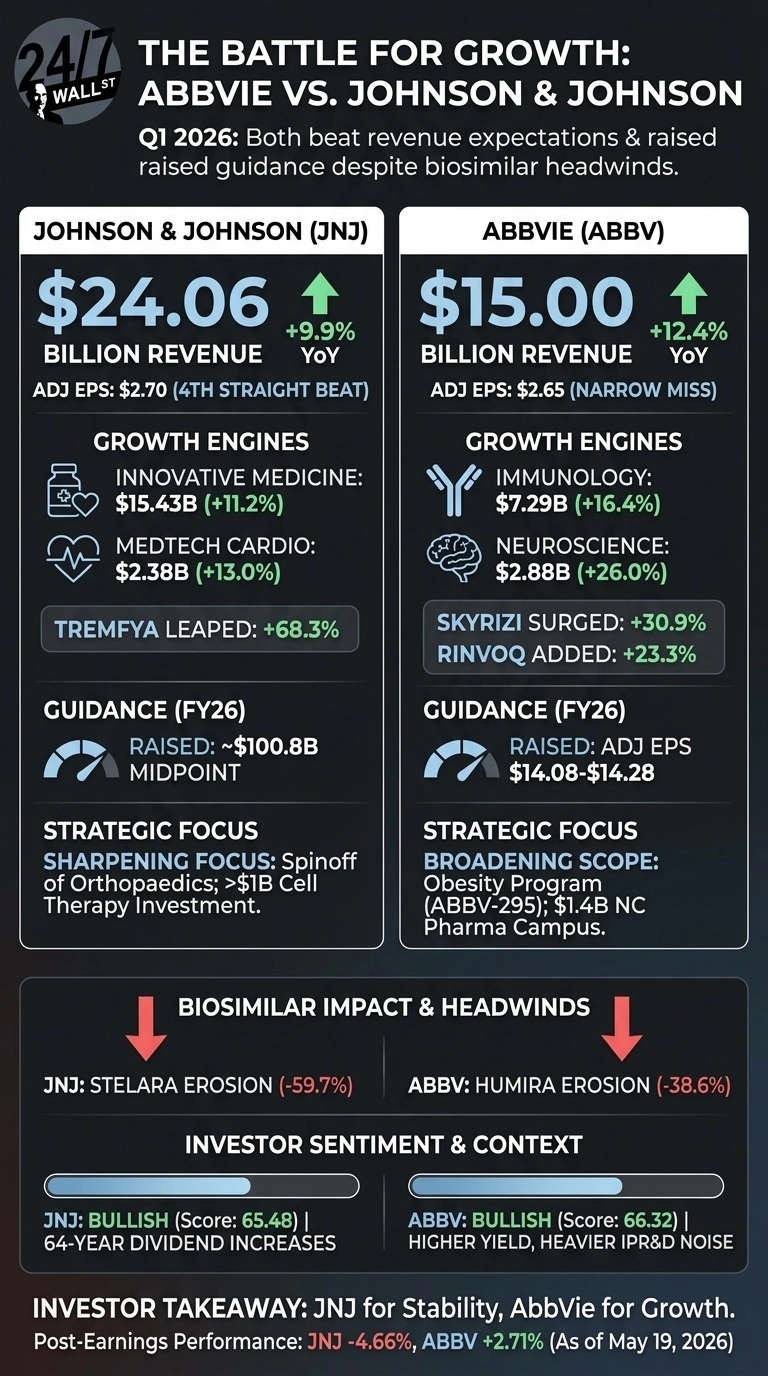
AbbVie reported $15 billion in revenue (+12.4%), but adjusted EPS of $2.65 narrowly missed consensus after a $744 million IPR&D charge clipped earnings by $0.41. Skyrizi reached $4.48 billion (+30.9%) and Rinvoq added $2.12 billion (+23.3%), more than offsetting Humira’s 38.6% decline. CEO Robert Michael said the firm is “off to an excellent start in 2026”.

A Diversified Giant Meets a Concentrated Specialist
The strategic split is meaningful. JNJ is sharpening focus by spinning off DePuy Synthes Orthopaedics and pouring over $1 billion into Pennsylvania cell therapy manufacturing.
AbbVie is going the opposite way, broadening into obesity through ABBV-295, a non-incretin candidate showing weight reduction in Phase 1, while committing $1.4 billion to a North Carolina campus.
| Lens | JNJ | AbbVie |
| Core Bet | Oncology, immunology, cardio devices | Skyrizi and Rinvoq immunology |
| Biosimilar Drag | STELARA -59.7% | Humira -38.6% |
| Dividend Story | 64 straight annual hikes | Higher yield, heavier IPR&D noise |
JNJ’s $330 million in litigation charges and 55.4% drop in free cash flow are real overhangs. AbbVie’s 32.9% GAAP tax rate and trenibotE Complete Response Letter add their own friction.
The Next Test Is Pipeline Conversion
I am watching whether TREMFYA can sustain that 68% growth trajectory while DARZALEX FASPRO combinations roll out in multiple myeloma. The December 8, 2026 Enterprise Business Review will reveal how the post-separation JNJ will be framed.

For AbbVie, the Skyrizi subQ Crohn’s filing and the ABBV-295 obesity readouts are the catalysts that matter. JNJ shares are down 4.66% since filing, while ABBV is up 2.71%, suggesting investors are giving the immunology growth story a slight edge for now.
Why I Lean Toward JNJ for Stability, AbbVie for Growth
If I want defensive ballast, JNJ wins for me. Diversification, a $551 billion balance sheet, and that 64-year dividend record are hard to replicate. The trade-off is slower top-line growth and unresolved talc litigation.
If I want torque, AbbVie is the more interesting bet. Skyrizi and Rinvoq are still scaling, and the obesity optionality is real, even if accounting noise from IPR&D charges keeps GAAP earnings messy. Reddit and news sentiment land bullish on both, with composite scores of 65.48 for JNJ and 66.32 for AbbVie. I would split exposure rather than choose, treating JNJ as the anchor and AbbVie as the growth lever.
Contact [email protected] for any questions or corrections.
Vandita Jadeja is a financial publisher with over a decade of experience writing about financial topics, including investment, savings, retirement, insurance and banking. Vandita is a Chartered Accountant who loves to debunk financial concepts for readers.
Her work has appeared on sites that include The Motley Fool, InvestorPlace, and Benzinga. She covers investing and focuses on stock picks and price prediction for 24/7 Wall St.
When not looking for the next stock investment opportunity, she can be found traveling, reading, chasing sunsets and enjoying her iced latte.