JEPI’s 8.2 Percent Yield Looks Safe Until You See How the Distribution Swings Month to Month
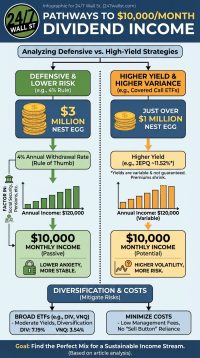
JPMorgan Equity Premium Income ETF (NYSEARCA:JEPI) trades on an 8.2% trailing yield paid monthly, but the actual dollars hitting your account swing meaningfully from one month to the next. JEPI is one of the safest covered-call products on the market…


JPMorgan Equity Premium Income ETF (NYSEARCA:JEPI) trades on an 8.2% trailing yield paid monthly, but the actual dollars hitting your account swing meaningfully from one month to the next. JEPI is one of the safest covered-call products on the market in terms of credit risk and NAV stability, yet calling the distribution “steady” misreads what JEPI actually does.
How JEPI Manufactures Its Yield
JEPI runs two engines. The first is a low-volatility sleeve of U.S. large caps selected to behave more defensively than the S&P 500. The second, driving most of the headline yield, is a basket of equity-linked notes that write out-of-the-money call options on the S&P 500. Premiums from those calls flow to shareholders as monthly distributions. Stock dividends contribute a smaller, predictable layer underneath.
The fund charges a 0.35% net expense ratio and has scaled to roughly $43.86 billion in assets, with over $4 billion of inflows year-to-date in 2026. That growth reflects retiree demand for income, but does not mean the income is fixed.
Twelve Months of Payouts
Here is what JEPI paid per share over the past year:
| Month | Distribution |
|---|---|
| June 2025 | $0.54001 |
| July 2025 | $0.39953 |
| August 2025 | $0.35772 |
| September 2025 | $0.36826 |
| October 2025 | $0.36102 |
| November 2025 | $0.34636 |
| December 2025 | $0.3706 |
| January 2026 | $0.42709 |
| February 2026 | $0.34443 |
| March 2026 | $0.35134 |
| April 2026 | $0.4205 |
| May 2026 | $0.44761 |
| June 2026 | $0.38921 |
The high was 54 cents in June 2025. The low was 34 cents in February 2026. A retiree budgeting around the peak would have come up short by more than a third on a soft month. On 1,000 shares, the swing between best and worst month exceeded $200 per payment.
The VIX Is Your Distribution Forecast
JEPI’s payouts track implied volatility because option premiums do. The CBOE Volatility Index spiked to almost 31 in late March 2026 during the spring selloff, and the call premiums JEPI collected during that window funded the strong April and May checks. The VIX bottomed near 13 in late December 2025, which compressed premium income and produced the lighter February and March distributions.
The VIX now sits near 19, in the middle of its normal range. That implies distributions in the 35-to-42-cent zone rather than the 54-cent peak from a year ago.
The Total Return Trade-Off
Over the past 12 months JEPI returned 7% on price, while the S&P 500 via SPY gained 23%. Even after layering JEPI’s roughly 8% income on top, the index outpaced the covered-call strategy by a meaningful margin. Crispus Nyaga at Invezz called JEPI’s high yield a “value trap” in bull markets because written calls cap upside on the stocks generating that premium.
That trade reverses in sideways or down markets, where JEPI’s defensive sleeve and harvested premiums cushion the ride. It is engineered for flat tape.
One More Wrinkle: Taxes
Most of JEPI’s distribution is taxed as ordinary income rather than qualified dividends, because option premium income lacks preferential treatment. For a retiree in a 24% or 32% bracket holding JEPI in a taxable account, the headline yield overstates spendable income. The fund belongs in an IRA or Roth for almost everyone relying on cash flow.
Who JEPI Actually Fits
JEPI’s distribution is structurally safe and will not zero out or get cut by management decree. The risk lies in assuming a fixed monthly check. Budget around the trailing 12-month average, not the recent peak, and expect any month to come in 20% to 30% light when volatility collapses. For a retiree wanting S&P-correlated income with a defensive tilt and able to absorb variable payments, JEPI delivers. For anyone needing an exact dollar figure monthly or wanting to keep pace with a rising market, Schwab U.S. Dividend Equity ETF (NYSEARCA:SCHD) is a better fit on the same income thesis, with lower yield but qualified dividends and uncapped upside.
Contact [email protected] for any questions or corrections.
Austin Smith is a financial publisher with over two decades of experience as an investor, analyst, and advisor. He covers stocks, ETFs, Artificial intelligence and personal finance for 24/7 Wall St. Previously, he spent over a decade at The Motley Fool as a senior editor for Fool.com, portfolio advisor for Millionacres, and launched The Ascent to help reader take control of their personal finances.
His work has been featured on Fool.com, NPR, CNBC, USA Today, Yahoo Finance, MSN, AOL, Marketwatch, and many other publications. He is as an advisor to private companies, and co-hosts The AI Investor Podcast with Eric Bleeker.
When not looking for investment opportunities, he can be found skiing, running, or playing soccer with his children. Learn more about Austin's investment approach here.