Dividend Safety Check: JEPI and Covered Call Equity Income
JEPI deposits a check every single month, but two investors holding identical shares can collect very different amounts depending on when they look at their account. Understanding what actually controls the size of that payment changes how you budget around…

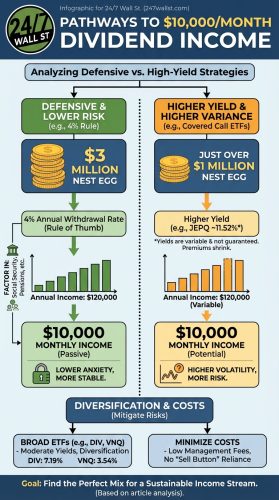
If you own the JPMorgan Equity Premium Income ETF (NYSEARCA:JEPI) for the monthly check, the question in mid-2026 is how much JEPI will pay you next month, and what that depends on. JEPI distributes monthly, currently yielding roughly 8.3% on a share price of $56, and the dollar amount of each payment swings meaningfully from month to month. The income stream is durable. The size of each check varies sharply.
How JEPI Actually Pays You
JEPI runs two engines. The first is a defensive, low-volatility basket of large-cap U.S. stocks, currently 122 holdings with no single name above 1.8% of assets. The top positions read like a quality screen: Broadcom near 2%, with Ross Stores, Amazon, Apple, Howmet Aerospace, Alphabet, Nvidia, Eaton, AbbVie, and EOG Resources rounding out the top ten. These holdings throw off ordinary dividends.
The second engine, and the one that does most of the income work, is a sleeve of equity-linked notes that replicate selling out-of-the-money S&P 500 call options. Those calls generate premium. When volatility is high, premiums are fat. When markets are quiet, premiums shrink. That mechanic is the single most important thing to understand about JEPI’s distribution.
Why The Payment Size Bounces Around
The 2026 monthly distributions tell the story plainly: $0.34 in February, $0.35 in March, $0.42 in April, $0.45 in May, and $0.39 in June. In 2025, the range was wider, from $0.33 to $0.54. That is roughly a 66% spread between the lightest and heaviest month in a single year. Budget on the low end.
The VIX explains most of this. Today the fear gauge sits at almost 19, slightly above the 12-month average near 18, after touching about 31 in late March 2026. The April and May distribution bumps line up with that volatility spike. JEPI gets paid more to sell calls when investors are nervous. When VIX drifts back toward the low teens, as it did in December 2025 near 13, the premium engine throttles down.
NAV Behavior And The Total Return Problem
Distribution safety is not the same as investment safety. JEPI has returned about 2% year-to-date and roughly 8% over the trailing year. The S&P 500 returned about 11% through May. That gap is the cost of the covered-call strategy: selling calls caps your upside in rallies. Over five years JEPI has delivered roughly 42% including distributions reinvested, respectable for an income product but well short of the index.
The NAV itself has held up. There is no evidence of structural decay in the $56 share price relative to where it traded a year ago around $52. The fund is not eating its principal to fund distributions, which is the failure mode that kills covered-call ETFs.
Cost, Tax Character, And A Peer Worth Knowing
The expense ratio of 0.35% is low for an actively managed product, and over $4 billion in YTD inflows into a roughly $43.7 billion fund tells you institutional demand is intact. Distributions are taxed as ordinary income, not qualified dividends. In a taxable account at a high bracket, the headline yield overstates what you keep. In a Roth IRA, that problem disappears.
JEPQ, the Nasdaq-focused sibling, has outperformed JEPI in this tech-led tape and is worth comparing if you want the same income mechanic with growthier underlying exposure. For investors who prefer dividend growth over options premium, SCHD is the cleaner buy-and-hold alternative.
The Verdict
JEPI’s distribution is safe in the structural sense: it will arrive every month, the mechanics work, the fund is large and liquid, and the holdings are quality. The dollar amount, however, will swing. Budget on the low months, not the high ones, and hold it in a tax-advantaged account if you can. If you need monthly income and accept capped upside, JEPI does the job. If you are still compounding for growth, you are paying a real opportunity cost for that 8.3% headline yield.
Contact [email protected] for any questions or corrections.
After 15 years on Wall Street with 7 of them as Director of Corporate and Municipal Bond Trading for a NYSE member firm, I started my own project and corporate finance consultancy. Much of the work involves writing business plans, presentations, white papers and marketing materials for companies seeking budgetary allocations for spinoffs and new initiatives or for raising capital for expansion or startup companies and entrepreneurs. On financial topics, I have been published under my own byline at The Motley Fool, 247wallst.com, DealFlow Events’ Healthcare Services Investment Newsletter and The Microcap Newsletter, among others. Additionally, I have done freelance ghostwriting writing and editing for several financial websites, such as Seeking Alpha and Shmoop Financial. I have also written and been published on a variety of other topics from music, audiophile sound and film to musical instrument history, martial arts, and current events. Publications include Copper Magazine, Fidelity (Germany), Blasting News, Inside Kung-Fu, and other periodicals.